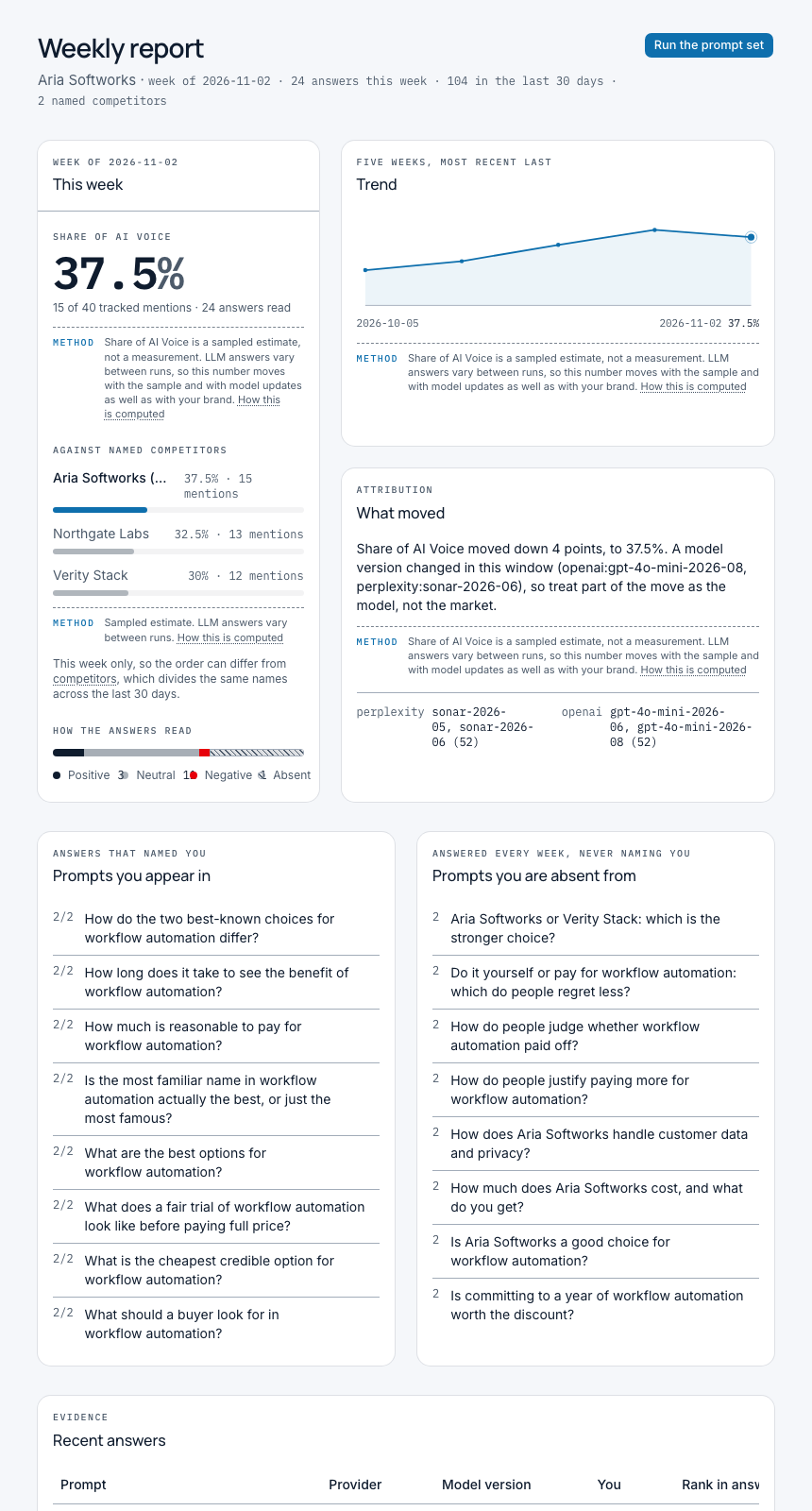
Share of AI Voice, the share of voice metric for AI search
Share of AI Voice is the percentage of AI search answers in a tracked set that name your brand, measured against a set of named competitors over a fixed period. It is the share of voice idea from PR and social listening, rebuilt for a world where the answer is one paragraph instead of ten links.
Seenby is not open yet, so anything on this page about what it does is what it is being built to do.
What share of AI voice means
Share of AI Voice is the proportion of brand mentions in a tracked set of AI search answers that belong to you rather than to the competitors you named, expressed as a percentage for a defined window such as a week.
The term is borrowed on purpose. Share of voice in PR counts your mentions against rivals' mentions across a defined media set. Share of AI Voice does the same across a defined prompt set run through AI answer engines. The reason marketers reach for it is structural: an AI answer has no page two. There is no ranking list to hold twenty results, so the useful question stops being "where do we rank" and becomes "when a buyer asks this, how often are we one of the names that come back, and who else is in the sentence".
An illustrative calculation
The arithmetic is simple, and the following figures are invented purely to show the shape of it. Suppose a brand freezes 60 buyer-style prompts, names three competitors, and runs the set once a week. Across that week's answers, the brand is named 21 times and the three competitors are named 63 times between them. Total mentions are 84, so Share of AI Voice is 21 divided by 84, or 25 percent. Next week the same prompts return 26 mentions for the brand out of 90 in total, which is 29 percent. The movement is four points. Whether those four points mean anything is the harder question, and it is the subject of the next section.
How the number is built, and what it cannot tell you
A Share of AI Voice score is only as meaningful as the four decisions behind it. Any tool or spreadsheet that reports the metric should state all four.
- The prompt set. The questions have to be frozen. If the prompts change between weeks, the trend measures your changing questions rather than the market.
- The competitor set. The score is relative. A percentage computed against three named rivals is not comparable to one computed against twelve, and a score computed against nobody is not a share of anything.
- The engines sampled. Different answer engines retrieve differently, so a score is defined only over the engines that were actually queried. The engine list belongs next to the number.
- The counting rule. Mentions per answer, unique answers naming the brand, and weighted position within the answer all produce different percentages from the same data.
The caveat that has to travel with the score
AI answers are non-deterministic. Ask the same question twice and the wording, the order and sometimes the names can differ. Models are also updated without notice, and a single update can shift a score across an entire category overnight. So a week-over-week move in Share of AI Voice may reflect a model update rather than any real change in how the market sees you, and a small move inside a sampled set is often noise. The honest reading is directional: watch the shape over several weeks, check the underlying answers before you act, and treat a sharp jump as a prompt to look for a model change first.
Related terms
Share of AI Voice sits inside a young vocabulary. These are the terms it is most often confused with.
- AI visibility. The broad, usually unquantified idea of being present in AI answers. Share of AI Voice is one attempt to put a number on it.
- Share of voice. The parent metric from PR and social listening, measured across media or social mentions rather than generated answers.
- Generative engine optimization, GEO. The practice of trying to change what answer engines say about you. Share of AI Voice is a measurement, not a tactic.
- Answer engine optimization, AEO. Used almost interchangeably with GEO, with more emphasis on being the cited answer to a specific question.
- Citations. The sources an answer links out to. Being cited and being named are different events: you can be recommended without being linked, and linked without being recommended.
- Sentiment. How you are described when named, positive, neutral or negative. A rising share with souring sentiment is a worse week than the percentage suggests.
- Rank position within an answer. Whether you are the first name or the fifth. Useful context for a share number, since first mention and last mention rarely carry equal weight.
- Model drift. Score movement caused by a model version change rather than by the market. The reason model versions should be recorded alongside every answer.
- Zero-click search. The wider shift that makes this metric matter, where the answer is read in place and the click never happens.
If your next question is where the underlying answers are stored and what is redacted before they are kept, that is covered on the security and data handling page.
Questions
How is AI share of voice calculated?
Count how often your brand is named across a frozen set of prompts run through AI answer engines, count how often your named competitors are named across the same answers, and divide your mentions by the total. The percentage only means something alongside the prompt set, the competitor set, the engines queried and the counting rule used.
What is a good AI share of voice score?
There is no published benchmark worth quoting, and any single number offered as a universal target should be treated with suspicion. The score is relative to how many competitors you named and which engines were sampled, so the useful comparison is your own trend over several weeks and your position against the specific rivals you chose.
Is Share of AI Voice the same as traditional share of voice?
The arithmetic is the same and the data source is not. Traditional share of voice counts mentions in media or social posts that exist whether or not you look. Share of AI Voice counts mentions in answers that are generated on request, which is why the prompt set and the sampling window matter far more.
Why does the score move when nothing about our marketing changed?
Because AI answers are non-deterministic and models are updated without notice. Repeated sampling reduces the noise but never removes it, so a week-over-week shift can reflect a model update rather than a real competitive change. Record the model version behind every answer and check that first.
Does it cover Google AI Overviews?
Only if the engine was actually queried. The metric is defined over the engines in the sample, so the honest way to report it is to name those engines next to the number rather than imply coverage of every AI surface.
Can you measure Share of AI Voice without naming competitors?
Not meaningfully. Share is a ratio, so with no comparison set the denominator collapses and any figure you print flatters you. Name a small set of rivals you genuinely compete with and keep that set stable so the trend stays readable.
Can I track it manually in a spreadsheet?
Yes, and it is a reasonable way to find out whether the metric tells you anything. The cost is consistency: the same prompts, the same competitors, the same engines, the same week every week, plus a record of which model version answered. That discipline is what separates a trend from a collection of screenshots.
Related
- Security and data handling at Seenby
A due diligence page for AI brand monitoring data security: the six kinds of record Seenby stores, the single AWS region they live in, the outside services they travel to, how to delete everything or download a copy, and what is not in place yet.
- Why ChatGPT answers change every time you ask
ChatGPT answers vary because the model samples its wording and because the model behind the name keeps being replaced.