AI search reporting for SEO teams
If you need AI search in the monthly report and not just in a Slack screenshot, this is the page. Seenby is built to measure how OpenAI and Perplexity answers name your brand, score it once a week as Share of AI Voice, and benchmark it against up to three competitors you name.
Seenby is not open yet, so anything on this page about what it does is what it is being built to do.
The question your report cannot answer yet
You already report rankings, clicks and impressions. Then a colleague forwards a ChatGPT answer that recommends a competitor and not you, and the follow-up question has nothing to do with rankings.
The first version of that question takes five minutes to answer once. It cannot be answered twice the same way, and that is the actual problem. Ask the same prompt on Tuesday and the wording moves, the list reorders, and a brand that sat third is absent. That is not sloppy method on your part. LLM answers are non-deterministic, and they shift again when the model behind them is updated.
So the job in front of you is not checking. It is measuring: one fixed method, run often enough that a line means something, with the underlying answers kept so you can show your work when a number moves and someone senior asks why. That is the job Seenby is built for. The category gets searched as GEO, AEO and AI visibility; the reporting problem is the same one under all three names.
Two neighbouring pages pick up the parts this one does not. If what you need is the wording itself, how an answer actually describes you, the brand manager page covers that. If the awkward part is the board slide and the language around it, the guide on reporting AI search performance to executives without overclaiming is the one to read next.
What makes an AI search report defensible
The prompt set has to stay still
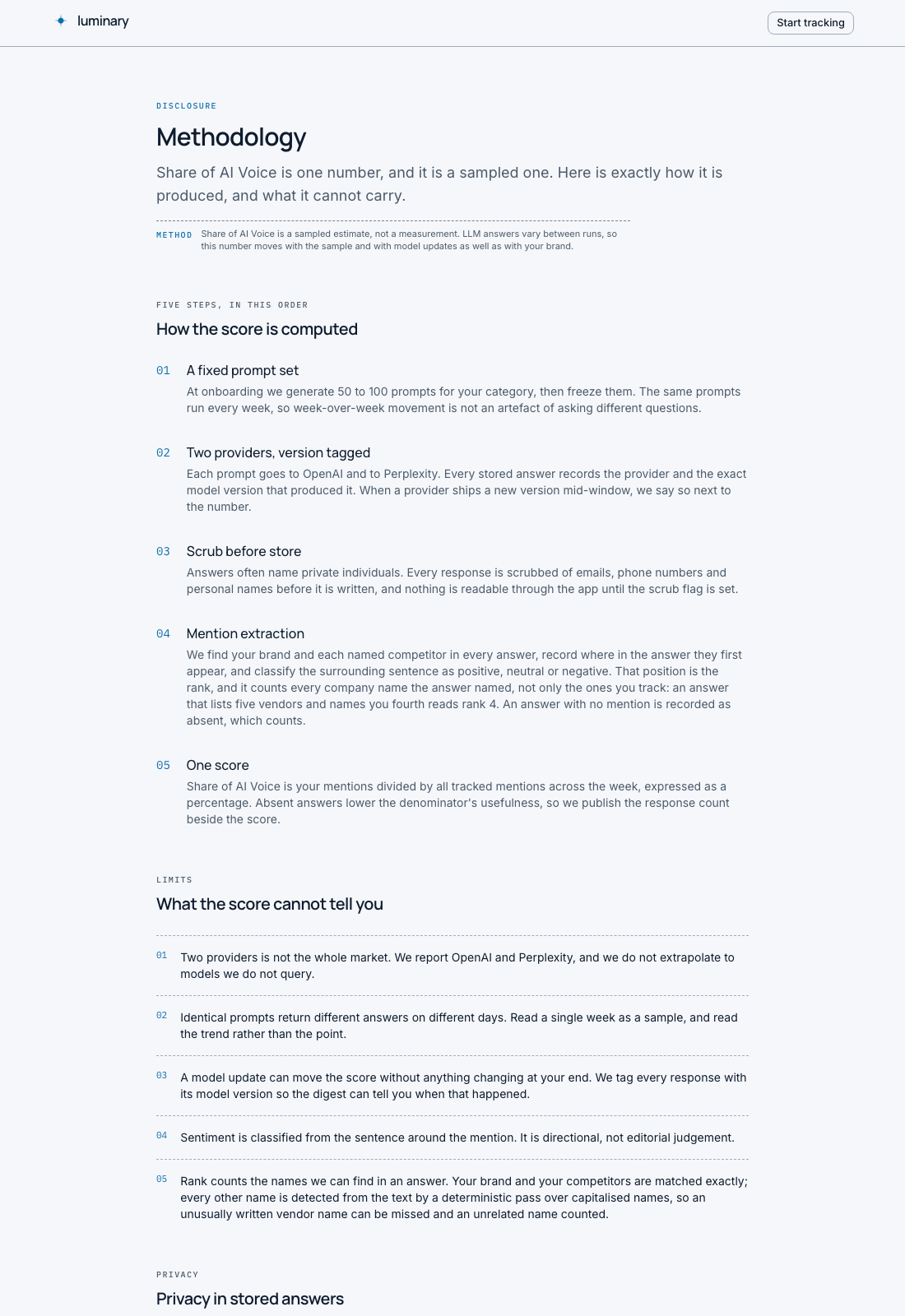
Seenby generates 50 to 100 prompt templates from your brand name, your description and up to three competitor names, and freezes that set at setup. If generation fails or returns too few prompts, a curated fallback set is used instead. A frozen set is a trade: you cannot chase a new prompt idea mid-quarter, and in exchange the week-over-week movement reflects the market rather than a change in the questions you asked.
The score has to carry its caveat
Share of AI Voice is one headline metric per brand per week. Every computed record is stored with its methodology caveat text attached, and the methodology is disclosed in product on every score display and on a dedicated methodology page. Read the caveat out loud in the meeting: a week-over-week shift can reflect a model update rather than a real competitive change.
Drift has to be separable from movement
Every stored answer is tagged with the model version that produced it, which is how real drift is distinguished from model-update drift. Without that tag, an AI search report is a line chart you cannot interpret.
A worked week, counted on the Starter plan
The argument above is only worth as much as the arithmetic under it, so here is the week using the plan's own numbers and nothing else.
Starter runs 50 prompts a week against two providers, OpenAI and Perplexity. That is 100 answers read in the week. Each one is put through the PII-scrubbing step before it becomes queryable, so emails, phone numbers, handles and personal names are redacted and the stored answer carries a scrubbed flag. Each one is tagged with the model version that produced it. The parser then reads each answer for brand and competitor mentions, classifies the sentiment of each mention as positive, neutral, negative or absent, and records ranking position within that response.
Those 100 parsed answers roll into one figure: Share of AI Voice for the week, stored with its methodology caveat text on the record. On Starter the answer log keeps 30 days of history, which is the same window as the trend line on the dashboard. Growth doubles the prompts to 100 a week, so 200 answers, and keeps the full scrubbed answer log for as long as the account exists, with the per-prompt evidence behind each week's score.
One number a week sounds thin until you count what it is made from. The point of the count is that you can state it in a meeting without reaching for an estimate.
The dashboard an SEO lead reports from
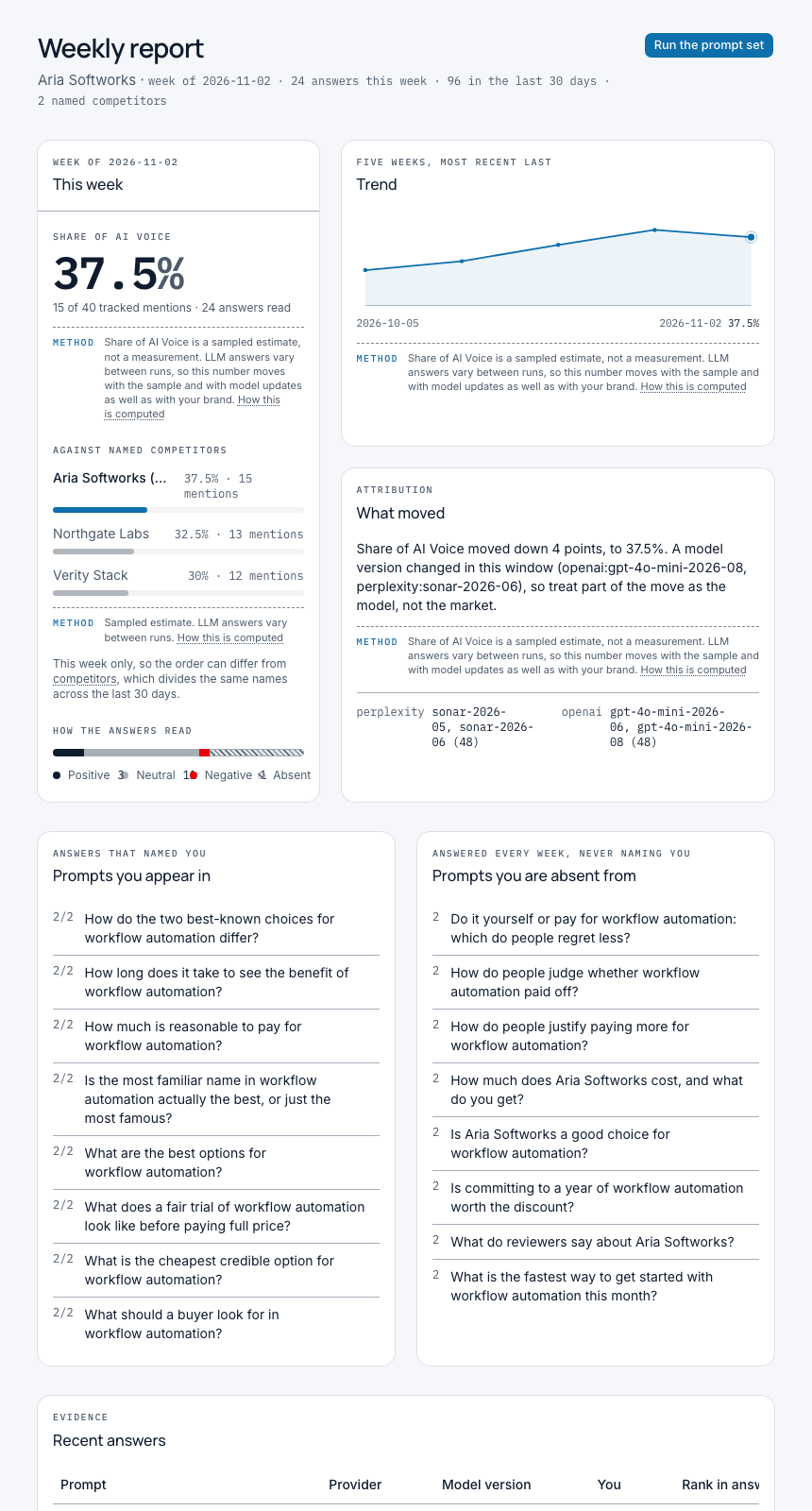
The dashboard holds 30-day trend lines for Share of AI Voice, a sentiment breakdown, the top prompts where your brand is and is not mentioned, and a competitor benchmarking view. Methodology disclosure is surfaced on every score display, so the caveat sits beside the number rather than in a footnote nobody reads.
The reporting workflow Seenby supports
- Name the brand, then name the rivals
Setup takes a brand name, a short description and up to three competitor names. Benchmarking runs against the names you choose, so the comparison set is your decision, not an inferred list.
- Freeze a prompt set of 50 to 100 prompts
One model call generates 50 to 100 prompt templates from what you entered, with a curated fallback set if generation fails or returns too few. The set is frozen so the same questions run every week.
- Read both providers on a schedule
The scheduled query engine hits two providers, OpenAI and Perplexity, behind an adapter interface that degrades gracefully to the remaining provider if one is disabled. Provider access is not something any tool in this category can guarantee forever, so the architecture assumes it can change.
- Scrub, tag and parse each answer
A scrubbing step runs before any response is queryable, and every stored answer carries its model version. The parser then extracts brand and competitor mentions, classifies sentiment as positive, neutral, negative or absent, and records ranking position within the response.
- Compute one score for the week
Share of AI Voice is computed once per brand per week and stored with its methodology caveat text on the record. One number, not a wall of metrics, because one number is what a monthly report can carry.
- Report from the dashboard and the digest
The dashboard holds the 30-day trend line, the sentiment breakdown, the top prompts where your brand is and is not mentioned, and the competitor benchmarking view. The weekly automated email digest carries the top insights, drift alerts tied to model-version changes when applicable, and the same methodology caveat.
Why this fits an SEO team's reporting cycle
One line for the deck
Share of AI Voice is a single weekly figure with a 30-day trend, so AI search becomes one slide rather than a research project. The methodology caveat travels with the score, which keeps the slide honest when the number goes up.
Movement you can explain
Model-version tags on every stored answer, and drift alerts in the digest tied to model-version changes, give you a first answer to "why did it drop" before the meeting rather than after it.
A prompt list you can act on
The dashboard shows the prompts where your brand is named and the prompts where it is not. The second list is the part your content plan can work from.
Competitors you chose yourself, compared week to week
Up to three named competitors are benchmarked in the same view, so "our competitor gets recommended and we don't" stops being anecdote and becomes a position you can track.
Tone as well as presence
Sentiment is classified per mention as positive, neutral, negative or absent, so appearing in an answer and being described well are reported as two separate facts.
Reporting that arrives without you assembling it
The weekly email digest is built to land in your inbox with the week's top insights, any drift alerts and the caveat, so the reporting rhythm does not depend on you remembering to open a dashboard.
What the report covers, and what it does not
| The question | What Seenby reports |
|---|---|
| How often do AI answers name us | Share of AI Voice, one score per brand per week, stored with its methodology caveat |
| Is it moving | A 30-day trend line on the dashboard, plus the weekly email digest |
| Against whom | Competitor benchmarking against up to three names you enter at setup |
| How are we described | Sentiment per mention: positive, neutral, negative or absent |
| Where are we missing | The top prompts where the brand is mentioned and the prompts where it is not |
| Real change or model update | Model-version tagging on every stored answer, and drift alerts tied to model-version changes when applicable |
| Which engines | OpenAI and Perplexity. Not Gemini, not Google AI Overviews, not Claude as an answer source |
| Citations and source URLs | Not reported. The parser reads mentions, sentiment and position in the answer text |
| Traffic from AI answers | Not measured. Seenby measures presence in answers, not referral clicks |
| Several client brands in one account | Up to five brands on Agency, each with its own frozen prompt set and its own weekly digest. One brand on Starter and on Growth |
Three plans, priced in pounds
Starter
£79 / month
A brand manager or head of SEO at one mid-market company who just needs an answer to how ChatGPT and Perplexity describe them.
- Brands: 1
- Named competitors: Up to 3
- Prompts per week: 50
- AI providers: OpenAI and Perplexity
- Query cadence: Weekly
- Answer log history: 30 days
Growth
£149 / month
The same in-house buyer once the score is part of their reporting and they need the per-prompt evidence behind it for their CMO.
- Brands: 1
- Named competitors: Up to 3
- Prompts per week: 100
- AI providers: OpenAI and Perplexity
- API access: Not included
- White-label reports: Not included
Agency
£399 / month
An agency principal running SEO or brand for several client companies who needs a score per client in one account.
- Brands: Up to 5
- Named competitors: Up to 3 per brand
- Prompts per week: 100 per brand
- AI providers: OpenAI and Perplexity
- White-label reports: Not included
- API access: Not included
What is not in place yet
The gaps a procurement review will ask about, stated plainly:
- No independent security audit or certification, so no SOC 2 and no ISO 27001.
- No single sign-on. Sign-in is email and password.
- No signed data processing agreement on request.
- No choice of hosting region. The app and its Postgres database run in a single region on Amazon Web Services.
What is in place: a signed-in customer can export a JSON file of everything stored and delete the account from Settings, which removes the brand, the prompt set, the stored answers, the extractions, the scores and the digest history in one transaction. Card details go to Stripe and never reach our servers. Under UK GDPR, a request for a copy of a person's data or for its erasure is answered within one month; that is the law's rule rather than a promise of ours.
Questions
Which AI engines does Seenby report on?
Two: OpenAI and Perplexity. They sit behind a provider adapter interface that degrades gracefully to the remaining provider if one is disabled, and that interface is how further providers would be added. Google AI Overviews and Gemini are not covered.
How is Share of AI Voice calculated?
It is computed once per brand per week from the mentions the parser extracts across your frozen prompt set, counted against the competitors you named. Every computed record is stored with its methodology caveat text, and the full method is disclosed in product on every score display and on a dedicated methodology page.
The answers change every time I ask. Why trust a weekly score?
Because the score is not a single ask. The same frozen prompt set, 50 prompts a week on Starter and 100 on Growth, runs across both providers every week, so variance is averaged rather than sampled once. Trust the trend more than any single week, and read the caveat: a week-over-week shift may reflect a model update rather than a real competitive change.
How would I know whether a drop is real?
Every stored answer is tagged with the model version that produced it, which is how model-update drift is separated from real movement. When a change lines up with a model-version change, the weekly digest raises it as a drift alert.
Can I use it for several client brands?
Yes, on the Agency plan at £399 a month, which covers up to five brands, each with its own frozen prompt set, its own competitor benchmarking and its own weekly digest. Starter and Growth cover one brand, which is the shape an in-house team needs.
Does this replace my SEO platform?
No. Seenby reports on how AI answers name your brand: presence, sentiment, position recorded within the answer, and competitor standing. Rankings, backlinks, crawl and traffic stay where they are today.
Is VAT added, and are prices in pounds?
Prices are in pounds sterling: Starter £79, Growth £149 and Agency £399 a month. Stripe works out VAT at checkout.
What happens to the answers you store?
Emails, phone numbers, handles and personal names are redacted before any answer becomes queryable, and each stored answer keeps its model version, the extracted mentions and the week's score. Starter keeps 30 days of answer log history; Growth and Agency keep the full scrubbed log while the account exists, because the week-over-week trend is the product. Deleting the account from Settings removes the brand, the prompt set, the answers, the extractions, the scores and the digest history at once.