Benchmark your AI share of voice against three named competitors
Seenby is built to benchmark your Share of AI Voice against up to three competitors you name, answer by answer, across the same weekly prompt set. You see who was mentioned, in what order, and in what tone, instead of a single number for your own brand.
Seenby is not open yet, so anything on this page about what it does is what it is being built to do.
Your brand and three named competitors, side by side
The competitor benchmarking view sets your brand beside the three competitors you named, each with its Share of AI Voice figure, and the methodology disclosure sits on every score it shows. If you have to tell a CMO how ChatGPT and Perplexity describe you, and name a rival in the same breath, the waitlist form is at the foot of this page.
Your competitor gets recommended and you do not
The search that leads here starts with an executive question. How does ChatGPT describe us, and why does it keep naming someone else. A brand-only visibility score cannot answer the second half. It moves, you report it, and the next question in the room is who moved instead. Benchmarking turns the number into a decision. If your share slips, the useful fact is whether one named rival picked up those mentions on the same prompts. Or whether the answers simply got vaguer and named nobody at all. Those two situations call for different work.
A ranked list of links
- Legacy SEO tools were built for one shape of result. Ten positions, one per URL, for a keyword.
- Competitive comparison is arithmetic on positions. Who is at 3, who is at 7.
- Nothing in that model has a place for tone, or for an answer that names nobody.
A paragraph that names three brands in an order
- An AI answer is prose. It may name three brands, one brand, or none.
- The order carries meaning. Adjectives are attached to each name.
- To benchmark inside that, something has to read the answer, find every tracked brand, note the order and judge the tone.
Seenby is built to do that on a repeating weekly set. Same prompts, same providers, same week, so the comparison is like for like.
One answer, parsed four ways
Here is the mechanic on a single response. The example is an illustration of what the parser records, not a stored customer answer.
Prompt: which analytics platforms are best for a mid-market finance team that needs board-ready reporting?
Answer, abridged: Northgate is where most finance teams land, with strong reporting templates out of the box. Aria covers similar ground and is often chosen by smaller teams. Brightside is cheaper, though support is thin.
Four tracked names, one response, four rows. Kestrel, the third competitor, is not in this answer at all. Absence is recorded rather than skipped.
What benchmarking means here
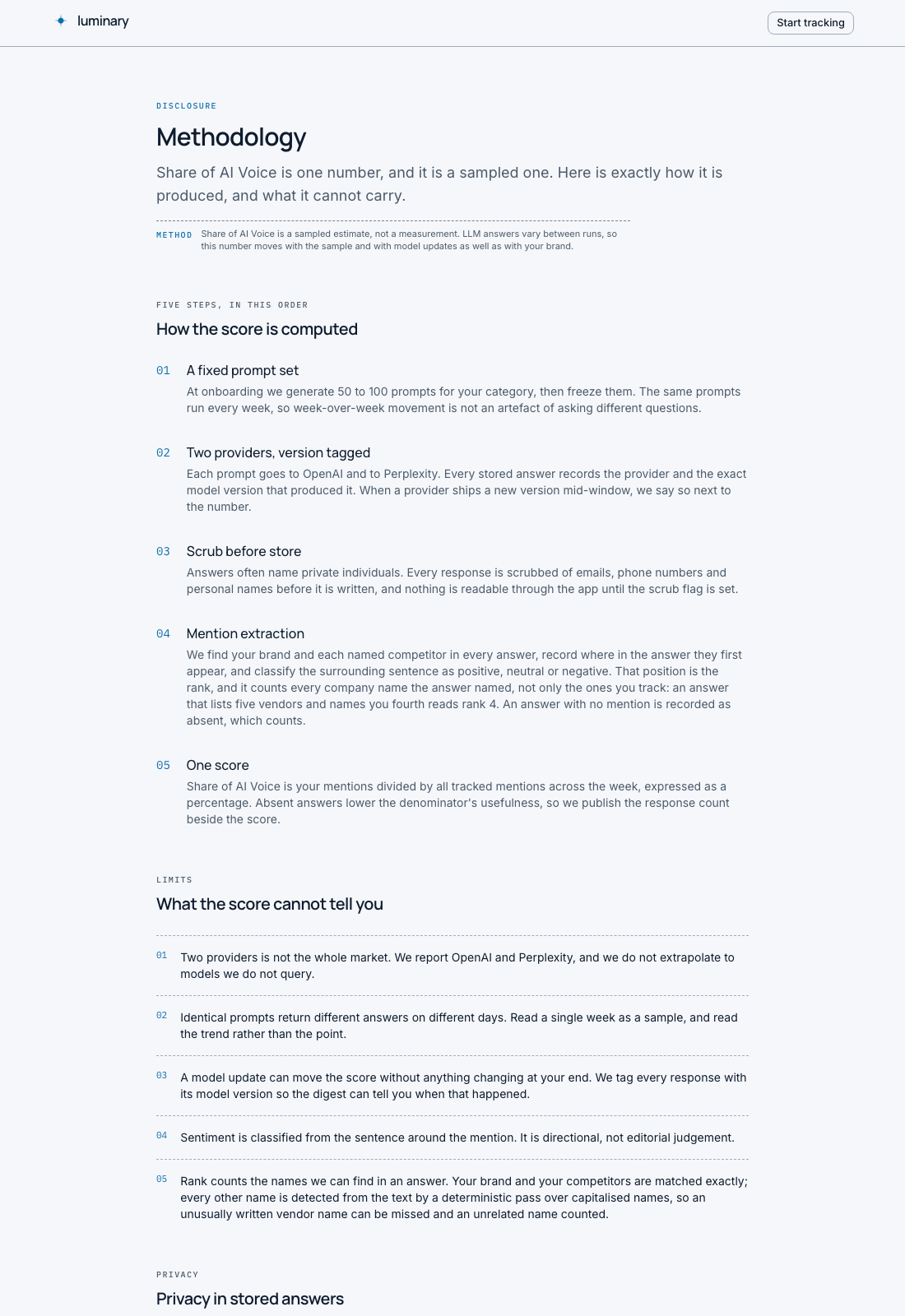
Not a market-wide league table. A relative measure across the set you defined: your brand plus up to three competitors you name yourself. That is a narrower claim than your position in the category, and it is the honest one.
The four rows that one answer produces
| Tracked name | Position in the answer | Sentiment recorded |
|---|---|---|
| Northgate, a named competitor | First of the tracked names to appear | Positive |
| Aria, your brand | Second | Neutral |
| Brightside, a named competitor | Third | Negative |
| Kestrel, a named competitor | Not named in this response | Absent |
How the benchmark is built
- Name your brand and up to three competitors
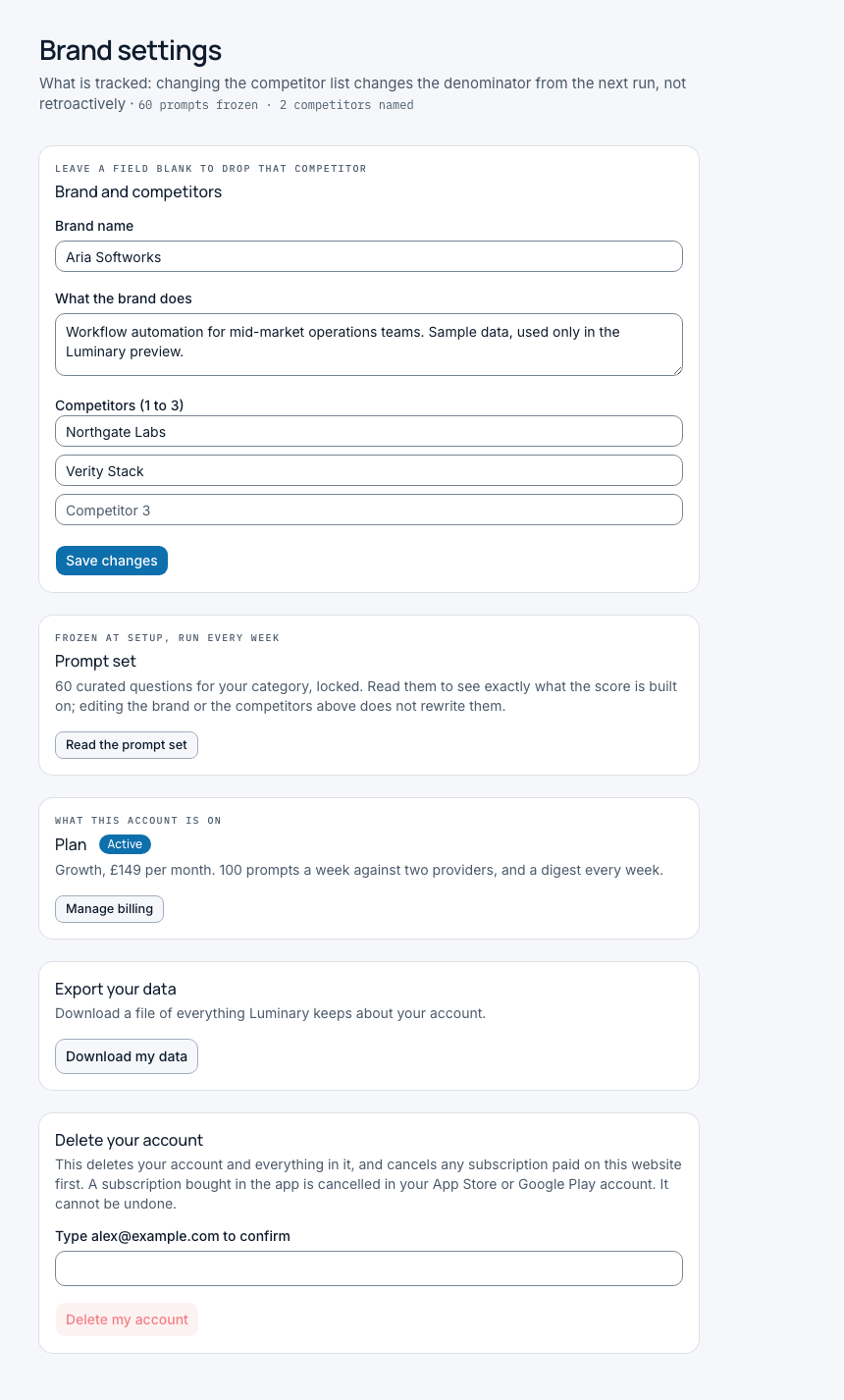
Onboarding takes your brand name, a short description of what you do, and up to three competitor names. Those three names are the benchmark set. Pick the rivals a buyer would shortlist beside you. The comparison is only as useful as the names in it.
- Seenby generates the prompt set
One model call turns your brand and description into 50 to 100 prompt templates. If generation fails or returns too few prompts, a curated fallback set takes its place. Onboarding ends with a working prompt set rather than an error screen.
- The same set runs on both providers
A scheduled query engine hits two providers, OpenAI and Perplexity, behind an adapter interface that degrades gracefully if one of them is disabled. Same questions, same week, for all four names.
- Every answer is parsed for all four names
The response parser extracts brand and competitor mentions from each stored answer. It classifies sentiment as positive, neutral, negative or absent, and records ranking position within that response. Absent is recorded as a result, not left as a blank.
- The benchmarking view puts the four side by side
The dashboard carries a competitor benchmarking view next to 30-day trend lines for Share of AI Voice and a sentiment breakdown. It also lists the top prompts where your brand is mentioned and the top prompts where it is not. That second list is where a benchmark becomes a task list: the questions a rival owns and you do not.
What you get from benchmarking answer by answer
One prompt set, four brands, same week
Your brand and your three named competitors are read from the same responses. That holds constant what usually ruins these comparisons: different questions, different days, different providers.
Position inside the answer, not just presence
Ranking position is recorded per response, as the order the tracked names appear in. Being named third of three reads differently from being the first recommendation. A presence-only metric flattens the two into the same tick.
Tone, split four ways
Each mention is classified positive, neutral, negative or absent. A rival named more often but described more flatly is a different competitive picture from one named more often and praised.
Per-prompt evidence, not a black box
Growth and Agency include per-prompt evidence answer by answer and the full scrubbed answer log, kept while the account exists, with model-version tags on every stored answer. Any number in your report traces back to the answers that produced it.
A movement you can explain
A 30-day trend line plus a named competitor set gives you the sentence a board deck needs. Our share moved, this rival moved the other way, on these prompts. Or, just as usefully, nothing real moved this week.
What the benchmark answers, and what it does not
Today: one number, your brand only
You run a spot check, or you report a visibility score for yourself. It moves and nobody can say who moved against you. No rival is named, no prompt is held constant, and a single ask proves nothing because the wording changes each time.
With Seenby: four names, one weekly set
Whether a named competitor is mentioned more often than you across the same prompt set. Which prompts name them and not you, and which name you. Where each brand sits in the ranking order inside a single answer. How mentions split across positive, neutral, negative and absent.
What changes, and what it still will not tell you
You get a share relative to the three names you chose, with the trend and the drift alert to read it against. It does not explain why an engine prefers a rival, which stays your editorial call. It does not cover brands you did not name, and it does not measure clicks, traffic or revenue from an AI answer.
What competitor benchmarking costs
Starter, £79 / month
One brand, up to 3 named competitors, 50 prompts a week, OpenAI and Perplexity, weekly cadence, 30 days of answer log history. Includes the weekly Share of AI Voice score, the 30-day trend line, the sentiment breakdown, the competitor benchmarking view, the weekly email digest and the methodology disclosure on every score. Planned pricing, may change before launch.
Growth, £149 / month
Everything in Starter, plus per-prompt evidence answer by answer and the full scrubbed answer log, kept while the account exists. Model-version tags on every stored answer, drift alerts in the weekly digest, and the top prompts where the brand is and is not mentioned. One brand, up to 3 named competitors, 100 prompts a week. No API access, no white-label reports. Planned pricing, may change before launch.
Agency, £399 / month
Everything in Growth, per brand, for up to 5 brands. Its own frozen prompt set for each brand, competitor benchmarking per brand, up to 3 named competitors per brand, 100 prompts a week per brand, and a weekly digest per brand you can forward to the client. One account for all five. No API access, no white-label reports. Planned pricing, may change before launch.
Where this sits today
Seenby is not open yet. This page describes what the product is built to do, not results anyone has reported. There are no customer numbers on it for that reason.
If you want the benchmark, the useful preparation is deciding on the three names. Most teams have five candidates and a real argument about which three matter. The incumbent everyone cites, the fast-moving challenger, and the one your sales team keeps losing to. Three is a constraint, and a constraint makes you choose the comparison you would actually act on.
Join the waitlist with an email address and the brand you would track first. Sign-in is email and password when your account opens. Seenby is the product and the name to use when you write to us. The company that sells it is named in the site's terms and privacy policy, and it reads email at hello@kaleidoapps.com.
Questions
How is AI share of voice benchmarked against competitors?
Each stored answer is parsed for your brand and your three named competitors. Seenby records who was mentioned, the ranking position within that response, and sentiment as positive, neutral, negative or absent. The competitor benchmarking view aggregates that across the week's prompt set, beside a 30-day trend line, with the methodology caveat on every score.
Why only three competitors?
Onboarding takes up to three competitor names. Three keeps the benchmark readable and forces a choice about which comparison you would act on, rather than producing a wide table nobody reads. Every mention, ranking position and sentiment class is computed against those three names.
Which AI engines is the benchmark read from?
OpenAI and Perplexity, on every plan. The query engine sits behind a provider adapter interface that degrades gracefully if one provider is disabled, and the same prompt set runs across both, so the competitor comparison stays like for like.
Can I see the actual answers behind the numbers?
On Growth and Agency, yes: per-prompt evidence answer by answer, and the full scrubbed answer log, kept while the account exists and tagged with its model version. Starter keeps 30 days of answer log history. Personal names, emails, phone numbers and handles are redacted before any answer is stored.
What if the score moves because the model changed, not because we lost ground?
That happens, and it is the main reason to distrust a single week. Every stored answer is tagged with its model version. The weekly digest carries drift alerts tied to model-version changes when they apply, so a shift that coincides with a model update is visible as such rather than filed as a competitive loss.
How many prompts does the benchmark run on?
Starter runs 50 prompts a week. Growth and Agency run 100 a week, per brand. The set is generated from your brand name and description at setup, with a curated fallback set if generation returns too few prompts, and it stays frozen so week to week comparisons are on the same questions.
Can I run this for several brands or clients?
The Agency plan at £399 a month covers up to 5 brands in one account, each with its own frozen prompt set, its own competitor benchmarking and its own weekly digest you can forward to the client. Starter and Growth cover one brand. All prices are planned and may change before launch.
Can I use Seenby now?
Not yet. Seenby is on a waitlist, so this page states what the product is built to do rather than what it has done. Leave your email and the brand you would track first.