Profound alternatives for mid-market brand and SEO teams
If you are shopping for Profound alternatives, you are deciding how your team will measure the way AI assistants describe your brand, week after week. This page lays out the options mid-market brand and SEO teams actually use, what each one produces, and where Seenby fits among them.
Seenby is not open yet, so anything on this page about what it does is what it is being built to do.
What you are actually comparing
Profound is one of the platforms in the AI visibility category, and teams evaluating it usually arrive after an executive asks some version of "how does ChatGPT describe us?". We do not restate another vendor's features or prices here. Both change, and only their own site can be authoritative, so read it before you decide.
What is worth comparing is the shape of each option. Six questions separate them, and most shortlists collapse once you answer them honestly.
- Continuity or snapshot. Does the option give you one score now, or the same measurement repeated on a fixed cadence so a trend means something?
- Which models. Coverage differs by vendor and changes often. Check the current list rather than a blog post from last quarter.
- Named competitors. Can you benchmark against the three or four brands your CMO actually names, answer by answer?
- Methodology. Can you see how the score is computed, and does the caveat travel with the number into your board deck?
- Who it is priced for. Enterprise, sales-led tools and self-serve tools solve the same question at different commitments.
- Data handling. You are storing third-party model output about your market. Ask what is kept, where, and for how long.
Other dedicated AI visibility platforms
The closest substitutes are the other purpose-built tools in the same category. Names that come up repeatedly in practitioner discussion include Peec AI, Otterly.AI, Scrunch AI, AthenaHQ and Evertune.
We are deliberately not publishing their capability lists or prices, and we are not going to characterise what each one does. We have no retrieved quote from any of their live pages, this category ships fast, and a stale comparison table is worse than no table. So the differences are yours to confirm, not ours to assert. Open each site, find the product page and the pricing page, and write down four things: the cadence of measurement, whether benchmarking against the competitors you name is included at the tier you would buy, whether the methodology behind the headline score is documented, and whether a price is published at all. If citations or AI crawler analytics matter to your reporting, check on their own pages whether those are part of the product rather than assuming they are. Those answers will separate the shortlist more cleanly than any feature grid we could write for you.
The SEO suite you already pay for
Most mid-market teams already hold a Semrush or Ahrefs subscription, and the first question in the room is usually whether the suite already covers this. We cannot answer that here. The suites move quickly, we have no retrieved quote for what either ships today, and only their own product and pricing pages can tell you what sits in your tier this month.
So treat it as the first thing you go and check rather than the thing you assume. Open the suite's product page and its pricing page, and look for four answers: whether anything there measures how AI assistants describe your brand, how often that refreshes, whether benchmarking against the competitors you name is included at the tier you already hold or sold as an add-on, and whether you can read the underlying answers or only an aggregate score.
The appeal is genuine if those answers come back well, because procurement is already done and the data would sit next to rank tracking in the same login. If bundled reporting answers the executive question well enough, that is a legitimate outcome of this comparison, and we would rather you reached it from their pricing page than from a demo call with us.
Manual spot checks in ChatGPT or Perplexity, logged in a sheet
The incumbent in almost every company is a person on the marketing team typing ten category prompts into ChatGPT or Perplexity, screenshotting the answers, and pasting them into a spreadsheet. It costs nothing, it starts today, and it is often the right first move to confirm the problem is real.
It breaks on repeatability. Model answers are non-deterministic, so the same prompt asked twice can return different brands in a different order, and a hand-run sample of ten prompts cannot tell you whether a change is a real shift in how the market is described or ordinary variance. Model updates add a second source of movement. A spreadsheet of screenshots is evidence of a moment. It is not a trend, and it will not survive the question "is that number up or just noisy?" in a board meeting.
An in-house script against the model APIs
Technical teams build this in an afternoon. A prompt list, a scheduled job, a call per prompt per provider, and results written into a sheet or a warehouse. The licence cost is the API spend, and you own the data outright.
The real cost lands later. You have to write mention extraction that does not fire on substrings, decide how sentiment is classified and how negation is handled, tag every response with the model version so you can tell a model update apart from a market change, and define a share metric with a defensible denominator. Then you maintain it while providers change models and rate limits. This is the honest build-versus-buy line: the querying is easy, the measurement discipline is the product. If your team wants to own that discipline, build it. If nobody has time to defend the methodology, buy it.
A one-off agency or consultant AI visibility audit
Agencies and independent consultants sell a point-in-time audit of how AI assistants describe a brand, usually delivered as a deck with recommendations. It comes with interpretation, which software does not, and a good analyst will tell you which findings matter and what to change on your site.
The limitation is continuity. An audit is a photograph. Models update, competitors publish, and the deck ages. Two audits six months apart will rarely be comparable unless the same prompt set was used both times and the analyst says so. Audits and continuous tracking also work together: the audit sets direction, the tracker tells you whether the direction worked. If you buy an audit, ask for the prompt list in writing so you can keep measuring the same questions afterwards.
Free one-off AI visibility checkers
Several vendors publish a free scan that returns a single visibility score for your domain or brand. It answers the executive's question once, at no cost, and it is a reasonable way to see whether you have a problem worth budget.
Treat the number as a sample, not a measurement. A free scan rarely tells you how many prompts it ran, which models it asked, when it asked them, or how the score was computed, and those four facts determine whether the score means anything. Run the same checker twice a week apart and see how much the number moves on its own. That variance is the argument for or against paying for continuity, and it is a cheap experiment to run before any demo call.
AI referral traffic in GA4 and Search Console
Many teams approximate AI visibility with tools they already pay nothing extra for: segmenting referral traffic from AI assistant domains in GA4, or watching impressions and clicks in Search Console for the pages exposed to AI Overviews.
This measures a different question, and it is a good question. It tells you about downstream traffic outcomes. It does not tell you whether an assistant named you, how it described you, or which competitor it recommended instead, because most answers never produce a click at all. If your worry is "AI Overviews are eating our clicks", analytics is the right instrument. If your worry is "our competitor gets recommended and we do not", analytics cannot see it, and you need something that reads the answers themselves.
How the options differ in shape
| Approach | Cadence | Reads the answer text | Ongoing effort on your side |
|---|---|---|---|
| Dedicated AI visibility platform | Recurring, set by the vendor | Check their own page | Setup, then review |
| AI reporting in an SEO suite | Check their own page | Check their own page | Depends on the tier you hold |
| Manual spot checks in a sheet | Whenever someone remembers | Yes, by hand | High and recurring |
| In-house script on the model APIs | Whatever you schedule | Yes, if you parse it | Engineering and maintenance |
| Agency or consultant audit | One point in time | Yes, with interpretation | Low, until it ages |
| Free one-off checker | One point in time | Usually not shown | None |
| GA4 and Search Console | Continuous | No, traffic only | Low, already configured |
Where Seenby fits
Seenby is built for the mid-market brand manager or SEO lead who needs one defensible number every week, not an enterprise deployment and not a spreadsheet.
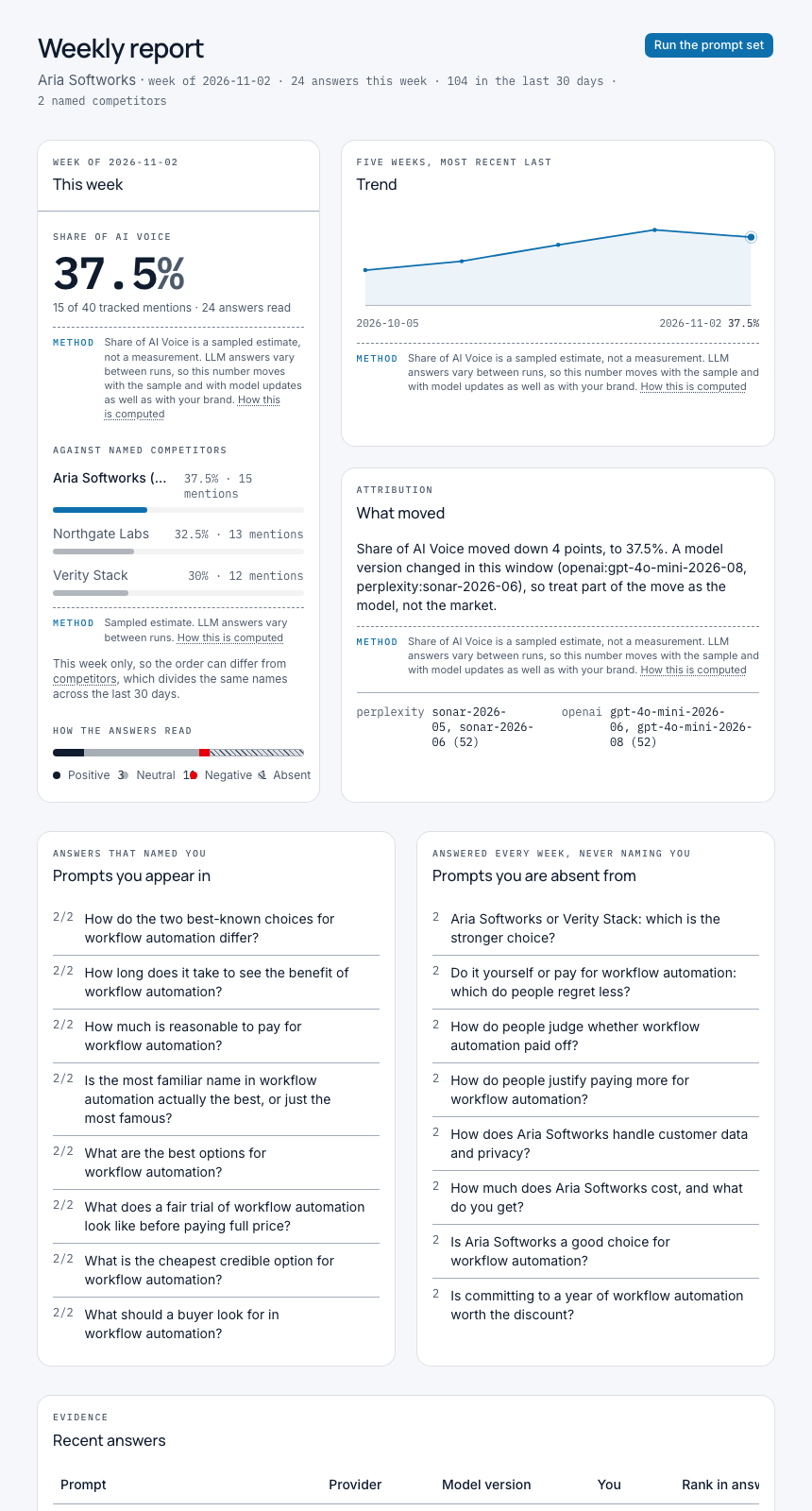
At setup you give a brand name, a description and up to three competitor names, and Seenby generates a set of 50 to 100 prompts and freezes it. The same set runs every week, so the trend measures the market rather than changing questions. A scheduled query engine puts those prompts to two providers, OpenAI and Perplexity, behind an adapter that keeps running on the remaining provider if one is unavailable. Two providers is the deliberate limit at this stage, and we would rather say so than imply coverage we do not have.
From those answers Seenby computes Share of AI Voice: one headline metric per brand per week, stored with its methodology caveat attached to every computed record. The caveat is not a footnote we hide. It is surfaced in-product on every score display and on a dedicated methodology page, because a score built on non-deterministic model output has to travel with the reason it might move. Every stored response is tagged with its model version, so a week-over-week shift that came from a model update can be told apart from a real change in how your market is described. The dashboard shows a 30-day trend, sentiment, the prompts where you are and are not named, and the competitor benchmark. The weekly digest carries the top insights, drift alerts tied to model-version changes when applicable, and the same caveat.
What Seenby is not: it is one brand per subscription, there is no SOC 2 or ISO 27001 certification, sign-in is email and password with no SAML or OIDC, and there is no self-serve export or choice of hosting region. If your procurement needs those, one of the enterprise platforms in this category is the better fit, and we would rather you found that out here than on a call.
What a Seenby subscription is
Starter
£79 / month
A brand manager or head of SEO at one mid-market company who just needs an answer to how ChatGPT and Perplexity describe them.
- Brands: 1
- Named competitors: Up to 3
- Prompts per week: 50
- AI providers: OpenAI and Perplexity
- Query cadence: Weekly
- Answer log history: 30 days
Growth
£149 / month
The same in-house buyer once the score is part of their reporting and they need the per-prompt evidence behind it for their CMO.
- Brands: 1
- Named competitors: Up to 3
- Prompts per week: 100
- AI providers: OpenAI and Perplexity
- API access: Not included
- White-label reports: Not included
Agency
£399 / month
An agency principal running SEO or brand for several client companies who needs a score per client in one account.
- Brands: Up to 5
- Named competitors: Up to 3 per brand
- Prompts per week: 100 per brand
- AI providers: OpenAI and Perplexity
- White-label reports: Not included
- API access: Not included
Questions
What does Profound cost?
We do not publish other vendors' prices, because they change and only their own pricing page can be authoritative. Check tryprofound.com for current pricing and coverage.
Which models does Seenby read?
Two at this stage: OpenAI and Perplexity. They sit behind a provider adapter that keeps the weekly run going on the remaining provider if one is disabled. If you need broader model coverage today, one of the other platforms in this category will suit you better.
The results change every time I ask. Does any tool solve that?
No tool removes non-determinism, and any vendor who implies otherwise is overclaiming. What a tool can do is hold the prompt set constant, run it on a fixed cadence, and tag every answer with the model version so a shift caused by a model update can be told apart from a real one. Seenby attaches its methodology caveat to every computed score for that reason.
Should I just build this in-house?
If your team will own mention extraction, sentiment handling, model-version tagging and a defensible share denominator, and keep them working as providers change, building is reasonable. The querying is the easy part. The measurement discipline is the part that takes ongoing time.
Can I track more than one brand or run client accounts?
A subscription covers one brand with up to three named competitors. Agencies running several clients need a subscription per client brand, which is set out on our agencies page.
Is the AI reporting in Semrush or Ahrefs enough?
We cannot tell you what either suite ships today. We have no quote from their live product pages, and this part of the market changes month to month, so read their own product and pricing pages for what your tier includes. Then judge whatever you find by the same three tests: a fixed cadence, benchmarking against the competitors you name, and sight of the underlying answers rather than only an aggregate. If a bundled report clears those, it may well be enough for your reporting.
Can I start with Seenby today?
Not yet. The site is a waitlist while we finish the product. Joining tells us the brand and the competitor set you would track, and we will write when weekly tracking opens.
Sources
Related
- How to choose an AI visibility tool: eleven questions to ask a vendor
A buyer's guide to AI visibility tools, built around eleven questions about model coverage, prompt sets, score method, drift, evidence, data handling and price.
- AthenaHQ vs Seenby
A comparison for anyone choosing between AthenaHQ and Seenby: what Seenby is built to do, stated from its own build, and the questions to put to AthenaHQ directly rather than take from us.
- Evertune vs Seenby
A head-to-head for anyone shortlisting Evertune and Seenby: what Seenby measures, what it will cost, what it does not have, why it is still a waitlist, and why the Evertune column on this page says ask Evertune.
- Free AI visibility checkers: what a one-off scan can and cannot tell you
A free AI visibility checker gives you one sample of how an AI model describes your brand.
- How much does AI brand monitoring cost?
AI brand monitoring is priced on query volume, so cost tracks how many prompts, providers and brands you watch.
- Otterly.AI vs Seenby
A head-to-head for brand and SEO leads choosing an AI visibility tracker: what Seenby measures, what it will cost, what it does not do, and the questions to put to Otterly.AI before you decide.