Free AI visibility checkers: what a one-off scan can and cannot tell you
A free AI visibility checker asks an AI model a handful of questions about your brand and shows you whether it named you. That answers the question most teams start with, and it is also a single sample of a system that changes its answers.
Seenby is not open yet, so anything on this page about what it does is what it is being built to do.
What a free AI visibility checker actually does
A free AI visibility checker is usually a web form. You give it your brand name or domain. It puts a small set of questions to one or two AI models, then shows you whether your brand was named. Some return a percentage. For the executive question that starts most of these searches, how does ChatGPT describe us, that is a reasonable first answer. It costs nothing.
What a free scan cannot tell you is whether the answer holds. Model answers are not deterministic. Ask the same question twice and the wording can change, the order of the brands can change, and sometimes the list itself changes. Providers also ship new model versions. An answer from this month and an answer from last month may not be comparable. One scan is one sample of a moving system. Nothing in that sample separates a real competitive shift from a model update.
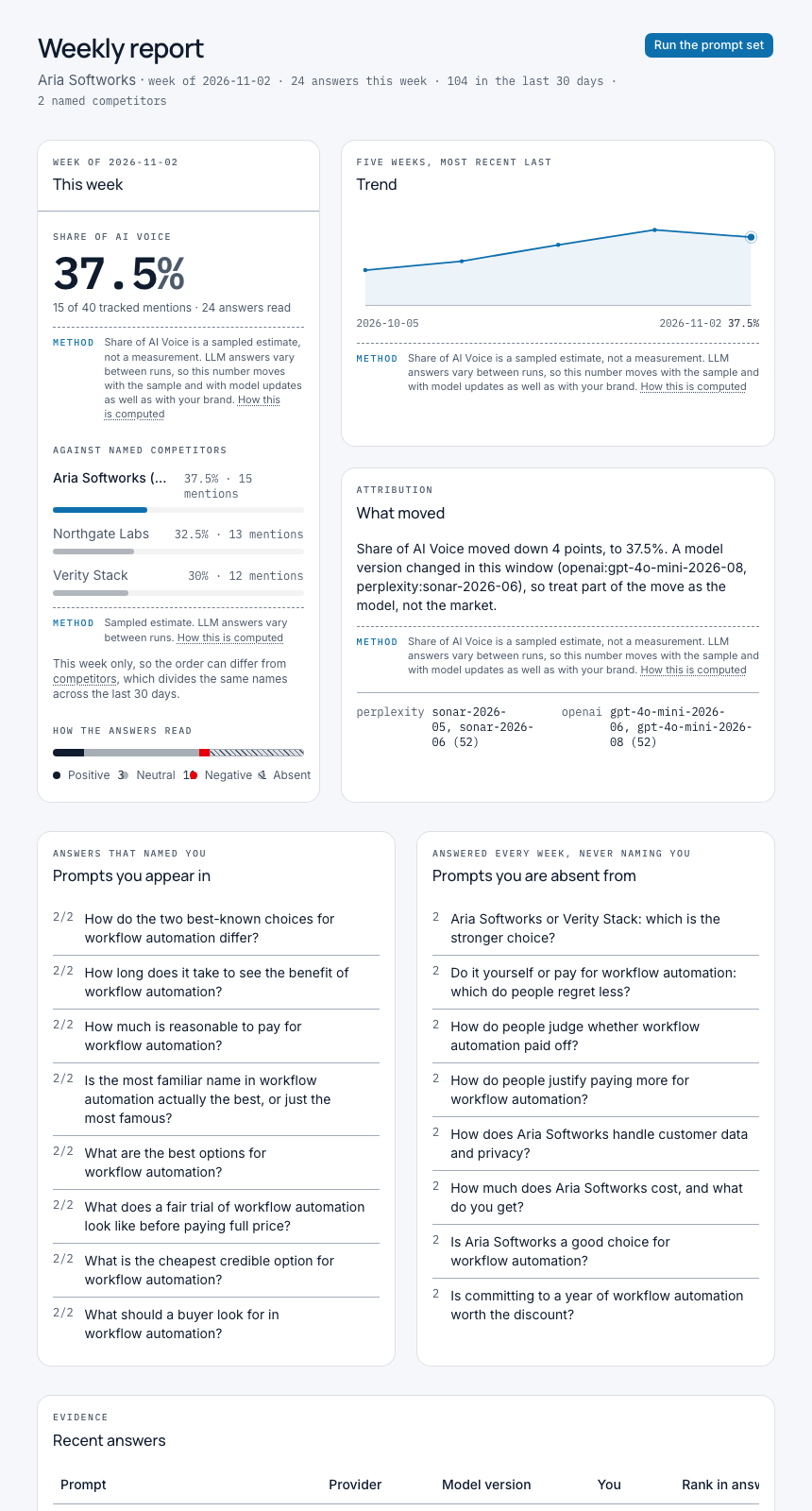
Seenby is not a free checker. That is worth stating plainly before you read on. It is built for the other half of the problem. The same frozen prompt set runs every week. Each week produces one Share of AI Voice figure per brand, and the methodology caveat is attached to every computed record. The site is in waitlist mode today, so joining the list is the only step available.
One free scan against a repeated weekly measurement
| What you want to know | A one-off free scan | A weekly measurement |
|---|---|---|
| Does the model name us at all today? | Yes, for whichever prompts it happens to ask | Yes, plus the top prompts where you are named and where you are not |
| Are we rising or falling? | No. One sample has no trend | A 30-day trend line for Share of AI Voice |
| How do we stand against three named rivals? | Only inside whatever single answer you happen to read | A competitor benchmarking view, answer by answer |
| Is the tone positive, neutral or negative? | You judge it yourself, one answer at a time | A sentiment breakdown across the week's answers |
| Did the change come from the market or the model? | No way to tell from one reading | Every stored answer is tagged with its model version, and the weekly digest flags drift tied to model-version changes |
Questions
Can I check my brand in ChatGPT for free?
Yes, and it takes an afternoon rather than a tool. Open the model and ask the questions your buyers would ask, without your brand name in the prompt. Note whether you appear and where in the list. Run each prompt a few times, because one run only tells you about that run. Write down the date and the model version you used, so the note is still worth something next quarter. That is the honest baseline before you consider paying anyone.
Is a free AI visibility checker accurate?
It is accurate about what it saw, which is a narrower claim than it sounds. The real question is whether the sample represents your category: how many prompts, how many repeats of each, which providers, and which model version. If a checker does not disclose those four things, treat its number as directional rather than measured. Seenby attaches its methodology caveat to every computed score for the same reason, and surfaces the disclosure on every score display.
Why does the score change every time I run a free checker?
Two separate mechanisms are at work. Within one model, repeated answers to the same prompt vary, so a small sample moves on its own. Between models, providers ship new versions, and a new version can reorder which brands it reaches for. Neither is a fault in the checker. Together they mean a difference between two one-off scans is not evidence of anything. Separating the two is a measurement design problem: hold the prompt set constant, repeat it on a schedule, and record the model version behind each answer.
Does Seenby offer a free AI visibility checker or a free trial?
No. There is no free tier and no trial period. The product is in waitlist mode, so signing up today puts you in line rather than into the dashboard. The pricing page lists exactly what the plan includes.
What can I usefully learn from a single free scan before spending anything?
Three things. Whether you are named at all in the obvious category prompts, which competitors the model reaches for when you are not, and how it characterises you when it does mention you. That is enough to decide whether AI visibility deserves a budget line this quarter. It is not enough for a board slide, because you have no baseline to compare against and no way to attribute a change to the market rather than the model.
How many prompts does a check need before the result means something?
The count matters less than holding the set constant. Five prompts run once tell you about five prompts on one day. The same fifty prompts run every week tell you about direction. Seenby generates 50 to 100 prompts from your brand description and named competitors at setup, freezes them, and runs that same set each week, so the trend reflects the market rather than changing questions. If you are sampling by hand, pick a set you can repeat and resist editing it between runs.
Which AI providers do free checkers cover?
It varies, and coverage decides what the number means, so ask before you trust it. Ask which providers are queried, which model versions, and whether web search was enabled during the query. If a checker will not name those, treat its coverage as unknown rather than broad. Seenby reads two providers, OpenAI and Perplexity, and tags every stored answer with its model version, so a provider change is visible rather than buried in the score.
My brand did not appear in a free scan. What should I do next?
Do not over-read one reading. Re-run the same prompts over a few days and note which competitors appear in your place. A consistent absence across repeats and providers is a real gap; a single absence is noise. If the gap holds, ask which prompts you are missing from, since that points at content and coverage work rather than a generic optimisation project. Then decide whether the gap is worth measuring continuously, which is a purchasing question. Our guide on how to choose an AI visibility tool lists the questions worth putting to any vendor, including us.
Related
- How to choose an AI visibility tool: eleven questions to ask a vendor
A buyer's guide to AI visibility tools, built around eleven questions about model coverage, prompt sets, score method, drift, evidence, data handling and price.
- AthenaHQ vs Seenby
A comparison for anyone choosing between AthenaHQ and Seenby: what Seenby is built to do, stated from its own build, and the questions to put to AthenaHQ directly rather than take from us.
- Evertune vs Seenby
A head-to-head for anyone shortlisting Evertune and Seenby: what Seenby measures, what it will cost, what it does not have, why it is still a waitlist, and why the Evertune column on this page says ask Evertune.
- How much does AI brand monitoring cost?
AI brand monitoring is priced on query volume, so cost tracks how many prompts, providers and brands you watch.
- Otterly.AI vs Seenby
A head-to-head for brand and SEO leads choosing an AI visibility tracker: what Seenby measures, what it will cost, what it does not do, and the questions to put to Otterly.AI before you decide.
- Peec AI vs Seenby
A head-to-head between Peec AI and Seenby, written with a hard rule: Seenby is described from what it is built to do, and Peec AI is not described from memory. Use the question list to hold both tools to the same standard.