Peec AI vs Seenby
You are choosing between Peec AI and Seenby, two tools in the AI visibility category, and you want the differences stated without spin. Here is exactly what Seenby is built to measure, and an honest account of what this page will not tell you about Peec AI.
Seenby is not open yet, so anything on this page about what it does is what it is being built to do.
What this page can and cannot tell you
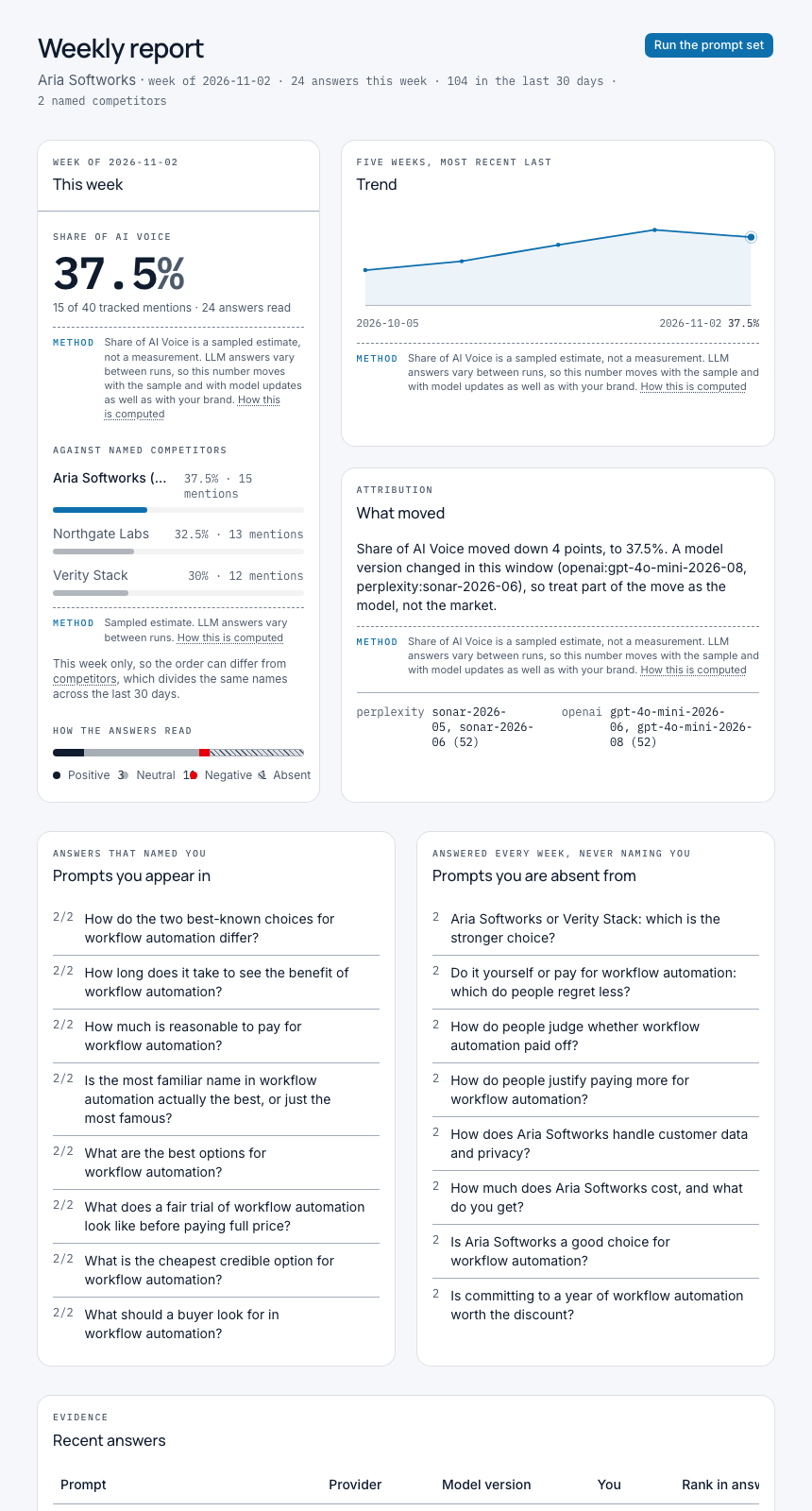
Seenby tracks one brand across two AI answer providers, OpenAI and Perplexity, using a prompt set frozen at setup, and reduces the week to a single number: Share of AI Voice, benchmarked against up to three competitors you name. Seenby is on a waitlist today, so everything here is what the product is built to do, not a report from customers.
Peec AI is another tool in the same category. Our research on it is recall, not retrieval: we have not fetched its live product or pricing pages, and we will not print a price, a model list or a feature set we cannot quote. So this page does not tell you what Peec AI costs or covers. For that, read peec.ai and ask their team directly.
That sounds like an odd way to write a comparison page. It is the only honest one we have. What we can do is describe Seenby precisely enough that you can hold any other tool, Peec AI included, to the same set of questions, and know what a straight answer looks like when you get one.
The decision underneath the search
Most people arriving at a query like this are not really choosing between two logos. They were asked how ChatGPT describes the company, they checked by hand a few times, got a different answer each time, and concluded that spot-checking is not a measurement. The real decision is what kind of instrument you want: a broad one that watches many surfaces at a shallow depth, or a narrow one that measures a small number of surfaces the same way every week so the trend line means something. Seenby is deliberately the second kind.
What Seenby measures, in its actual scope
Scope first, because scope is where comparison pages usually go soft.
Two providers, named. The scheduled query engine hits exactly two providers, OpenAI and Perplexity, behind a provider adapter interface that degrades gracefully if one provider is disabled. Not four. If your board deck needs Gemini coverage this quarter, that is a real reason to look elsewhere, and we would rather you learn it here than on a call.
One headline metric. Share of AI Voice is computed once per brand per week, and every computed record is stored with its methodology caveat text attached. The caveat is not a footnote we can quietly drop later; it travels with the number.
Methodology in the open. The disclosure is surfaced in-product on every score display and on a dedicated methodology page. You can read how the score is built before you believe it, and so can the colleague who challenges it in the monthly review.
Drift you can tell apart. Every stored response is tagged with its model version, so a movement caused by a model update can be distinguished from a movement caused by the market. This matters because the strongest objection to this whole category is that the results change every time you ask. That objection is correct. Model updates move scores. A tool that hides this is selling you confidence, not measurement.
Evidence under the number. The response parser extracts brand and competitor mentions, classifies sentiment as positive, neutral, negative or absent, and records ranking position within each response. The dashboard shows 30-day trend lines, a sentiment breakdown, the prompts where you are and are not named, and a competitor benchmarking view.
Limits, stated. One brand per subscription, up to three named competitors, 50 to 100 prompts per week, OpenAI and Perplexity. Sign-in is email and password. There is no SAML or OIDC, no SOC 2 or ISO 27001, and no choice of hosting region.
Side by side, with the gaps marked as gaps
| Dimension | Seenby | Peec AI |
|---|---|---|
| Answer providers queried | OpenAI and Perplexity, behind an adapter that degrades gracefully if one provider is disabled | Not verified by us. Ask which assistants are queried, and how often each is sampled |
| Headline metric | Share of AI Voice, one score per brand per week | Not verified by us. Ask what their headline number counts and what it excludes |
| Methodology disclosure | Surfaced in-product on every score display and on a dedicated methodology page | Not verified by us. Ask where the calculation is documented and whether it ships with the number |
| Handling of model updates | Every stored response is tagged with its model version, to separate model-update drift from real movement | Not verified by us. Ask how a score change caused by a model update is identified |
| Score caveat | Methodology caveat text stored with every computed score record and included in the weekly digest | Not verified by us |
| Prompt set | 50 to 100 prompts generated at onboarding and frozen, so the same set runs every week | Not verified by us. Ask whether the prompt set is fixed or regenerated |
| Competitor benchmarking | Up to 3 named competitors, compared answer by answer | Not verified by us. Ask how many competitors a plan allows |
| Brands per subscription | One | Not verified by us. Agencies should ask about multiple workspaces |
| Sign-in | Email and password. No SAML or OIDC | Not verified by us |
| Hosting and subprocessors | Amazon Web Services in a single region. Stripe, OpenAI, Perplexity, Anthropic and Resend | Not verified by us |
| Independent certification | None. No SOC 2, no ISO 27001 | Not verified by us. Ask directly if procurement will require it |
Five questions worth asking both tools
Which models, and how many samples per prompt
Coverage claims are usually a list of logos. The number that matters is how many times each prompt is asked on each model per week, because a single sample of a non-deterministic system is an anecdote. Ask for the sampling design, not the logo wall.
How is the headline score calculated
Share of voice metrics differ in the denominator. Seenby computes one score per brand per week and publishes the method on a dedicated page. Ask any vendor for the equivalent document, and read whether the caveat is attached to the score or buried in a help centre.
Can you tell a model update from a market change
If the tool cannot tag which model version produced an answer, it cannot distinguish a provider shipping a new model from your competitor winning ground. Seenby tags every stored response with its model version for exactly this reason.
Can you read the actual answers
A score without evidence is unarguable in both directions. Ask to see how the tool shows the prompts where you were named, the prompts where you were not, the sentiment attached, and the rank position inside each answer.
What happens to the stored text
AI answers routinely name real people. Seenby runs a scrubbing step in the storage pipeline before any response is queryable, with a flag on every stored response. Ask any vendor what is stored, for how long, and who processes it.
When to choose which
Reasons to look closely at Peec AI
If you need more than one brand in a single account, you are an agency reporting across a client roster, or you require coverage of assistants beyond OpenAI and Perplexity, those are concrete requirements Seenby does not meet today, and you should evaluate tools that state they do. We are not going to describe who Peec AI is built for, or what it covers, from memory: read peec.ai and put the questions above to their team. European buyers with data residency requirements should also ask both vendors where data is stored; Seenby runs in a single Amazon Web Services region and does not offer a choice of region.
Reasons to look closely at Seenby
Choose Seenby if you are measuring one brand seriously and the credibility of the number matters more than the breadth of the dashboard. The design decisions all point the same way: a frozen prompt set so the trend measures the market rather than changing questions, model-version tagging so drift is attributable, one score a week rather than a figure that twitches hourly, and the methodology visible on every score display so the number survives a sceptical colleague. If you have to put AI search in a board deck and then defend it, that is the trade we optimised for.
Choose it also if you want the price on the page. No demo gate to find out.
An honest limit on both
Neither tool can promise a stable number, and you should distrust one that implies otherwise. Large language models are non-deterministic and their outputs shift with every model update. A week-over-week change in any AI visibility score may reflect a model update rather than a real competitive change. The useful question is not whether a tool eliminates that noise, which none can, but whether it shows you the noise and helps you name it.
Questions
Why does this page not list Peec AI's features and pricing?
Because we have not retrieved their live pages, and we will not publish figures or feature lists from memory. Recalled details in this category go stale quickly. Read peec.ai for their current pricing and coverage, then bring the five questions above to both tools.
Which AI assistants does Seenby track?
Two at present: OpenAI and Perplexity. They sit behind a provider adapter that degrades gracefully if one provider is disabled. Anthropic is used once at onboarding to generate your prompt set, not as an answer surface we measure.
What does Seenby cost?
It covers one brand, up to three named competitors, 50 to 100 prompts a week, both providers, the answer log and the weekly digest. See the pricing page for the full breakdown.
Can I track more than one brand or run client accounts?
Each subscription covers one brand. Agencies running several clients need a subscription per client brand, which is set out on the agencies page.
How do you stop model updates from looking like real movement?
Every stored response is tagged with its model version, so a shift that lines up with a provider's model update can be identified rather than misread. The weekly digest flags drift tied to model-version changes when applicable. It is mitigation, not elimination: a week-over-week change may still reflect a model update rather than a market change, and the caveat is stored with every score.
What happens to personal names that appear in AI answers?
A scrubbing step runs in the response-storage pipeline before any answer becomes queryable, with a flag recorded on every stored response. Emails, phone numbers, handles and personal names are redacted before storage.
Do you have SOC 2 or single sign-on?
No to both. There is no independent security audit or certification, and sign-in is email and password with no SAML or OIDC. If procurement requires either, that is a genuine blocker worth raising early.
Can I try it today?
Not yet. Seenby is on a waitlist, so nothing on this page is a report of results in production. It describes what the product is built to do and the scope it is built within.
Sources
Related
- How to choose an AI visibility tool: eleven questions to ask a vendor
A buyer's guide to AI visibility tools, built around eleven questions about model coverage, prompt sets, score method, drift, evidence, data handling and price.
- AthenaHQ vs Seenby
A comparison for anyone choosing between AthenaHQ and Seenby: what Seenby is built to do, stated from its own build, and the questions to put to AthenaHQ directly rather than take from us.
- Evertune vs Seenby
A head-to-head for anyone shortlisting Evertune and Seenby: what Seenby measures, what it will cost, what it does not have, why it is still a waitlist, and why the Evertune column on this page says ask Evertune.
- Free AI visibility checkers: what a one-off scan can and cannot tell you
A free AI visibility checker gives you one sample of how an AI model describes your brand.
- How much does AI brand monitoring cost?
AI brand monitoring is priced on query volume, so cost tracks how many prompts, providers and brands you watch.
- Otterly.AI vs Seenby
A head-to-head for brand and SEO leads choosing an AI visibility tracker: what Seenby measures, what it will cost, what it does not do, and the questions to put to Otterly.AI before you decide.