Evertune vs Seenby
Evertune is the other name on your list, and because we have no verified, dated quote from their material, this page state
Seenby is not open yet, so anything on this page about what it does is what it is being built to do.
Where each one sits
Two different shapes of purchase sit behind this search, and it helps to name them before the table.
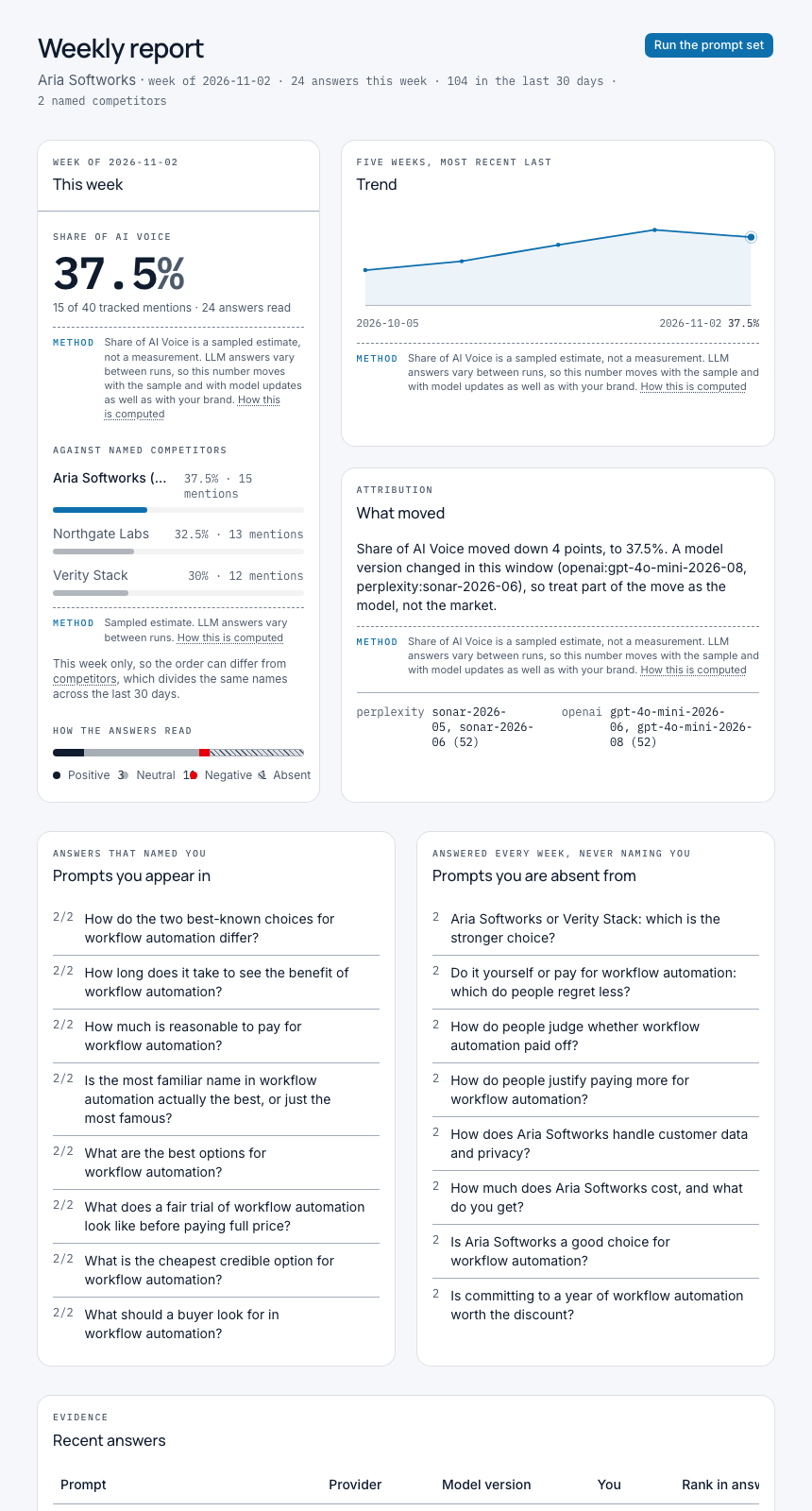
Seenby is a weekly tracker for a single brand. You give it a brand name and description and up to three competitor names, and a set of 50 to 100 prompts is frozen at setup. That same frozen set runs every week against two answer providers, OpenAI and Perplexity, so the trend measures the market rather than a changing list of questions. The output is one headline number per brand per week, Share of AI Voice, stored with its methodology caveat attached to every computed record.
One fact belongs at the top rather than in a footnote. Seenby is not open yet. The site is a waitlist, so everything below describes what the product is built to do and what it will cost, not something you can buy this afternoon. If your decision has to close this quarter, that is probably the line that decides it, and you should read the rest with it in mind.
Evertune is the other name on your shortlist, and we are not going to characterise their product for you. The research we hold on Evertune is recalled, not retrieved: no quote, no retrieval date, nothing we would publish as fact about another company's work. So the third column below mostly reads ask Evertune. That is less satisfying than a tidy feature grid. It is also the only version of this page we can stand behind, and it tells you something about how we handle numbers we cannot show our working for.
Read Evertune's own material at evertune.ai, then hold it against the second column, which is ours to answer for.
Side by side, with the gaps marked
| Dimension | Seenby | Evertune (not verified by us) |
|---|---|---|
| Available today | No. Waitlist, not open yet | Ask Evertune. |
| How you sign in | Email and password | Ask Evertune. |
| Brands per subscription | One brand | Ask Evertune. |
| Named competitors | Up to 3, benchmarked answer by answer | Ask Evertune. |
| Answer providers | Two: OpenAI and Perplexity | Ask Evertune. |
| Prompt volume | 50 to 100 prompts, frozen at setup, run weekly | Ask Evertune. |
| Headline metric | Share of AI Voice, one score per brand per week | Ask Evertune. |
| Methodology disclosure | Shown on every score display and on a static methodology page | Ask Evertune. |
| Model updates | Every stored answer is tagged with its model version, to separate real drift from model-update drift | Ask Evertune. |
| Evidence you can read | The full answer log, scrubbed, plus sentiment and per-prompt evidence | Ask Evertune. |
| Security and data posture | No SOC 2 or ISO 27001, no SAML or OIDC single sign-on, no DPA on request, no self-serve export, one AWS region, no region choice | Ask Evertune. |
The three rows that carry the weight
Most of the second column is scope. Three rows are the argument.
One score, per brand, per week
Share of AI Voice is computed as a single headline metric for your brand each week. It is not a live gauge and it is not a ranking. It is a weekly reading taken from a fixed prompt set, which is the only way a week-over-week line means anything. A score computed from different questions each time measures your questions, not your market.
The caveat travels with the number
Every computed score record carries its methodology caveat text, and the methodology is disclosed in-product on every score display as well as on a dedicated static page. We do this because the honest description of this category includes a limitation: model outputs are not deterministic, and a movement of a few points may be noise rather than news. You should expect that stated next to the number, not buried in a help centre. If a tool you are evaluating shows you a score without showing you how it was produced, ask.
Model-version tagging
Every stored response is tagged with the model version that produced it. This is the answer to the objection practitioners raise first, that the results change every time you ask. Tagging does not make the underlying answers stable. It does let a drop be examined against the possibility that the provider shipped a new model version that week, which is the difference between a real competitive shift and a measurement artefact.
When to choose which
Being fair here is easy, because the boundary is a matter of scope rather than quality.
Seenby fits when
You have one brand to defend and a named competitive set you can count on one hand. You want a price you can read before you talk to anyone, and you are willing to wait for an invitation rather than open a procurement cycle now. You report monthly or quarterly and need a weekly line, a sentiment breakdown and the actual answers to quote in the deck when someone asks how ChatGPT describes you. You are comfortable with two providers, OpenAI and Perplexity, covered properly rather than a longer list covered thinly. And you would rather have the caveat printed next to the number than a confident chart.
Evertune, or another vendor, fits when
Several things are genuinely outside what Seenby does, and if any of them is a requirement then Seenby is the wrong tool and you should evaluate the alternatives on their merits. Timing comes first: Seenby is a waitlist today, so a need you have to serve this month is a need it cannot serve. Seenby tracks one brand per subscription, so a portfolio of brands or a roster of clients does not fit in one seat. It names up to three competitors, so a wide category map is out of range. It queries two providers, so if your buyers live in Gemini or Claude, that coverage is not here. It has no independent security certification, no single sign-on, no data processing agreement on request and no self-serve export, which several mid-market and most enterprise procurement processes will treat as a hard stop. If your evaluation is being run by a security reviewer rather than a marketer, start there.
If you are an agency weighing this for client work, the one brand per subscription limit shapes the whole decision, and the agencies page sets out how that plays out in practice.
Questions worth putting to both vendors
How is the headline score calculated?
Ask for the formula and the denominator in writing. Seenby computes Share of AI Voice from mentions of your brand against your named competitors, and attaches the methodology caveat to every record it stores.
Do the prompts stay the same week to week?
A trend only means something if the question set is fixed. Seenby freezes 50 to 100 prompts at setup and runs that same set every week.
What happens when a model updates?
Ask how the tool distinguishes a real move from a model change. Seenby tags every stored answer with its model version and flags drift tied to model-version changes in the weekly digest.
Can I read the underlying answers?
A score without evidence is hard to act on. Seenby keeps the full answer log, scrubbed of emails, phone numbers, handles and personal names before storage, with the model version attached.
What are the limits, in numbers?
Brands, competitors, prompts, providers.
What is not in place yet?
Ask any vendor to name the gap. Ours: the product is still on a waitlist, and there is no SOC 2 or ISO 27001, no single sign-on, no DPA on request, no self-serve export and no choice of hosting region.
Questions
Is this comparison endorsed by Evertune?
No. Evertune's name appears here only to identify the company you are comparing us against. Nothing on this page is written or approved by them, and we make no claim about their product, pricing, security or support.
Why does the Evertune column not list any features?
Because we have no dated, verified quote from their material. We would rather leave a column honest and empty than publish a feature grid built from memory. Read evertune.ai and judge their product from their own words.
Can I buy Seenby today?
No. Seenby is in waitlist mode and not open yet, so joining the list is the way in when it opens. The plan and its price are published now so the cost is known before that point.
What will Seenby cost?
It covers one brand, up to three named competitors, 50 to 100 prompts a week across OpenAI and Perplexity, the answer log, competitor benchmarking and the weekly digest. Full detail is on the pricing page.
Which AI models does Seenby query?
Two providers, OpenAI and Perplexity. We do not claim coverage of models we do not query. If Gemini or Claude coverage is a requirement for your evaluation, this is the point where Seenby drops out of your shortlist.
The answers change every time I ask. Does a weekly score mean anything?
Only with two guards in place, and they are why the score is built this way. The prompt set is frozen at setup so the questions do not move, and every stored answer is tagged with its model version so a shift can be checked against a provider update. Week-over-week movement can still reflect a model change rather than a real competitive change, and the caveat is shown next to every score.
Can I track more than one brand, or run client accounts?
One brand per subscription. If you are an agency, the agencies page explains how one client brand per subscription works and where it stops working.
How will I sign in?
With an email address and a password. There is no SAML or OIDC single sign-on, which is worth raising early if your IT team requires it.
Sources
Related
- How to choose an AI visibility tool: eleven questions to ask a vendor
A buyer's guide to AI visibility tools, built around eleven questions about model coverage, prompt sets, score method, drift, evidence, data handling and price.
- AthenaHQ vs Seenby
A comparison for anyone choosing between AthenaHQ and Seenby: what Seenby is built to do, stated from its own build, and the questions to put to AthenaHQ directly rather than take from us.
- Free AI visibility checkers: what a one-off scan can and cannot tell you
A free AI visibility checker gives you one sample of how an AI model describes your brand.
- How much does AI brand monitoring cost?
AI brand monitoring is priced on query volume, so cost tracks how many prompts, providers and brands you watch.
- Otterly.AI vs Seenby
A head-to-head for brand and SEO leads choosing an AI visibility tracker: what Seenby measures, what it will cost, what it does not do, and the questions to put to Otterly.AI before you decide.
- Peec AI vs Seenby
A head-to-head between Peec AI and Seenby, written with a hard rule: Seenby is described from what it is built to do, and Peec AI is not described from memory. Use the question list to hold both tools to the same standard.