AI visibility for B2B SaaS brands
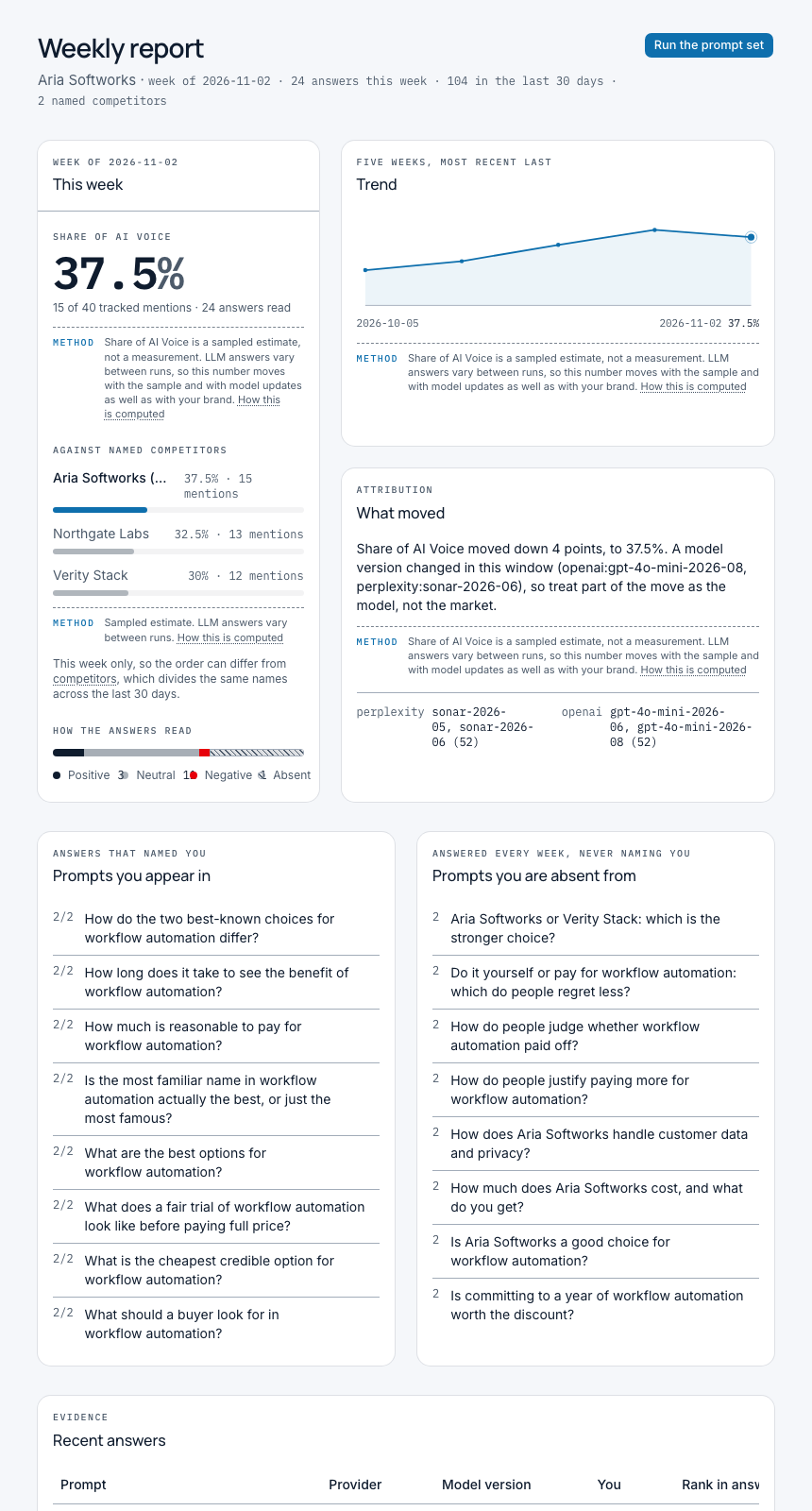
AI visibility for a B2B SaaS brand is whether an assistant names you when a buyer asks which tools fit their company, and which competitors it names instead. Seenby is built to measure that as one Share of AI Voice score per week, with its methodology caveat attached to every score it computes.
Seenby is not open yet, so anything on this page about what it does is what it is being built to do.
AI visibility for B2B SaaS, defined narrowly
A buyer evaluating software rarely starts with ten blue links now. They ask an assistant which tools are best for a 200-person company in your category, and they read one paragraph that names three or four vendors. AI visibility for B2B SaaS is whether your name appears in that paragraph, how you are framed when it does, and which rivals stand beside you.
That is the measurement Seenby is built for. One thing to say before the detail: Seenby is not open yet. Everything below describes what the product is built to do, not a tour of something you can sign into this afternoon, and you can join the waitlist to hear when tracking starts.
As built, onboarding takes your brand name, a description, and up to three competitor names. Seenby generates 50 to 100 prompt templates from that in a single model call, with a curated fallback set if generation fails or returns too few prompts, then freezes the set. The same questions run every week, so movement in the trend reflects the market rather than a change in what you happened to ask.
One boundary, stated early. Seenby measures presence and does not prescribe content. It is built to show the prompts where no answer named you, the sentiment attached to you when you were named, and where you stood against the three competitors you nominated. The editorial call about what to publish next stays with you.
How B2B SaaS teams check this today
The spot check
Someone opens ChatGPT, types the category question, screenshots the answer and pastes it into Slack. It is free, it is fast, and it is a sample of one. Ask again an hour later and the vendor order can differ. Nothing in that sample becomes a number anyone can defend in a quarterly review.
The listicle instinct
B2B SaaS marketing has a decade of muscle memory for ranking on best tools for X pages, so the reflex is to audit those pages and assume the assistant reads them the same way. It might. Without a record of what the assistant actually returned, week over week, you are optimising against a guess.
The unbranded question is the whole funnel
In B2B SaaS the expensive question is rarely your brand name. It is the category question, asked by someone who has not heard of you yet, often on behalf of a buying committee that will shortlist three vendors. Brand-name monitoring hides this: an answer to a question about you naturally mentions you, so the picture looks healthy while the category prompts pass you by.
The objection that blocks the purchase
Every buyer in this category raises the same point. LLM answers are non-deterministic, and they shift when a provider ships a model update. The objection is correct. It is why Seenby stores its methodology caveat with every computed score, tags every stored answer with the model version behind it, and ties drift alerts to model-version changes when applicable. A week-over-week move may be a model update rather than a competitive change, and the product is built to say so where the number is shown.
The weekly workflow Seenby is built around
- Describe the brand, name up to three rivals
Onboarding takes a brand name, a short description and up to three competitor names. Three is deliberately the size of a real B2B SaaS shortlist, not a long tail of adjacent vendors.
- Freeze a prompt set of 50 to 100 prompts
Seenby generates the set from your description and competitor names in one model call, using Anthropic, with a curated fallback template set if generation fails or returns too few prompts. The set is frozen so every week asks the same questions.
- Run the set against both providers
The scheduled query engine is built to hit exactly two providers at launch, OpenAI and Perplexity, behind a provider adapter interface that degrades gracefully if one provider is disabled.
- Read every answer for mentions, sentiment and rank
The parser extracts brand and competitor mentions, classifies sentiment as positive, neutral, negative or absent, and records ranking position within each response.
- Scrub before anything is queryable
A PII-scrubbing step runs in the response-storage pipeline before any response can be queried, and every stored response carries a pii_scrubbed flag.
- Compute one score for the week
Share of AI Voice is a single headline metric per brand per week, stored with its methodology caveat text attached to every computed record, so the caveat travels wherever the number goes.
- Open the dashboard, then read the digest
The dashboard is built to carry 30-day trend lines for Share of AI Voice, a sentiment breakdown, the top prompts where your brand is and is not mentioned, and a competitor benchmarking view. A weekly automated email digest sends top insights, drift alerts tied to model-version changes when applicable, and the same caveat.
Why this matters in B2B SaaS
One number the board deck can hold
Share of AI Voice is a single weekly figure per brand, which is what a monthly reporting cycle can actually carry. The methodology caveat is stored with the number rather than buried in a footnote.
A competitor set the size of your win-loss sheet
Up to three named competitors, benchmarked in the dashboard, matches how B2B SaaS deals are actually lost. You choose the three names rather than accepting a category average.
The prompts where you are absent
The dashboard lists top prompts where your brand is mentioned and where it is not. For a SaaS brand, the absent list is the interesting one: unbranded category questions that reached a buyer without you in the answer.
Framing, not just presence
Being named as the expensive option is a different problem from not being named. Sentiment is classified per mention as positive, neutral, negative or absent, alongside your ranking position inside the response.
Drift you can attribute
Every stored response is tagged with its model version, which is how a real competitive shift is distinguished from a provider shipping a model update. Where a drift alert applies, the digest ties it to the version change.
What we can tell your security team
Emails, phone numbers, handles and personal names are redacted before any answer is stored or queryable, the app and its Postgres database run in a single region on Amazon Web Services, and card details go to Stripe and never reach Seenby's servers. What is not in place, plainly: no SOC 2 or ISO 27001 certification, no single sign-on (sign-in is email and password), no signed data processing agreement on request, no self-serve export and no choice of hosting region. If any of those is a hard requirement for your review, this is the wrong tool for now.
What the score settles, and what it does not
| What you want to know | What Seenby records | What it cannot settle |
|---|---|---|
| Are we named when buyers ask for tools in our category? | Mention or absence in every answer to your frozen prompt set, on OpenAI and Perplexity | Whether a real buyer asked that exact question this week |
| Are we gaining on a named rival? | Share of AI Voice each week, a 30-day trend line and a competitor benchmarking view | Whether a move is competitive or a model update, beyond what the version tag shows |
| How are we described? | Sentiment per mention and ranking position inside each response | Why a model framed you that way, or what it will say next week |
| Did our content work? | Whether mention rate moved on the prompts that previously omitted you | Causation. The prompt set is a sample of your category, not the whole of AI search |
What tracking costs
Starter
£79 / month
A brand manager or head of SEO at one mid-market company who just needs an answer to how ChatGPT and Perplexity describe them.
- Brands: 1
- Named competitors: Up to 3
- Prompts per week: 50
- AI providers: OpenAI and Perplexity
- Query cadence: Weekly
- Answer log history: 30 days
Growth
£149 / month
The same in-house buyer once the score is part of their reporting and they need the per-prompt evidence behind it for their CMO.
- Brands: 1
- Named competitors: Up to 3
- Prompts per week: 100
- AI providers: OpenAI and Perplexity
- API access: Not included
- White-label reports: Not included
Agency
£399 / month
An agency principal running SEO or brand for several client companies who needs a score per client in one account.
- Brands: Up to 5
- Named competitors: Up to 3 per brand
- Prompts per week: 100 per brand
- AI providers: OpenAI and Perplexity
- White-label reports: Not included
- API access: Not included
Questions
Is Seenby available today?
No. The site is a waitlist: tracking is not open yet, and this page describes what the product is built to do. Join the waitlist and we will write when it starts.
Which AI engines does Seenby query?
Two at launch, OpenAI and Perplexity. They sit behind a provider adapter interface that degrades gracefully if one provider is disabled, so a week still produces a score from the remaining provider.
How are the prompts chosen for a B2B SaaS brand?
From your brand name, your description and up to three competitor names. Seenby generates 50 to 100 prompt templates in one model call, with a curated fallback template set if generation fails or returns too few, and then freezes the set so each week asks identical questions.
The answers change every time I ask. How can a weekly score mean anything?
It means one thing precisely: across a fixed set of 50 to 100 prompts, on both providers, this is the share of mentions you held this week. It is a sample, the caveat text is stored with every computed score, and every response is tagged with its model version so model-update drift can be told apart from competitive movement.
Can I track more than one brand or more than three competitors?
Not on Weekly tracking.
Does Seenby tell me how to improve my AI visibility?
No. It records what the answers said, which prompts omitted you, the sentiment and rank of each mention, and how the three named competitors compared. The strategy call is yours.
What happens to the AI answers you store?
Emails, phone numbers, handles and personal names are redacted before any answer is stored or queryable. Answers and scores are kept while the account exists, because the week-over-week trend is the product. You can delete the account from Brand settings, which removes the brand, its prompt set, every stored answer, the extractions, the scores and the digest history at once.
Where does it run, and what is not in place yet?
The app and its Postgres database run in a single region on Amazon Web Services, with Stripe for payments. Not in place: no SOC 2 or ISO 27001 certification, no single sign-on (sign-in is email and password), no signed data processing agreement on request, no self-serve export of your answers and scores, and no choice of hosting region.
Related
- How to measure AI visibility: a working method for mid-market teams
A practical method for measuring AI visibility: the four decisions that define the number, how to sample non-deterministic answers, and how to tell a real competitive move from a model update.
- AI brand sentiment tracking: sentiment and rank inside every answer
Seenby is built to read every AI answer your prompt set returns and record three things: whether your brand was named, how the language around the mention read, and where you sat in the order the model gave.
- AI search prompt tracking, from a set of 50 to 100 prompts
Seenby builds an AI search prompt set for you at setup, 50 to 100 prompts generated from your brand description and up to three named competitors, then keeps that set still so movement in the answers is movement in the market.
- An AI visibility tracker built around one weekly score
Seenby is an AI visibility tracker that reads what OpenAI and Perplexity say about your brand, extracts every mention, sentiment and rank, and computes one Share of AI Voice score a week with its methodology caveat attached.
- Benchmark your AI share of voice against three named competitors
Seenby benchmarks your Share of AI Voice against up to three competitors you name, answer by answer, across one repeating weekly prompt set on OpenAI and Perplexity.