AI brand sentiment tracking: sentiment and rank inside every answer
AI brand sentiment tracking answers the question a mention count cannot: not just whether ChatGPT named you, but how it described you and who it named first. Seenby is built to label every mention of your brand and your named competitors positive, neutral, negative or absent, and to record where each one sat inside the answer.
Seenby is not open yet, so anything on this page about what it does is what it is being built to do.
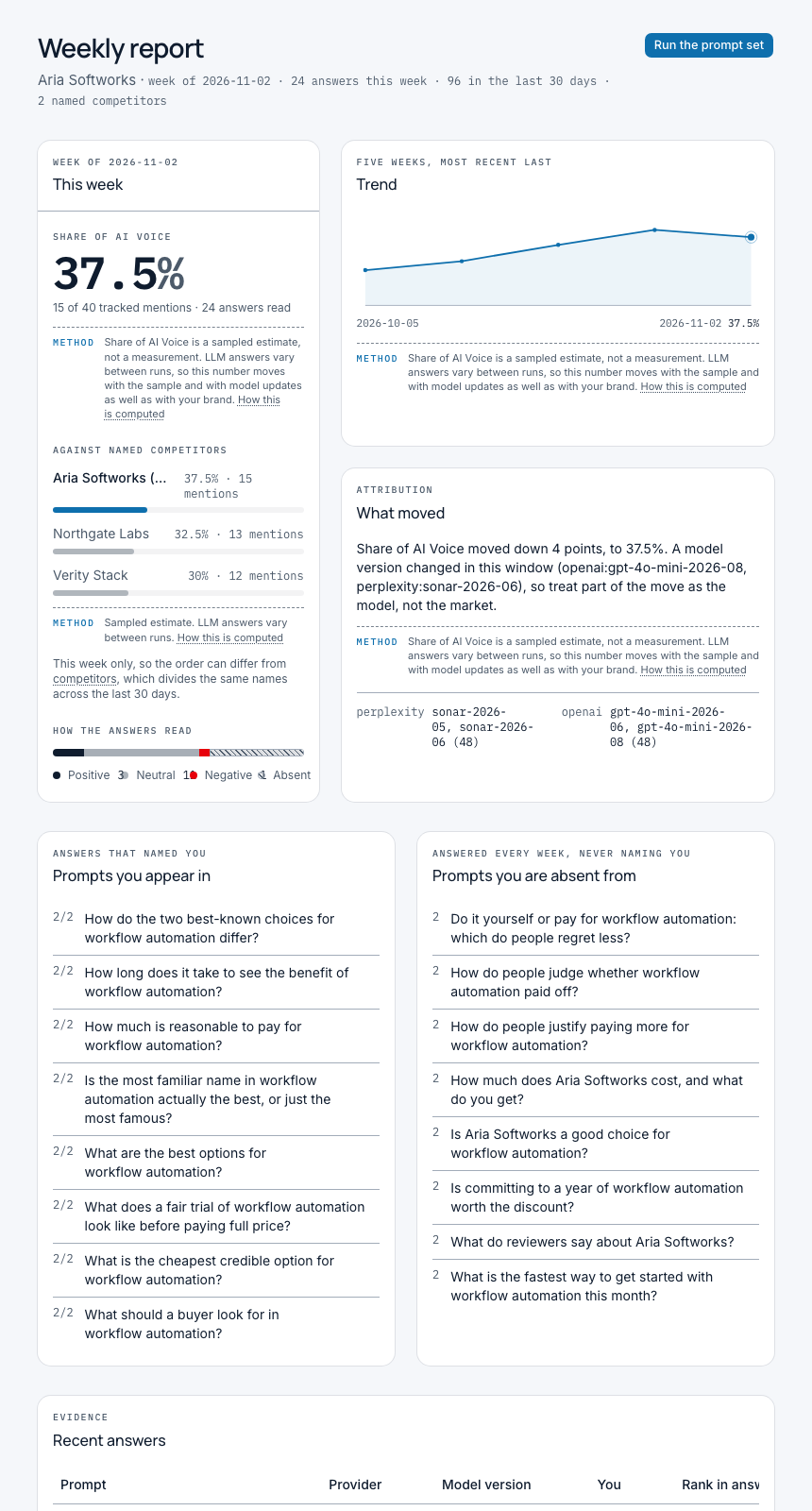
Counting mentions is not the same as reading them
You are probably here from one of two moments. Either a colleague forwarded an AI answer that described your brand in terms you would never have chosen, or you have a mention count in front of you and no way to tell whether those mentions helped.
A count flattens both cases. "Named in 14 of 60 answers" reads the same whether the model put you first as the obvious choice or named you last as the option buyers outgrow. It also says nothing about the answers where the model replied in full and never reached for your name.
In a generative answer, three questions are really one question. Was the brand there. How was it framed. Who came first. Seenby's response parser is built to record all three on every answer it stores, for your brand and for up to three competitors you name at setup.
One piece of housekeeping before the detail: Seenby is not open yet. Everything below describes what it is built to do, not a service running for customers today, and the whole page should be read in that tense.
How Seenby is built to read an answer
- Your prompt set is made to run against both providers
Between 50 and 100 prompts, frozen at setup, are built to go out each week to OpenAI and Perplexity. The provider layer sits behind an adapter interface designed to degrade gracefully, so if one provider is unavailable the week is meant to run against the other rather than fail outright.
- Each response is read for your brand and your named competitors
The parser is built to extract mentions of your brand and of the competitors you named from the same answer. The comparison is therefore like for like by design, rather than two separate searches run at two different moments.
- Every mention takes one of four labels
Positive, neutral, negative or absent. Absent is designed to be stored as a label rather than left as a blank row, which is what will let you see the prompts a model answered without naming you.
- Ranking position is recorded inside the response
Generative answers have an order, and the order carries weight. The parser is built to record where your brand appeared within each answer, so first-named and fourth-named do not collapse into the same data point.
- The dashboard is designed to turn the labels into a picture
A sentiment breakdown, 30-day trend lines for Share of AI Voice, the top prompts where your brand is and is not mentioned, and a competitor benchmarking view, all computed from the same parsed answers. Every score display is built to carry its methodology disclosure.
The four labels and what each one puts to you
| Label | What the parser is built to record | The question it raises |
|---|---|---|
| Positive | Your brand was mentioned and the language around it reads favourably | Which prompts produce this, and what do those answers have in common |
| Neutral | Your brand was mentioned with no clear favourable or unfavourable framing | Are you one name in a list, and is anyone in the same answer framed better |
| Negative | Your brand was mentioned and the language around it reads unfavourably | Is this one prompt, one provider, or a pattern worth a content response |
| Absent | The answer came back and your brand was not named in it | Which tracked competitor took the slot, and is this a question you expect to win |
What this is built to change for a brand manager
Absence becomes measurable
Because absent is designed as a classification rather than missing data, the dashboard can list the top prompts where your brand is not mentioned, a view that sits on the Growth plan and up. That list is meant to read as a work queue for the content team, not as a gap in the data.
Position is separated from presence
Ranking position is stored per response, so being recommended and being listed are not built to look alike. Two brands with the same mention count can sit in very different places in the answer.
Competitors are scored from the same answers
Up to three named competitors are parsed out of the responses your own brand is parsed from, so the benchmarking view is designed to rest on shared evidence rather than a separate run at a separate time.
Sentiment has a direction, not just a value
The dashboard is built to carry 30-day trend lines alongside the sentiment breakdown, so one uncomfortable week can be read against the weeks before it instead of reacted to alone.
The prompts stay attached to the number
Each figure is meant to trace back to the prompts that produced it. On the Growth plan that goes down to per-prompt evidence, answer by answer, which is what turns a board slide into a working list.
What sentiment tracking cannot promise
This is measurement built on non-deterministic systems, and we would rather say so plainly than sell around it.
Ask the same model the same question twice and the wording can change. A model update can move your sentiment mix in a week when nothing in your market moved. Two things are designed to handle that. The storage pipeline tags every stored answer with the model version it came from, and from the Growth plan up those model-version tags sit on the answers you read, so a shift can be weighed against a model update instead of assumed to be a competitive event. And the methodology caveat is built to travel with the score, in-product on every score display and on a dedicated methodology page.
Sentiment classification is a label applied to the language around a mention. Read it as a signal to investigate, not as a verdict on how a buyer felt. A run of negative labels on one prompt cluster is a question worth answering, not proof of anything.
Week-over-week movement in any AI visibility metric, ours included, may reflect model updates rather than real change in how your market sees you. Read the trend, not the reading. The editorial call stays with you, which is where we think it belongs.
Which plan carries which part of this
Starter
£79 / month
A brand manager or head of SEO at one mid-market company who just needs an answer to how ChatGPT and Perplexity describe them.
- Brands: 1
- Named competitors: Up to 3
- Prompts per week: 50
- AI providers: OpenAI and Perplexity
- Query cadence: Weekly
- Answer log history: 30 days
Growth
£149 / month
The same in-house buyer once the score is part of their reporting and they need the per-prompt evidence behind it for their CMO.
- Brands: 1
- Named competitors: Up to 3
- Prompts per week: 100
- AI providers: OpenAI and Perplexity
- API access: Not included
- White-label reports: Not included
Agency
£399 / month
An agency principal running SEO or brand for several client companies who needs a score per client in one account.
- Brands: Up to 5
- Named competitors: Up to 3 per brand
- Prompts per week: 100 per brand
- AI providers: OpenAI and Perplexity
- White-label reports: Not included
- API access: Not included
Where Seenby is today, and what sits behind it
Seenby is pre-launch and taking names on the waitlist. No part of this page describes a customer running today, and we will not dress intent up as track record.
When accounts open, sign-in will be by email and password. Answers are stored as the evidence behind the score, and emails, phone numbers, handles and personal names are redacted by a scrubbing step that runs before any answer becomes queryable, with a scrubbed flag on every stored response. The app and its Postgres database run on Amazon Web Services in a single region. The services Seenby uses are Stripe for card payments and subscription status, Anthropic to write your prompt set at setup, Amazon SES for the weekly digest and password reset email, and Sentry.
The product on this site is Seenby.
Questions
How will Seenby classify sentiment in an AI answer?
The response parser is built to extract each mention of your brand or a named competitor and assign one of four labels: positive, neutral, negative or absent. The label describes how the language around that mention reads, so treat it as a prompt to look closer rather than a measured opinion.
Which AI engines does it read?
OpenAI and Perplexity. Your prompt set is built to go to both each week, and the provider layer is designed to keep the week running on one if the other is unavailable rather than losing the week entirely.
What does the absent label mean?
It means the model answered the prompt and did not name your brand at all. Storing that as a label instead of a gap is what lets the dashboard list the top prompts where your brand is not mentioned, a view included from the Growth plan up.
Will it show where my brand ranks inside the answer?
Yes, that is the design. Ranking position within each response is recorded per answer, so being named first and being named last in the same list are different data points rather than the same mention.
The answers change every time I ask, so is any of this meaningful?
It is meaningful as a trend, not as a single reading. The same frozen prompt set runs every week, the dashboard shows 30-day trend lines, the storage pipeline tags each answer with its model version and surfaces those tags from the Growth plan up so a model update can be weighed against a market move, and the methodology caveat sits on every score.
Does sentiment feed the Share of AI Voice score?
They are separate readings taken from the same parsed answers. Share of AI Voice is a single headline metric per brand per week, with its methodology caveat attached to every computed record. The sentiment breakdown sits beside it and describes how the mentions read.
Which plan do I need for the sentiment breakdown?
The sentiment breakdown is included from Starter at £79 a month. Per-prompt evidence, the full scrubbed answer log, model-version tags on every answer and the top prompts where your brand is and is not mentioned start at Growth, £149 a month.