An AI visibility tracker built around one weekly score
Seenby is an AI visibility tracker: it runs a fixed prompt set against OpenAI and Perplexity every week and turns the answers into a single Share of AI Voice score per brand. Every place that score appears, the caveat explaining how it was computed appears with it, because a number this new is only useful when you can see how it was made.
Seenby is not open yet, so anything on this page about what it does is what it is being built to do.
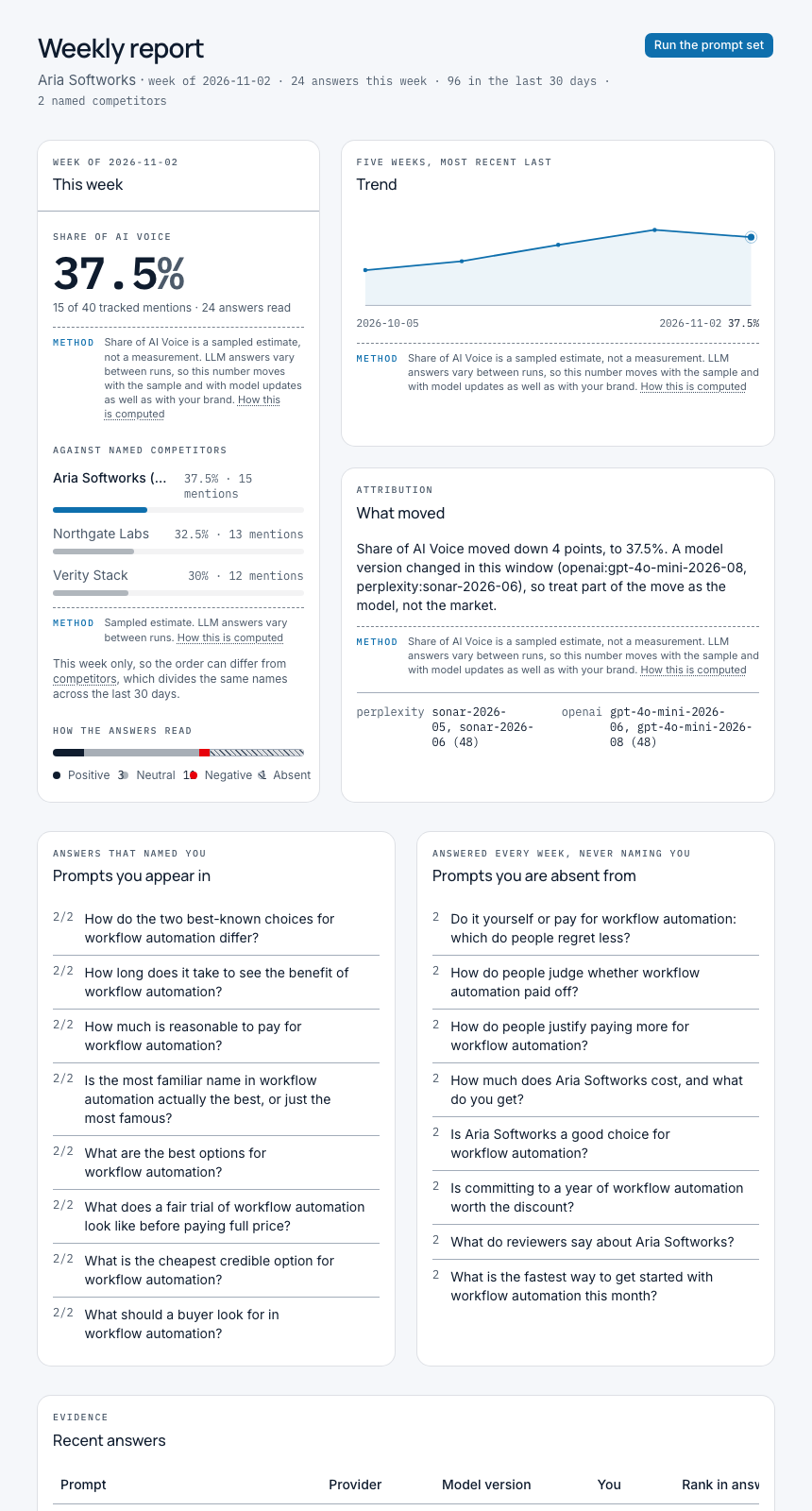
From anecdote to measurement
Checking an AI answer engine by hand tells you what one model said once. Ask the same question again and the wording moves, because generated answers are not deterministic, so a single check is an anecdote rather than a measurement.
Seenby closes that gap by asking the same frozen questions on a schedule, reading every answer the same way, and reducing the week to one number with the limits of that reading written next to it.
Two sibling pages cover the situations readers usually arrive from, and they argue those cases properly so this page does not have to: the brand manager's version, how ChatGPT describes your brand when a senior colleague asks, and the reporting version, putting AI search into the monthly report. This page is about the measurement itself, which means how the weekly score is made, what it does and does not prove, and what happens to the answers behind it.
How the weekly score gets made
- Setup freezes the questions
You give a brand name, a short description and up to three competitor names. From those, one model call generates 50 to 100 prompt templates, with a curated fallback set used if generation fails or returns too few. The set is frozen, so the same questions run every week and the trend measures the market rather than your changing curiosity.
- The week's answers come back from both providers
The scheduled query engine runs the prompt set against OpenAI and Perplexity, the two providers included in the plan, behind a provider adapter interface. If one provider is disabled, the run degrades gracefully to the other rather than failing the week.
- Every answer is scrubbed before it is readable
A PII-scrubbing step runs in the storage pipeline before any response becomes queryable, and every stored response carries a pii_scrubbed flag. Emails, phone numbers, handles and personal names are redacted first, then the answer becomes evidence.
- Each answer is tagged with the model version that produced it
Model-version tagging is recorded on every stored response. That tag is what lets you separate a real movement in your market from a movement that followed a provider's model update.
- The parser extracts every mention
Each response is read for your brand name and for the names of the competitors you listed. The parser records which brands were named in that answer and which were not, one answer at a time.
- Each mention gets a sentiment label and a position
Mentions are classified as positive, neutral, negative or absent, and the parser records where your brand falls within the response. Absent is a real value, not a blank, and being named eighth in a list of ten is a different result from being named first.
- One Share of AI Voice score is computed for the week
The mentions from the week's answers become a single headline metric per brand per week. One number, one cadence, so week two is comparable to week one and week twelve, and the dashboard carries a 30-day trend line built from them.
- The methodology caveat is stored with the number
Every computed record is stored with its methodology caveat text attached. The disclosure is surfaced in the product on every score display, and the full version lives on a dedicated methodology page you can read before you decide whether to trust the figure.
What is recorded on every answer
| Recorded | Values | What it tells you |
|---|---|---|
| Brand mention | Named or not named in this response | Whether the model reaches for you at all on this prompt |
| Competitor mention | Named or not named, for each competitor you listed | Who occupies the space you are missing from |
| Sentiment | Positive, neutral, negative, absent | Whether presence is helping you or quietly working against you |
| Ranking position | Position of the mention within that response | The difference between the first recommendation and the footnote |
| Model version | The provider model that returned this answer | Whether a weekly shift is drift in the model or movement in the market |
| Scrubbing state | A pii_scrubbed flag on every stored response | That personal details were redacted before the answer was queryable |
| Share of AI Voice | One score per brand per week | The comparable unit, with its caveat attached to the record |
What the weekly score is good for
A unit you can report without overstating it
One score per brand per week gives a reporting line that survives the question every executive asks next, which is how the number was produced. The methodology travels with the score, so the caveat is in the room when the number is.
A score that decomposes into evidence
The headline figure is built from the mentions, sentiments and ranking positions extracted from individual answers, and the full answer log is kept alongside it, scrubbed and tagged with its model version. You can go from the number back to the answers that moved it.
Absence counted as a result, not a gap in the data
Answers where your brand is never named are classified as absent and counted. The dashboard shows the top prompts where you are and are not mentioned, so the silences sit next to the mentions. Which of those silences is worth acting on is your editorial call, not the score's.
A named set to be measured against
You list up to three competitors at setup, and their mentions are extracted from the same answers as yours, in the same week, from the same prompts and the same two providers.
A cadence that matches how the surface changes
One reading a week is slow enough to be stable and frequent enough to catch a shift while you can still respond to it, and the 30-day trend line puts each reading next to the three before it. Daily checks on a non-deterministic surface mostly measure noise.
What a Share of AI Voice score does not prove
We would rather you buy this with clear eyes, so here is the honest boundary.
- It is a sample, not a census. The score is computed from your frozen prompt set on two providers, OpenAI and Perplexity. It is a reading of that sample, not of every conversation anyone has ever had about your category.
- The underlying answers are non-deterministic. The same prompt can produce different text on different days. One reading a week and a fixed prompt set reduce that variance. They do not eliminate it.
- Providers change underneath the measurement. When a model is updated, phrasing and recommendations can change without anything changing in your market. Treat a single week's movement as a question to investigate, not a conclusion to present.
- It is not a ranking guarantee. No tool can promise a position in a generated answer, and nothing here should be read as one. The score tells you where you stand in the sample. The editorial call about what to do next stays with you.
Everything above is written out in full on the methodology page, in the same words the product shows next to the number.
What happens to the answers behind the score
The score is only as trustworthy as the handling of the text it came from, so here is what is kept and where.
Stored: your name, email address and a hashed password, plus a session cookie. The brand name and description you enter, up to three competitor names, and the 50 to 100 prompts frozen at setup. Every answer the providers return, tagged with its model version, plus the mentions extracted from it and the weekly score. Your Stripe customer id and subscription status, since card details go to Stripe and never reach our servers. Structured operational logs of event names, record ids and timings, with no answer text written to them.
Answers and scores are kept for as long as the account exists, because the week-over-week trend is the product. A shared provider-answer cache holds scrubbed answer text with no account or brand attached and expires within a day. You can delete the account yourself from brand settings: the brand, its prompt set, every stored answer, the extractions, the scores and the digest history go at once, and a live subscription is cancelled first. The app and its Postgres database run on Amazon Web Services, in a single region.
What is not in place
- No independent security audit or certification, so no SOC 2 and no ISO 27001.
- No single sign-on. Sign-in is email and password.
- No signed data processing agreement on request.
- No self-serve export of your stored answers and scores.
- No choice of hosting region.
If any of those is a procurement requirement, it is better to know now than after a trial.
What tracking one brand costs
Starter
£79 / month
A brand manager or head of SEO at one mid-market company who just needs an answer to how ChatGPT and Perplexity describe them.
- Brands: 1
- Named competitors: Up to 3
- Prompts per week: 50
- AI providers: OpenAI and Perplexity
- Query cadence: Weekly
- Answer log history: 30 days
Growth
£149 / month
The same in-house buyer once the score is part of their reporting and they need the per-prompt evidence behind it for their CMO.
- Brands: 1
- Named competitors: Up to 3
- Prompts per week: 100
- AI providers: OpenAI and Perplexity
- API access: Not included
- White-label reports: Not included
Agency
£399 / month
An agency principal running SEO or brand for several client companies who needs a score per client in one account.
- Brands: Up to 5
- Named competitors: Up to 3 per brand
- Prompts per week: 100 per brand
- AI providers: OpenAI and Perplexity
- White-label reports: Not included
- API access: Not included
Where Seenby is today
Seenby is not open yet. There is a waitlist, and joining it is the whole commitment: a note when tracking opens, and nothing else in between. No customer results, because there are none to show.
When it does open, accounts sign in with email and password, the product runs on Amazon Web Services, payment is handled by Stripe, and Anthropic generates your prompt set once at setup. Setup itself is a brand name, a short description and up to three competitor names, which is enough for the first prompt set.
If you want to read the measurement before you trust it, that is the right instinct, and it is the one this page was written for.
Questions
What is an AI visibility tracker?
It is software that asks AI answer engines the questions your buyers ask, reads the answers, and reports how often and how favourably your brand appears. Seenby does that on a weekly cadence and reduces each week to a single Share of AI Voice score per brand.
How is Share of AI Voice calculated?
The parser extracts brand and competitor mentions from each stored answer, labels sentiment as positive, neutral, negative or absent, and records ranking position within the response. Those mentions become one headline metric per brand per week. The full method is disclosed on a dedicated methodology page and next to every score in the product.
Which AI engines does Seenby read?
OpenAI and Perplexity. Those are the two AI providers included in the Weekly tracking plan, and they sit behind an adapter interface that degrades gracefully to the remaining provider if one is disabled.
Why does the score move from one week to the next?
Sometimes because your position genuinely changed, and sometimes because the model did. Generated answers are non-deterministic and model updates can shift phrasing and recommendations on their own. Every stored answer is tagged with its model version, and the caveat is stored with every computed record, so it is visible wherever the number is.
Is there a free AI visibility checker?
No free tier is offered.
Do you store the AI answers about my brand?
Yes, because the answers are the evidence behind the score. A PII-scrubbing step runs before any response becomes queryable, with a scrubbed flag on every stored response, so emails, phone numbers, handles and personal names are redacted first. Answers and scores are kept while the account exists and are deleted with it.
Can I see the answers behind the score?
The plan includes the full answer log, scrubbed and tagged with its model version, alongside sentiment and per-prompt evidence and a view of the top prompts where your brand is and is not mentioned, so the headline number can be traced back to the responses it was computed from.
How do I get access?
Join the waitlist. Seenby has not opened to customers yet, so there are no results to show you and we will not pretend otherwise. You will get a note when tracking opens.