For brand managers: how does ChatGPT describe your brand
Someone asked ChatGPT about your category, and your brand was either absent or described in words nobody on your team wrote. Seenby asks the same 50 to 100 questions of ChatGPT and Perplexity every week, then gives you one Share of AI Voice score with its caveat attached.
Seenby is not open yet, so anything on this page about what it does is what it is being built to do.
The hallway question you cannot answer yet
The question arrives from outside your team. Someone senior asked ChatGPT about your category. Your brand was not in the answer, or it was, described in a way nobody in your team wrote. By Monday the question is yours: how does ChatGPT describe us?
Checking by hand does not survive a follow-up question
One screenshot is one sample. You open ChatGPT, type the question a buyer would type, read the paragraph, capture it. An hour later the wording has moved, the competitor that was second is first, and Perplexity returns a different shape of answer again. Two feelings define this job right now:
- Our competitor gets recommended and we do not. You can see it happening and you cannot size it.
- The results change every time I ask. Which makes every capture you have collected unusable as evidence.
What you need is a line that holds
A trend, a likely cause, and the evidence underneath. One figure for the monthly report. A way to tell a real shift from a model update. The specific prompts where a competitor is named instead of you. That is a measurement problem rather than a browsing problem, and Seenby is built to be the measurement, including the parts it cannot prove.
How Seenby is built to answer the question
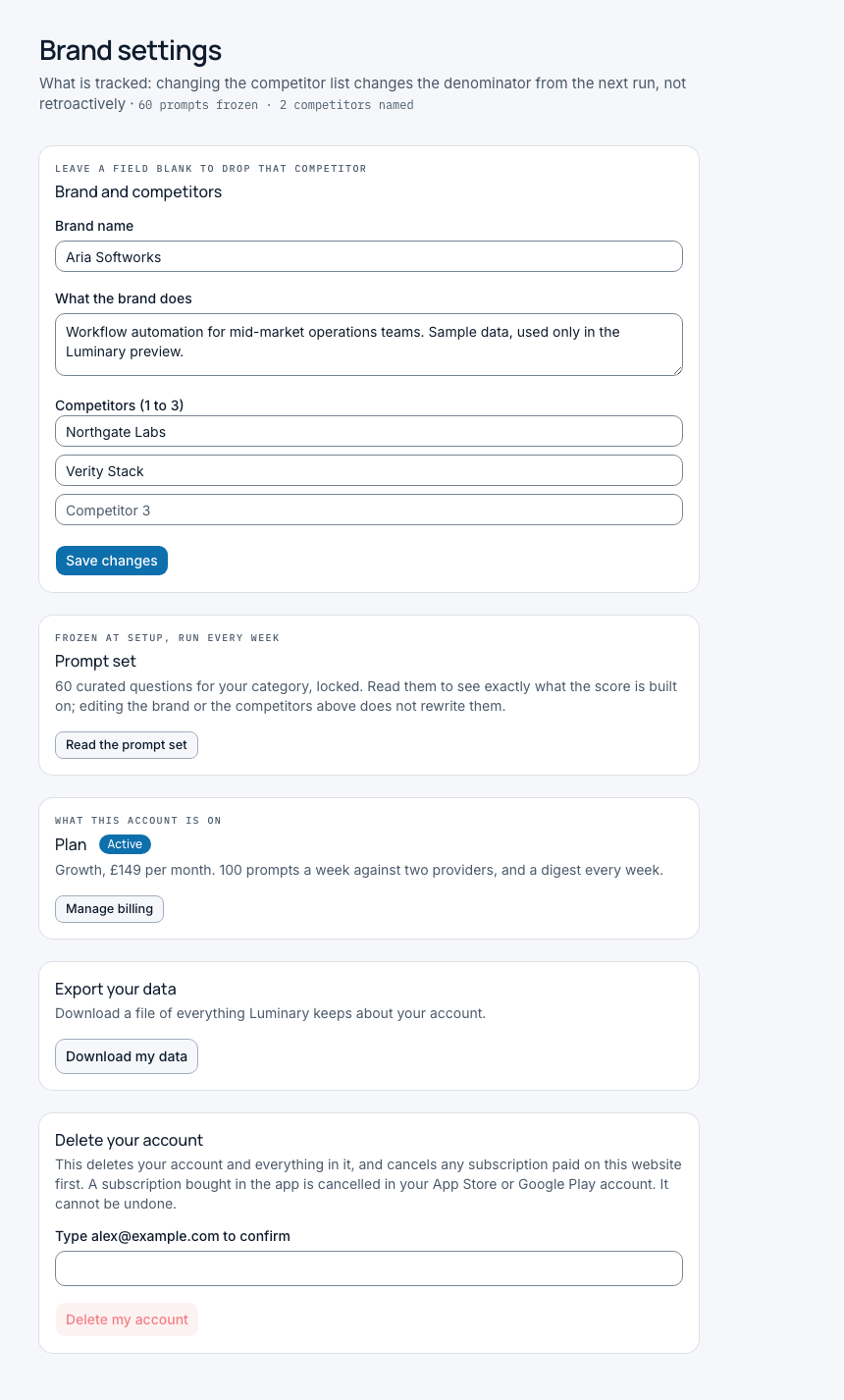
- Describe the brand and name up to three competitors
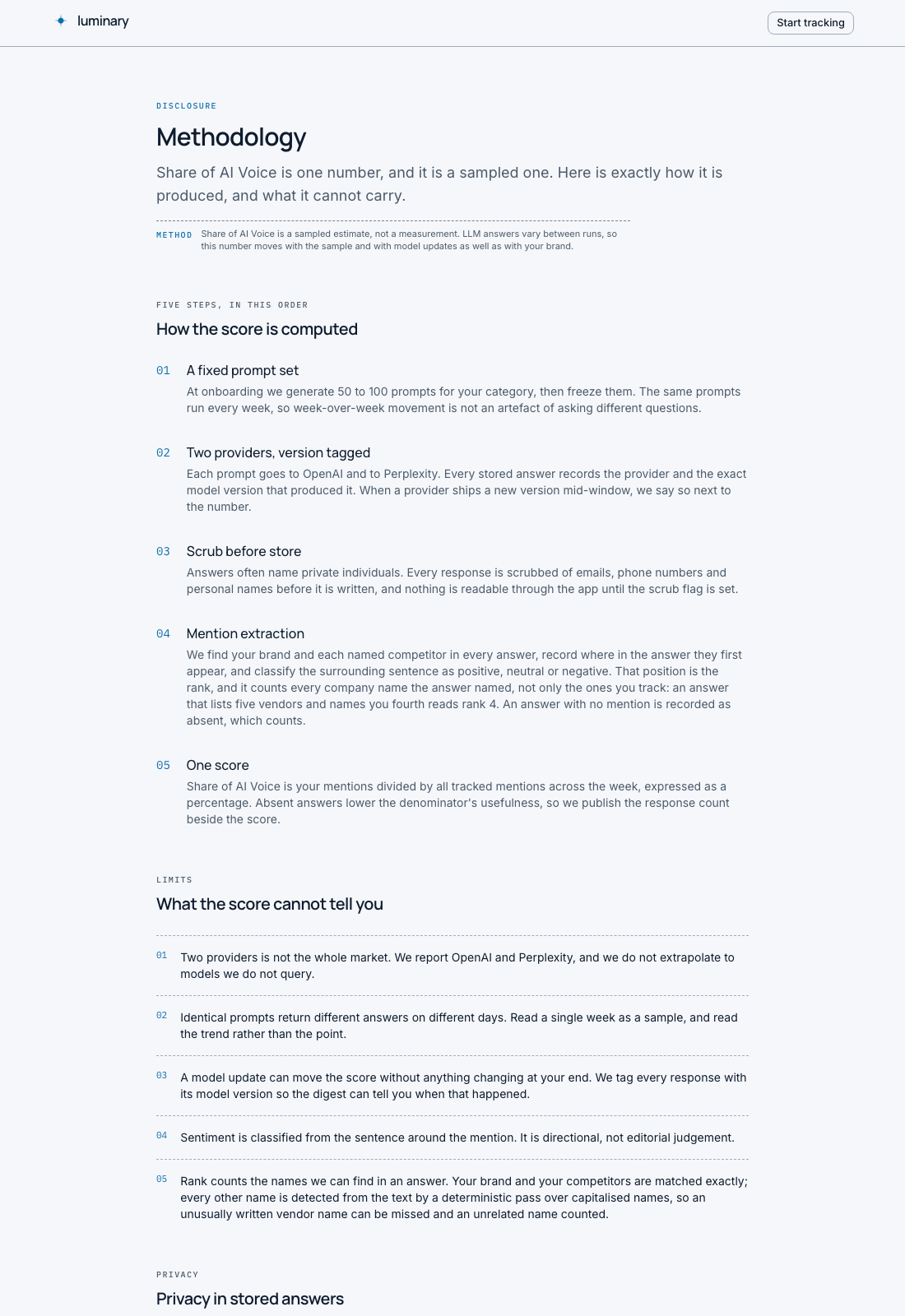
You enter your brand name, a short description of what you do, and up to three competitor names. From that, a prompt set of 50 to 100 questions is generated at setup, with a curated fallback set if generation fails or returns too few. Those prompts are then frozen.
- The same prompt set runs every week
The frozen set is queried against two providers, OpenAI and Perplexity, behind an adapter layer that degrades gracefully to the remaining provider if one is disabled. The questions do not change week to week, so the trend measures the market rather than your changing curiosity.
- Each answer is parsed for how you were described
The parser extracts mentions of your brand and of each named competitor, classifies sentiment as positive, neutral, negative or absent, and records your ranking position within the response. That is the machine-readable version of "how did it describe us".
- Every stored answer is scrubbed and tagged
A scrubbing step runs in the response-storage pipeline before any answer becomes queryable, redacting emails, phone numbers, handles and personal names, with a flag on every stored response. Each response also carries the model version that produced it.
- One score per brand per week
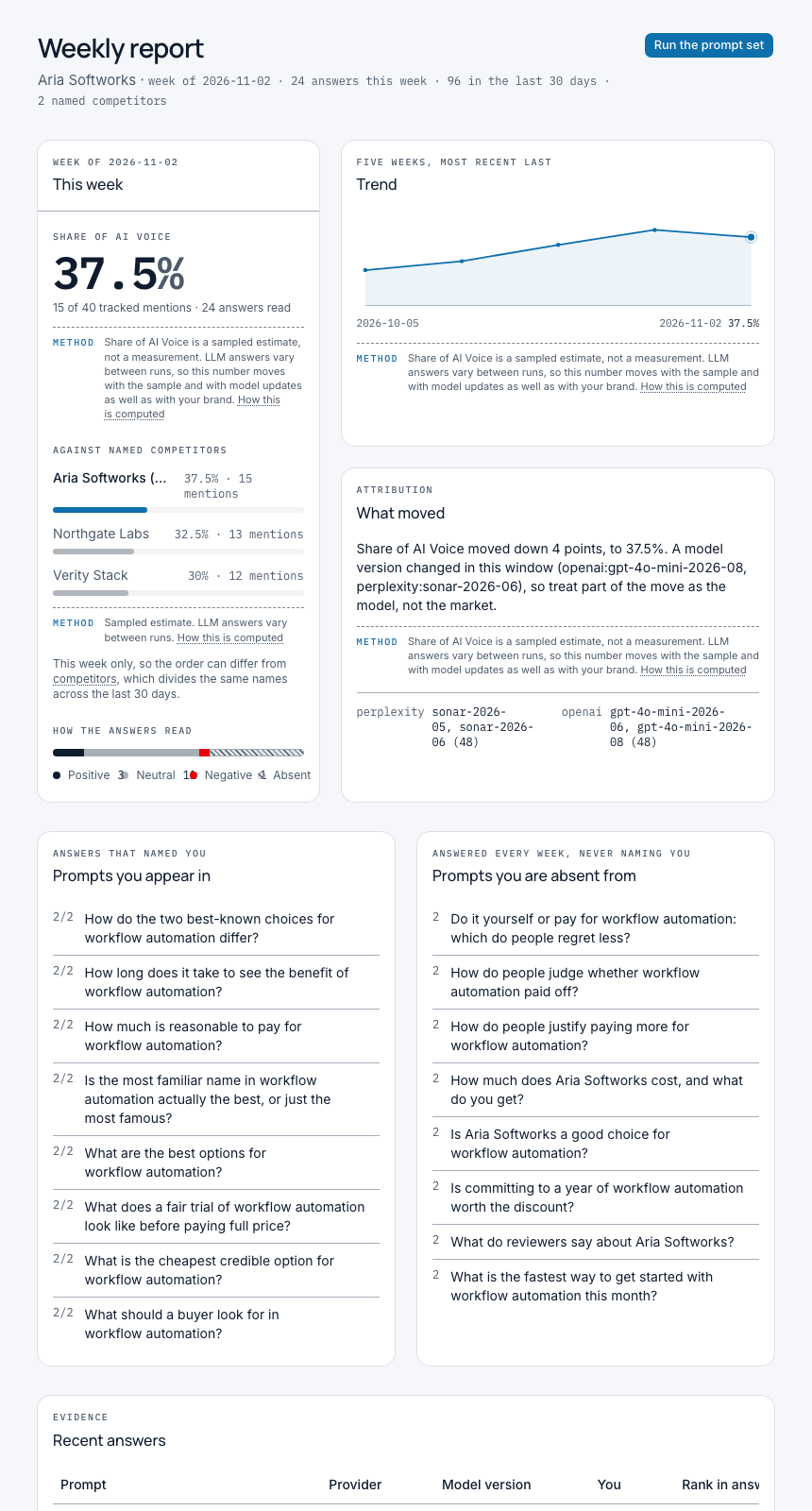
Share of AI Voice is computed as a single headline number for the week, stored with its methodology caveat text attached to every computed record. The dashboard shows it as a 30-day trend line with the sentiment breakdown and a competitor benchmarking view beside it.
- A weekly digest lands in your inbox
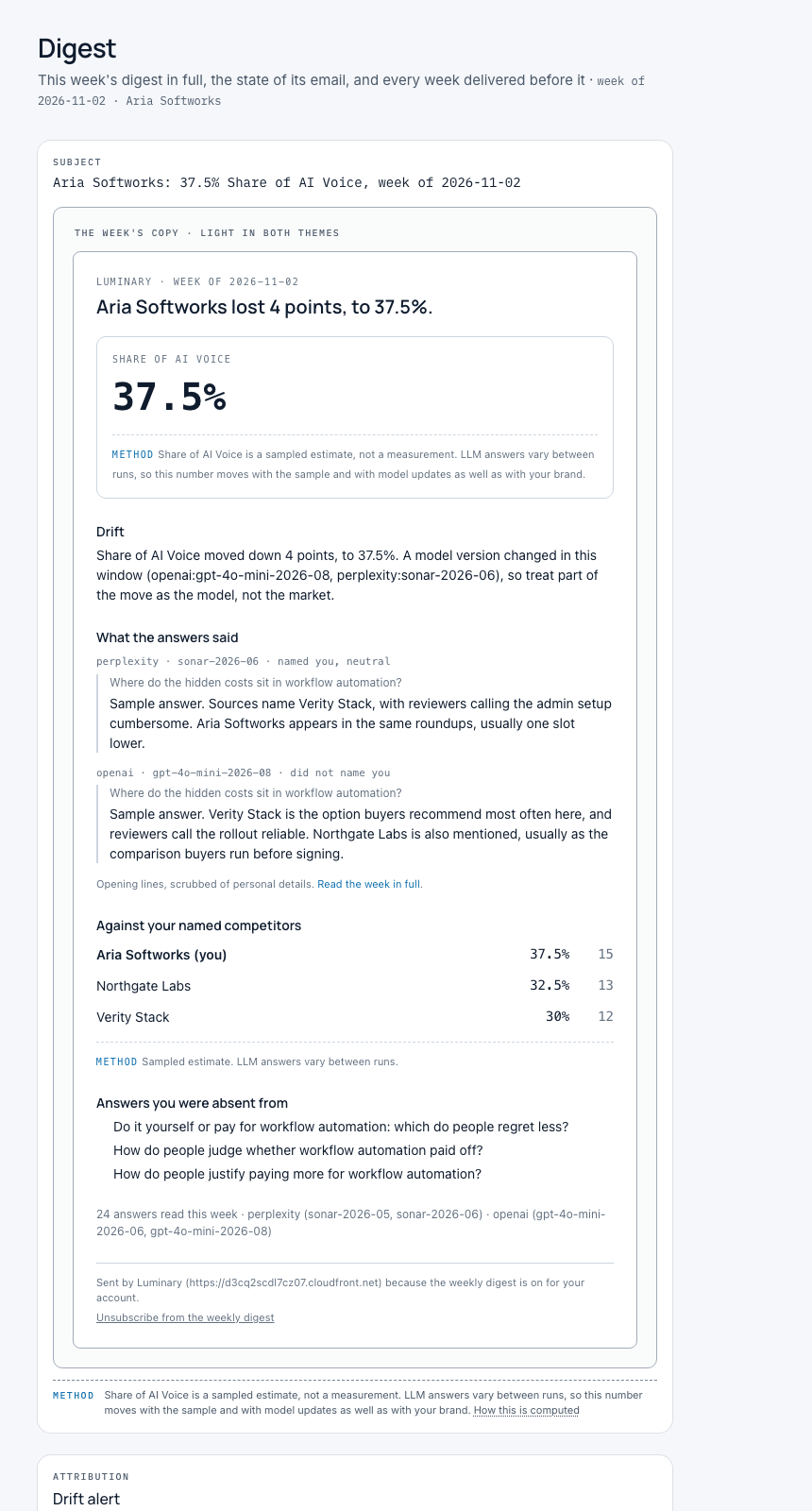
The digest is built to carry the top insights for the week, drift alerts tied to model-version changes when applicable, and the same methodology caveat. It is made to be the thing you forward, not another dashboard you have to remember to open.
- You make the editorial call
Seenby states what the answers contained and where the uncertainty sits. Whether a drop is worth a content brief, a PR push or nothing at all stays your decision, with the per-prompt evidence in front of you.
The score, the trend, and the prompts that never name you
The dashboard holds 30-day trend lines for Share of AI Voice, the sentiment breakdown, the top prompts where your brand is and is not mentioned, and a competitor benchmarking view. It is built so absence is as easy to find on the screen as a win.
What that gives a brand manager specifically
A number for the monthly report
One Share of AI Voice figure per week, benchmarked against the competitors you named, with the caveat travelling beside it. Reporting AI search stops being a paragraph of anecdote and becomes a line with a trend behind it.
Your absent prompts, named
Sentiment is classified as absent when you are not mentioned at all, so the gaps are recorded, not rounded away. Absence in a buying question can matter more than a small shift in tone, and you judge that with the prompt in front of you.
Compared, prompt by prompt
The same frozen prompt set is read for you and for up to three named competitors, so the comparison is answer by answer rather than vendor claim against vendor claim.
Drift you can explain
Every response is tagged with its model version, which is what lets real drift be told apart from model-update drift, and the digest raises drift alerts tied to model-version changes when they apply. When the number moves, you have the first sentence of the explanation ready.
A caveat already written
The methodology disclosure is surfaced on every score display and on a dedicated methodology page. You can hand the score to a data-literate colleague without defending the method from memory.
A published price
The weekly reading, parsing and scoring is the whole job: one brand, two providers, a fixed prompt set. The price sits on the site in pounds rather than behind a quote or an agency retainer.
What each signal proves, and what it does not
| Signal | What Seenby records | What it cannot tell you |
|---|---|---|
| Mention | Whether your brand and each named competitor appear in the answer to a given prompt | Whether any real buyer asked that prompt this week |
| Sentiment | A classification of positive, neutral, negative or absent for the mention | Intent or nuance beyond that four-way call, so read the evidence for anything contentious |
| Rank position | Where you sat in the order of the response | Why the model ordered it that way, since the providers do not explain their ranking |
| Share of AI Voice | A single weekly score per brand, stored with its methodology caveat | Whether a week-over-week move is competitive change or a model update, which is why drift is flagged separately |
What we will not claim
Models change without your market changing
Large language models are non-deterministic. Ask the same question twice and the wording, the ordering and sometimes the brands named will differ. Providers also update models, and an update can move a score while nothing changed in your market or your competitors'. That is why the methodology caveat is stored with every computed score, repeated in every digest, and why drift alerts are tied to model-version changes when they apply.
A score is evidence, not proof
Seenby measures how a fixed set of prompts was answered, by two providers, in a given week. It does not measure how every person asked, and it cannot promise how a model will answer next week. No tool can, and nobody can guarantee placement in an AI answer, ours included.
Coverage is two providers
OpenAI and Perplexity, named rather than implied. The query engine sits behind a provider adapter interface, so if one provider is disabled or withdraws access it is built to keep running on the remaining one rather than losing the week. We would rather you trusted a narrow number than doubted a wide one.
The caveat travels with the number
The methodology disclosure is surfaced in-product on every score display and on a dedicated static methodology page. The limits of the measurement arrive with the measurement, in the same place the score is read.
The three plans, in pounds
Starter
£79 / month
A brand manager or head of SEO at one mid-market company who just needs an answer to how ChatGPT and Perplexity describe them.
- Brands: 1
- Named competitors: Up to 3
- Prompts per week: 50
- AI providers: OpenAI and Perplexity
- Query cadence: Weekly
- Answer log history: 30 days
Growth
£149 / month
The same in-house buyer once the score is part of their reporting and they need the per-prompt evidence behind it for their CMO.
- Brands: 1
- Named competitors: Up to 3
- Prompts per week: 100
- AI providers: OpenAI and Perplexity
- API access: Not included
- White-label reports: Not included
Agency
£399 / month
An agency principal running SEO or brand for several client companies who needs a score per client in one account.
- Brands: Up to 5
- Named competitors: Up to 3 per brand
- Prompts per week: 100 per brand
- AI providers: OpenAI and Perplexity
- White-label reports: Not included
- API access: Not included
Three plans, three published prices
Starter is £79 a month, Growth £149 and Agency £399, all in pounds sterling. Each plan states its own prompts-per-week limit and what it includes, so the cost is readable before anyone asks you for a card.
What every plan shares, and what is not in place
Every plan reads the same two providers, OpenAI and Perplexity, on a weekly cadence, and tracks up to three named competitors. API access and white-label reports are not included on any plan. The agency motion, five client brands in one account, has its own page in this section, as does AI search reporting for an in-house SEO team.
Not in place yet
No independent security audit or certification, so no SOC 2 and no ISO 27001. No single sign-on: people sign in with email and password. No signed data processing agreement on request, and no choice of hosting region: the app and its Postgres database run in a single AWS region on Amazon Web Services.
What you can do with your own data
From Settings in the product a signed-in customer can download a copy of their data and delete their account. Under UK GDPR, a request for a copy of a person's data or for its erasure is answered within one month, which is the law's rule rather than a promise of our own. Seenby reads email at hello@kaleidoapps.com, including for a security problem or a request about a person's data, and the site's privacy policy names the company that sells Seenby.
Questions
Can I just ask ChatGPT how it describes my brand?
You can, and it is worth doing once. The limit is that the answer is one sample. Wording, ordering and the brands named vary between asks, so a single capture cannot show a trend or survive a follow-up question in a report. Seenby is built to ask a frozen set of 50 to 100 prompts every week and store what came back, which is what makes comparison possible.
Which AI engines does Seenby read?
Two: OpenAI and Perplexity. They sit behind a provider adapter interface that degrades gracefully if one is disabled, so a withdrawal of access reduces coverage rather than stopping the week. We name the two rather than implying we cover every model.
How is Share of AI Voice calculated?
It is a single headline metric per brand per week, computed from the mentions the parser extracts across your frozen prompt set and benchmarked against the competitors you named. Every computed record is stored with its methodology caveat text attached, and the disclosure appears on every score display in the product and on a dedicated methodology page.
What if the score moves because the model changed, not because we did?
That is the main failure mode in this category, so it is handled explicitly. Every stored response is tagged with the model version that produced it, which lets real drift be distinguished from model-update drift, and the weekly digest raises drift alerts tied to model-version changes when they apply.
Do I get the sentiment, or just whether we were mentioned?
Both. The parser extracts brand and competitor mentions, classifies sentiment as positive, neutral, negative or absent, and records your ranking position within each response. Absent is a first-class result, because the prompts where nothing named you are often the ones worth reading first.
Do the stored AI answers contain personal data?
Answers about brands sometimes name real people. A scrubbing step runs in the response-storage pipeline before any answer becomes queryable, redacting emails, phone numbers, handles and personal names, and every stored response carries a flag recording that it ran. Answer text is not written to operational logs.
What does it cost, and can I start now?
Starter is £79 a month, Growth £149 and Agency £399, all in pounds. Seenby is at waitlist stage today, so nothing is running for customers yet: join the waitlist and we will tell you when weekly tracking opens.
Can I track more than one brand or more than three competitors?
More brands, yes: Agency covers up to five brands in one account, each with its own frozen prompt set. More competitors, no: every plan tracks up to three named competitors per brand. We would rather publish the limit than let you discover it after signing up.