AI visibility tool for agencies: up to five client brands
Seenby scores Share of AI Voice for each client brand you run, every week, across OpenAI and Perplexity, benchmarked against up to three competitors you name per brand. The Agency plan holds up to five of those brands in one account at £399 a month, and Seenby is not open yet, so this page ends at a waitlist rather than a login.
Seenby is not open yet, so anything on this page about what it does is what it is being built to do.
The Monday email, and the job underneath it
A client's CMO typed the company name into ChatGPT at the weekend. The answer named three other vendors and not them. On Monday the question lands with you, worded roughly the way it always is: how does ChatGPT describe us, and why do they get recommended and we do not.
You already know the next two hours. Someone on the team opens ChatGPT, asks the question five ways, screenshots what comes back and pastes it into a slide. The client notices that the wording changed between two of the screenshots and asks why. Nobody has a clean answer. Next month the same question arrives, and there is nothing to compare against, because last month was screenshots too. Multiply that by the number of brands on your roster and it is not a reporting line, it is a recurring fire.
What the brief actually is
The brief is not "check ChatGPT". It is a reading you can put in a retainer review, defend when it moves, and produce again at the same hour next month, for every client, without a person sitting there typing prompts. That needs three things in place before the first run: the same questions asked every week, the answers kept so you can go back to the evidence, and a competitor set the client agreed to in writing.
Seenby is designed around those three things, one brand at a time. The Agency plan carries up to five brands in a single account. Each brand gets its own frozen prompt set, its own named competitors, its own benchmarking view and its own weekly digest, so a client's numbers never sit in the same denominator as another client's.
If the person doing this work is in house rather than at an agency, the sibling pages for SEO teams and for brand managers cover the same engine from those seats.
How an agency runs a roster on Seenby
- Set each client up as its own brand
You enter the client's brand name, a short description and up to three competitor names. Seenby generates 50 to 100 prompt templates from that in one LLM call, with a curated fallback template set if generation fails or returns too few prompts. Repeat per client, up to five brands on the Agency plan.
- Agree the competitor names before the first run
Share of AI Voice is the brand's share of mentions across the brand and the competitors you named, so that list is the denominator of every number you will later present. Three names per brand, chosen with the client, not chosen by you at 11pm. Change them and the history changes meaning.
- Freeze the prompt set
The same prompts run every week, deliberately. If the questions drift, the trend measures your prompt writing rather than the market, and the client will spot it the first time a number jumps with no explanation attached. Starter runs 50 prompts a week; Growth and Agency run up to 100 per brand.
- Let the week run across both answer providers
The scheduled query engine reads OpenAI and Perplexity behind a provider adapter that degrades gracefully if one provider is disabled, so a provider outage costs you coverage rather than the whole week. Every stored response is tagged with the model version that produced it.
- Read the dashboard before the client call
Per brand: a 30-day trend line for Share of AI Voice, a sentiment breakdown across positive, neutral, negative and absent, the top prompts where the brand is named and the top prompts where it is not, and the competitor benchmarking view. On Growth and Agency, the per-prompt evidence sits behind each of those.
- Forward the week's digest
The weekly automated email digest carries the top insights, drift alerts tied to model-version changes when they apply, and the methodology caveat. The Agency plan produces one digest per brand, addressed to the account, so you can read it first and forward the client's own week to the client.
- Say the caveat out loud, not in a footnote
The methodology disclosure is surfaced on every score display in the product and on a dedicated methodology page, and the caveat text is stored with every computed score. Read it on the call. Explaining the limits of the measurement before a client finds them is cheaper than explaining them afterwards.
When the client asks why the number moved
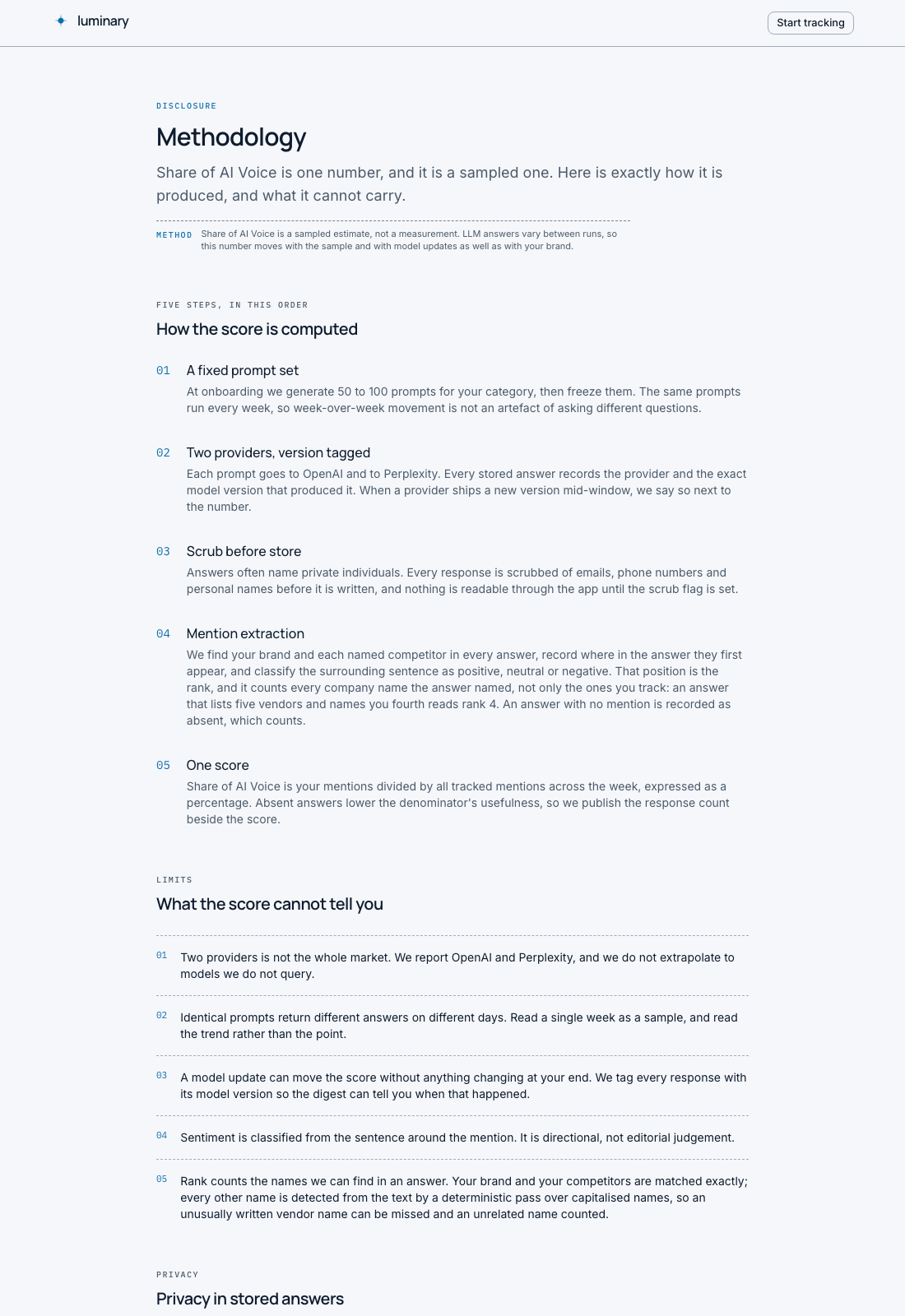
Every agency in this category meets the same objection, usually from the most technical person in the room: the results change every time you ask. It is a fair objection. Large language models are not deterministic, and providers update models without telling you first. A week-over-week move in Share of AI Voice may reflect a model update rather than any real change in how the market describes your client.
Seenby handles that in four ways, and none of them is a guarantee.
- The prompt set is frozen at setup, so the questions are held constant while the answers vary.
- Every stored response is tagged with its model version, so an underlying model change is visible in the record instead of hidden inside the score.
- The weekly digest raises drift alerts tied to model-version changes when they apply, so you can tell a client that the model changed this week rather than wearing a dip you did not cause.
- The methodology caveat is attached to every computed score and shown wherever a score is shown, in the product and in the digest.
What Seenby cannot do is promise that any single answer repeats. No tool in this category can. Treat the score as a weekly reading produced by a stated method, not as a rank, and write it that way in the deck. The sibling guide on reporting AI search performance to executives goes further into the wording that survives a sceptical CMO.
What the Agency plan covers, and what it does not
| What an agency asks | What the plan states |
|---|---|
| Several client brands in one account | Up to five brands under one login, each with its own frozen prompt set, competitors, benchmarking view and weekly digest. |
| Named competitors per client | Up to three per brand. They form the denominator of that brand's Share of AI Voice. |
| Prompt volume | Up to 100 prompts per brand per week, run on a weekly cadence. |
| Answer providers | OpenAI and Perplexity. Anthropic writes the prompt set at setup and does not answer the prompts. |
| White-label reports | Not included. |
| API access | Not included. |
| Client logins and single sign-on | Sign-in is email and password. There is no SAML or OIDC single sign-on. |
| Getting the data out | Brand settings exports a JSON file of everything stored, and deletes the account and its data in one transaction. |
| Security paperwork for client procurement | No independent audit or certification, no SOC 2 and no ISO 27001. No signed data processing agreement on request, and no choice of hosting region. |
Why this shape suits a retainer
Five clients, one login, five separate scores
One account holds up to five brands, and each one is scored against its own competitor set. You switch client without switching tool, and no client's mentions leak into another client's denominator.
A prompt set written per client
Each brand gets its own 50 to 100 prompt templates generated from that brand's name, description and competitors, then frozen. A consumer brand and a B2B client are not measured through the same questions.
The competitor slide the client actually asks for
Benchmarking against the names the client agreed to, drawn from the same prompt set in the same week. It answers "why do they get recommended and we do not" with stored answers behind it rather than one anecdote from a laptop.
The absent prompts are next month's scope
The dashboard separates prompts where the brand was named from prompts where it was not. On an evidence basis, that second list is the shortest route to a content and PR recommendation the client will sign.
Evidence under each number
On Growth and Agency, per-prompt evidence answer by answer, the full scrubbed answer log kept while the account exists, and a model-version tag on every stored answer. When a client challenges a figure, you can show where it came from.
A caveat you do not have to draft each month
The methodology disclosure travels with every score in the product and in the digest, which keeps your reporting honest about non-determinism without you writing a new disclaimer for every client deck.
The plans, and the agency arithmetic
Starter
£79 / month
A brand manager or head of SEO at one mid-market company who just needs an answer to how ChatGPT and Perplexity describe them.
- Brands: 1
- Named competitors: Up to 3
- Prompts per week: 50
- AI providers: OpenAI and Perplexity
- Query cadence: Weekly
- Answer log history: 30 days
Growth
£149 / month
The same in-house buyer once the score is part of their reporting and they need the per-prompt evidence behind it for their CMO.
- Brands: 1
- Named competitors: Up to 3
- Prompts per week: 100
- AI providers: OpenAI and Perplexity
- API access: Not included
- White-label reports: Not included
Agency
£399 / month
An agency principal running SEO or brand for several client companies who needs a score per client in one account.
- Brands: Up to 5
- Named competitors: Up to 3 per brand
- Prompts per week: 100 per brand
- AI providers: OpenAI and Perplexity
- White-label reports: Not included
- API access: Not included
The answers your client's procurement will ask about
Agencies get asked these questions by someone else's legal team, so here is what is in place and what is not.
What is stored
Your name, email address, a hashed password and a session cookie, to sign you in and address the digest. Each brand name and description, up to three competitor names, and the 50 to 100 prompts frozen from them at setup. Every answer the providers return, tagged with its model version, plus the mentions extracted from it and the weekly score. Your Stripe customer id and subscription status, with card details going to Stripe and never reaching our servers. Structured operational logs of event names, record ids and timings, with no answer text written to logs. First-party usage records of when the app was last used and which core actions the account completed, kept for 16 weeks in our own database, with no third-party analytics service involved.
Personal names in answers
LLM answers occasionally name real people. A PII-scrubbing step runs in the response-storage pipeline before any response is queryable, and every stored response carries a flag recording that it ran. Emails, phone numbers, handles and personal names are redacted before an answer is stored.
Retention, hosting and subprocessors
Answers and scores stay for as long as the account exists, because the week-over-week trend is the product. A shared provider-answer cache holds scrubbed answer text with no account or brand attached and expires within a day. The app and its Postgres database run in a single Amazon Web Services region. The subprocessors are Amazon Web Services for hosting, the database and email delivery through Amazon SES, Stripe for card payments and subscription status, OpenAI and Perplexity as the two answer providers your prompts travel to, and Anthropic to write each prompt set at setup. Sentry is used for error reporting.
Leaving
You delete the account yourself from Brand settings by typing the account's email address to confirm. The brands, prompt sets, stored answers, extractions, scores and digest history go in one transaction, with a live subscription cancelled in the same step, and the same screen exports a JSON file of everything stored first. Records Stripe must keep for tax purposes stay with Stripe.
Questions
Can I track several client brands in one account?
Yes, on the Agency plan at £399 a month, up to five brands in one account. Each brand has up to three named competitors, up to 100 prompts a week, its own frozen prompt set, its own competitor benchmarking view and its own weekly digest. Starter and Growth are single-brand plans.
Can I white-label the reports for clients?
No. White-label reports are not included on Growth or Agency. What you can do is read each brand's weekly digest and forward it, and export a JSON file of everything stored from Brand settings.
Which AI engines does it read?
Two answer providers: OpenAI and Perplexity. The query engine sits behind a provider adapter that degrades gracefully if one provider is disabled, and every stored answer is tagged with the model version behind it. Anthropic is used to write each brand's prompt set at setup, not to answer prompts.
What would five client brands cost?
£399 a month on the Agency plan, which covers up to five brands, or £79.80 per brand per month at five brands. A single brand is £79 on Starter or £149 on Growth. There is no trial, and payment is by card through Stripe.
The results change every time I ask, so why trust a score?
Because the method is held constant and stated. The prompt set is frozen, every answer carries its model version, the digest raises drift alerts tied to model-version changes when they apply, and the methodology caveat is attached to every computed score. A week-over-week shift can reflect a model update rather than a real change in how the market describes your client, so report it as a weekly reading with a stated method, not as a rank.
How do people sign in, and is there single sign-on?
Sign-in is email and password. There is no SAML or OIDC single sign-on.
What happens to the answer text about my clients?
Answers are stored as the evidence behind the score, with emails, phone numbers, handles and personal names redacted by a PII-scrubbing step that runs before any response can be queried. Answers and scores are kept while the account exists. A shared provider-answer cache holds scrubbed text with no account or brand attached and expires within a day. Everything runs in a single Amazon Web Services region.
What should I tell a client's procurement team is missing?
Four things, stated plainly: no independent security audit or certification, so no SOC 2 and no ISO 27001; no single sign-on; no signed data processing agreement on request; and no choice of hosting region. API access and white-label reports are not included on any current plan.