AI visibility for ecommerce and consumer brands
When a shopper asks an AI assistant which product to buy, the answer names three or four brands and stops. Seenby is built to tell an ecommerce or consumer brand how often it is one of them, in what position, and in what tone, week after week.
Seenby is not open yet, so anything on this page about what it does is what it is being built to do.
What AI visibility means for a consumer brand
A shopper used to type "best noise cancelling headphones under 300" and scan ten links. Now they ask an assistant, and the assistant replies with a short list of named brands and a sentence about each. If your brand is not on that list there is no position six to work back from. You are absent, and absence is the state most consumer brands cannot currently measure.
AI visibility asks a narrower question than SEO does. When an assistant is asked to recommend something in your category, how often does it say your name, where in the answer, and in what tone. Seenby is built to answer that for one brand at a time, benchmarked against up to three competitors you name yourself.
The prompts that matter are shopping prompts
Consumer categories generate a recognisable shape of question: best product for a use case, alternatives to a named brand, is one brand better than another, what people recommend for a specific need or budget. At setup you give a brand name, a short description and up to three competitor names. Seenby generates 50 to 100 prompt templates in that shape from a single model call, and falls back to a curated template set if generation fails or returns too few prompts.
The set is then frozen. The same prompts run every week, so a movement in the trend reflects the way the category is described rather than the fact that you asked differently this time. That is deliberate, and it is the trade-off: you get a comparable series, not an open-ended search bar.
How ecommerce teams do this job today, and where it breaks
Most consumer brand teams already own three habits that look like this work.
- Rank tracking and organic reporting. Built around a results page with positions, volumes and clicks. An AI answer has none of those. There is no tenth result, no impression count, and often no link at all.
- Social and review listening. Good at what real people say, silent on what a model says. The assistant is not a person with an account, and its recommendation is not a post you can find.
- Spot checks by hand. Someone on the team opens ChatGPT before a category review, asks the question, screenshots the answer and pastes it into a deck. It is the honest instinct, and it does not survive contact with a monthly meeting.
The hand-checked approach breaks in four predictable ways. Answers are non-deterministic, so two people asking the same question get different lists and the room argues about which is real. Coverage is thin, because nobody types 80 prompts by hand every week. There is no baseline, so a good answer this month cannot be compared with a bad answer last month. And when a provider ships a model update, every screenshot taken before it becomes incomparable with everything after, without anyone noticing.
There is a fifth problem specific to retail. In many consumer categories the assistant names retailers, marketplaces and review publishers as readily as it names manufacturers, so a brand can be discussed constantly and recommended rarely. Counting mentions without also reading position and tone tells you very little about whether you are being sold.
The weekly workflow Seenby is built around
- Describe the brand and name up to three competitors
Brand name, a short description of what you sell, and up to three competitor names. In a consumer category those three are the choice that shapes everything downstream, so pick the brands a shopper would actually be choosing between, not the largest names in the market.
- Freeze a prompt set of 50 to 100 prompts
One model call turns your description and competitor list into 50 to 100 prompt templates in the shape of category and recommendation questions. If generation fails or returns too few, a curated fallback set is used instead. You review the set before it is frozen.
- Run the same set every week against both providers
The Weekly tracking plan runs your set against OpenAI and Perplexity. Every stored answer is tagged with the model version that produced it, and personal names, emails, phone numbers and handles are redacted before any answer is stored.
- Extract mentions, tone and position from each answer
The parser pulls out every mention of your brand and of your named competitors, classifies sentiment as positive, neutral, negative or absent, and records the ranking position of each mention inside the answer. Being named last in a list of five is a different result from leading it.
- Read the dashboard the way a category review reads
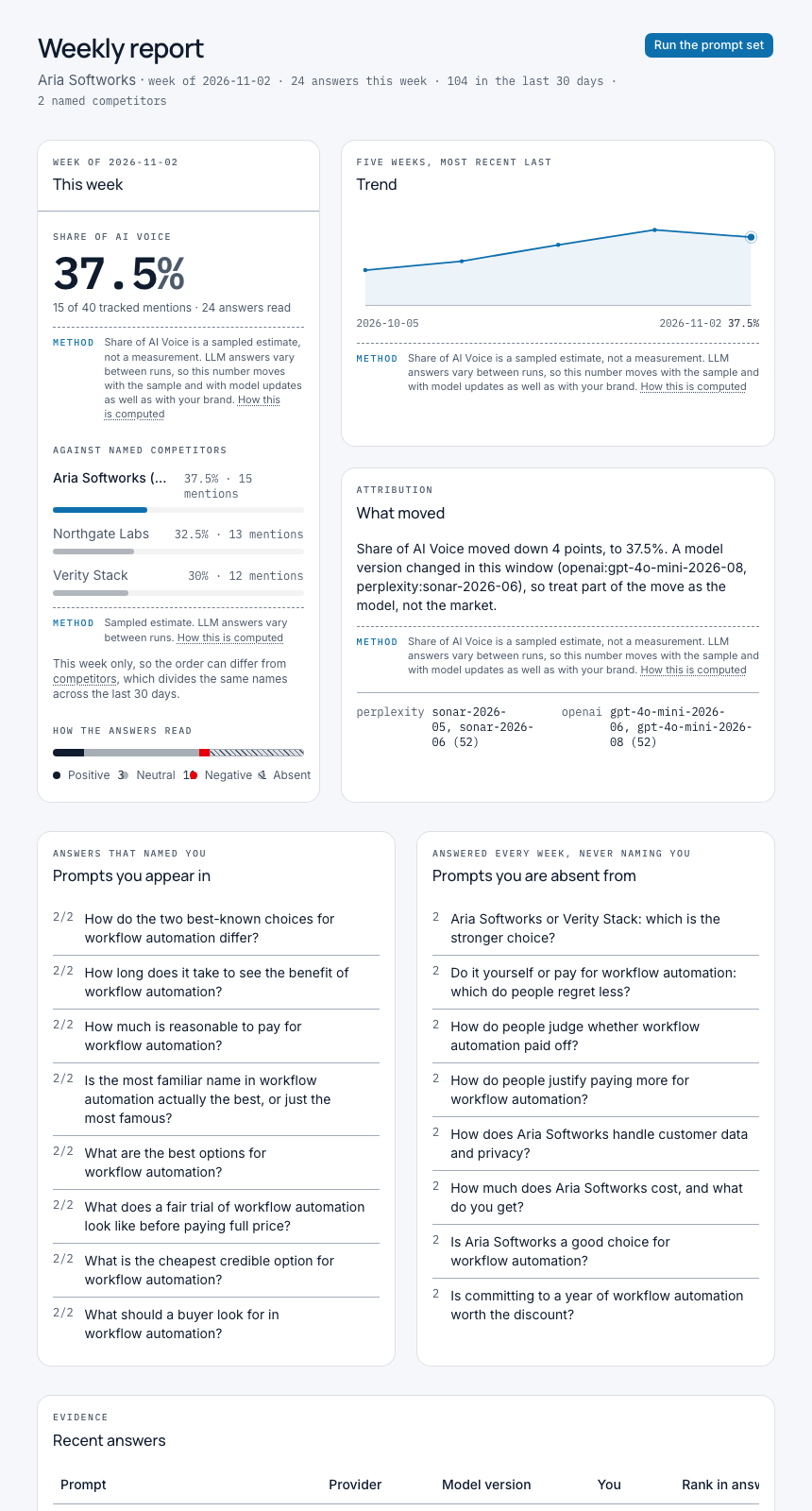
Share of AI Voice over a 30-day trend line, a sentiment breakdown, the top prompts where your brand is named and the top prompts where it is not, and a competitor benchmarking view across the brands you named.
- Take the digest into the week
The plan includes a weekly digest in your inbox with drift alerts, and every score carries its methodology caveat so a move that came from a model update is not read as a move in the market.
Why this matters in ecommerce specifically
Absent is a measurable state, not a blank
Sentiment is classified as positive, neutral, negative or absent, so the prompts where no answer names you are counted rather than lost. In a recommendation category, the list of questions where you never appear is usually the more useful list.
Position inside the answer, not just presence
The parser records ranking position within each response. A shopper reading a four-brand answer rarely weighs the fourth brand as heavily as the first, so presence alone overstates how well you are doing.
Benchmarked against the three brands you actually lose to
The competitor benchmarking view compares your mentions with the competitors you named, answer by answer. That is the comparison a merchandising or category argument needs, rather than a market-wide average nobody in the room recognises.
Prompt-level evidence for the people who write the copy
The dashboard surfaces the specific prompts where you are and are not named. Those prompts read like shopper questions, which makes them usable as a brief for product pages, category content and PR, without anyone guessing what to fix.
One number that survives a monthly meeting
Share of AI Voice is a single headline metric per brand per week with a 30-day trend, which is what a board slide can hold. Our sibling guide on reporting to executives covers how to present it without overstating what it proves.
Model updates are labelled, not silently absorbed
Every stored answer carries its model version, so a step change that lines up with a provider update can be told apart from a real shift in how your category is described. The caveat travels with the score wherever it is displayed.
What the score covers, and where it stops
| The question | What Seenby is built to show | Where it stops |
|---|---|---|
| Are we recommended in our category? | Mentions of your brand across a frozen set of 50 to 100 category prompts, scored weekly | Coverage is the prompt set you froze at setup, not every question a shopper could ask |
| Which assistants? | OpenAI and Perplexity on the Weekly tracking plan | Only those two providers. No other assistant is included today |
| How do we compare? | Competitor benchmarking against the competitors you named, answer by answer | Up to three named competitors, one brand per subscription |
| How are we described? | Sentiment per mention as positive, neutral, negative or absent, plus rank position in the answer | Automated classification of tone, not a human read of nuance or irony |
| Did something change? | A 30-day trend line, with every answer tagged by model version and every score carrying its caveat | A weekly change can reflect a model update or ordinary answer variation rather than the market |
What it costs
Starter
£79 / month
A brand manager or head of SEO at one mid-market company who just needs an answer to how ChatGPT and Perplexity describe them.
- Brands: 1
- Named competitors: Up to 3
- Prompts per week: 50
- AI providers: OpenAI and Perplexity
- Query cadence: Weekly
- Answer log history: 30 days
Growth
£149 / month
The same in-house buyer once the score is part of their reporting and they need the per-prompt evidence behind it for their CMO.
- Brands: 1
- Named competitors: Up to 3
- Prompts per week: 100
- AI providers: OpenAI and Perplexity
- API access: Not included
- White-label reports: Not included
Agency
£399 / month
An agency principal running SEO or brand for several client companies who needs a score per client in one account.
- Brands: Up to 5
- Named competitors: Up to 3 per brand
- Prompts per week: 100 per brand
- AI providers: OpenAI and Perplexity
- White-label reports: Not included
- API access: Not included
Questions
Which AI assistants are covered?
OpenAI and Perplexity. The Weekly tracking plan runs your frozen prompt set against those two providers, and no others are included today. If a report you produce needs to name its coverage, name those two.
Can I track individual products or SKUs?
Not as separate entities. Seenby tracks one brand per subscription, and the parser extracts mentions of that brand and of your named competitors. Product-level questions reach the score only through the prompts in your set, for example a prompt about the best option for a specific use case.
The answers change every time I ask. Why would a score be trustworthy?
Because the variation is what the method is designed around rather than hidden. The same 50 to 100 prompts run every week, every answer is stored with its model version, and every score carries a methodology caveat stating that a shift may come from a model update rather than the market. Read the trend, not a single week.
Can I add more than three competitors?
No. The plan allows up to three named competitors, which is a real constraint in a crowded consumer category. Choose the brands a shopper is genuinely deciding between, because the benchmarking view compares against exactly those names.
Does it track links or citations back to my store?
No. Seenby reads the answer text: whether your brand is mentioned, in what position, and with what sentiment. It is not a referral or clickstream measurement, so it will not tell you how much traffic an answer sent you.
Can an agency run this for several client brands?
One subscription covers one brand, so multi-client work means a subscription per client. The agency page in this section explains how that works and what it means for reporting.
What happens to the answers you store about my brand?
Answers are kept while the account exists, because the week-over-week trend is the product, and emails, phone numbers, handles and personal names are redacted before any answer is stored. The app and its database run on Amazon Web Services in a single region, and you can delete the account and everything in it from brand settings.
Related
- How to report AI search performance to executives without overclaiming
A reporting workflow for AI search: one headline number per period, its sample and caveat attached, competitor context beside it, and language that survives the first sharp question about non-determinism.
- AI search reporting for SEO teams
Seenby is built to give an SEO lead one reportable number for AI search: a weekly Share of AI Voice score per brand, benchmarked against up to three named competitors, with the evidence and the caveat attached.
- AI visibility tool for agencies: up to five client brands
Seenby is made for agency teams who have to report AI visibility per client.
- For brand managers: how does ChatGPT describe your brand
Seenby is built for brand managers who need a real answer to "how does ChatGPT describe us?", with weekly mention extraction, sentiment, rank position and one Share of AI Voice score per week.