Otterly.AI vs Seenby
If you are weighing Otterly.AI against Seenby for tracking how AI answers describe your brand, here is the honest shape of it: we will state exactly what Seenby does and what it costs, and we will not characterise another vendor's product on their behalf. Our research file on Otterly.AI contains no quoted line from a live page, so this page sends you to their site for their side and spends its
Seenby is not open yet, so anything on this page about what it does is what it is being built to do.
The comparison, stated neutrally
Two tools can both be described as AI search monitoring and still be answering different questions. So before the table, the ground rules we hold ourselves to on this page.
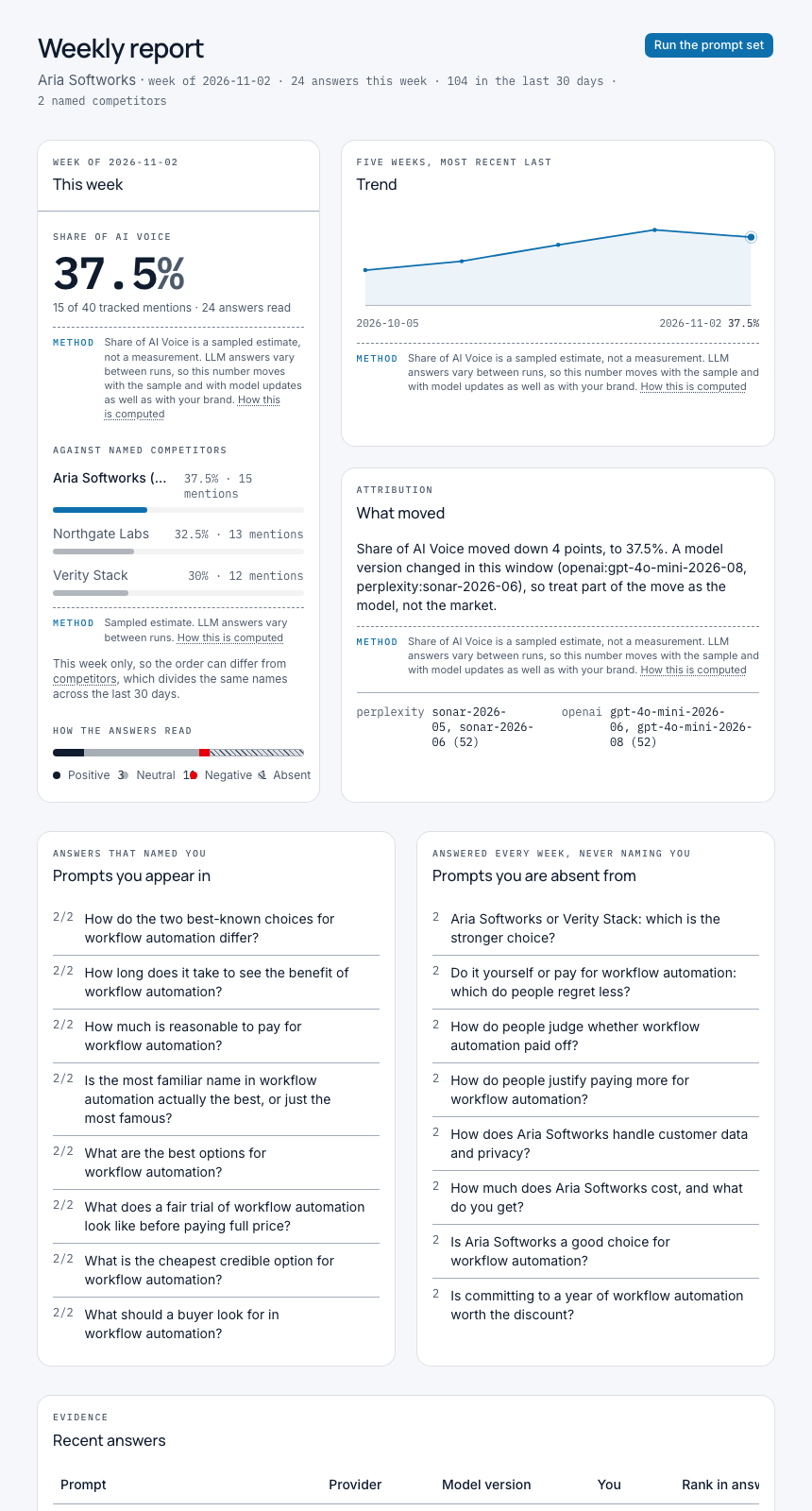
We describe Seenby only from what it is built to do. Seenby is a platform for brand managers and SEO leads who need to know how AI search engines represent them: a scheduled query engine runs a frozen prompt set every week, a parser extracts brand and competitor mentions, and one headline number, Share of AI Voice, is computed per brand per week with its methodology caveat stored on every record.
We describe Otterly.AI only from material we have quoted from their own pages. We have quoted none. Our internal notes on the product were recall, not retrieval, and recall is not evidence. Rather than publish a feature list or a price for someone else's product that we cannot stand behind, the third column of the table below points you at otterly.ai. Read their product and pricing material, then read ours, and compare like for like.
That is less satisfying than a tidy win column. It is also consistent: a number we cannot evidence does not get published here, whether it is theirs or ours.
The decision underneath the comparison
Most people landing on this query are not really choosing between two vendors yet. Three weeks ago someone in a meeting asked how ChatGPT describes the company. You typed a few prompts by hand and screenshotted the answers into a deck. Then you asked again, and the answers had changed. The real choice is between a repeatable weekly measurement and another quarter of spot checks. Pick either tool over the spreadsheet before you agonise over which tool.
What Seenby measures, in full
Seenby is deliberately narrow, and it is worth knowing the shape of that narrowness before you compare anything.
At setup you give a brand name, a description and up to three competitor names. From those, 50 to 100 prompt templates are generated, with a curated fallback set if generation returns too few. The set is then frozen. The same prompts run every week, because a trend only means something if the questions stop moving.
The query engine hits exactly two providers: OpenAI and Perplexity. They sit behind a provider adapter interface that degrades gracefully if one provider is disabled, which matters in a category where access policies can change without notice. Two providers is not every assistant your buyers use, and we would rather say that plainly than imply coverage we do not have.
Each stored response is tagged with its model version. Each mention is classified positive, neutral, negative or absent, with the brand's ranking position inside that response. The dashboard carries 30-day trend lines for Share of AI Voice, a sentiment breakdown, the prompts where you are named and the prompts where you are not, and a competitor benchmarking view against the names you chose. A weekly email digest carries the top insights, drift alerts tied to model-version changes where applicable, and the methodology caveat.
Dimension by dimension
| Dimension | Seenby | Otterly.AI |
|---|---|---|
| Headline metric | Share of AI Voice: one number per brand per week, stored with its methodology caveat attached to every computed record | Not stated here. We hold no quoted line from their pages; see otterly.ai |
| Providers queried | Exactly two at launch, OpenAI and Perplexity, behind an adapter that degrades gracefully if one is disabled | Not stated here. Check otterly.ai for current coverage |
| Cadence | A scheduled weekly run of the same frozen prompt set | Not stated here. Check otterly.ai |
| Prompt set | 50 to 100 prompts generated at onboarding from your brand description and up to 3 competitor names, then frozen so the trend measures the market | Not stated here. Check otterly.ai |
| Competitor benchmarking | Up to 3 named competitors, compared answer by answer in a dedicated view | Not stated here. Check otterly.ai |
| Sentiment and position | Positive, neutral, negative or absent per mention, plus ranking position within each response | Not stated here. Check otterly.ai |
| Trend window | 30-day trend lines, plus the prompts where the brand is and is not named | Not stated here. Check otterly.ai |
| Model-update handling | Every stored response tagged with its model version, so model-update drift can be told apart from real movement | Not stated here. Check otterly.ai |
| Email reporting | A weekly digest with top insights, drift alerts tied to model-version changes, and the methodology caveat | Not stated here. Check otterly.ai |
| Brands per subscription | 1 brand, up to 3 named competitors, 50 to 100 prompts per week | Not stated here. Check their plans and limits with them |
| Sign-in and assurances | Email and password. No SOC 2 or ISO 27001, no SAML or OIDC single sign-on, no self-serve export of stored answers, no choice of hosting region | Not stated here. Ask them directly about the same four items |
When to choose which
A fair answer here depends on which of these sentences is yours.
Seenby fits when
You have one brand, a named competitive set of no more than three, and a recurring reporting obligation. You need one defensible number you can put in a monthly deck, with the evidence underneath it: the prompt, the provider, the model version, the sentiment, the position. You care more about continuity than breadth, and you would rather have two providers measured the same way every week than a wider sweep you cannot compare across weeks. You are the person who will be asked why the number moved, and you want the answer in the tool rather than in a follow-up email.
Look elsewhere, including at Otterly.AI, when
Your requirements include something Seenby does not do. Several are worth listing because they are the common reasons to walk: more than one brand under one subscription, coverage beyond OpenAI and Perplexity, citation or source-level analytics showing which URLs a model cites, AI crawler and agent traffic reporting, white-labelled client reporting, single sign-on, a signed data processing agreement, an independent security certification, or self-serve export into your own warehouse. None of those are in Seenby today. Take that list to Otterly.AI and to anyone else on your shortlist and ask them to answer it line by line, then compare their answers against ours.
The two alternatives most teams actually weigh
Manual spot-checking in ChatGPT or Perplexity plus a spreadsheet costs nothing and produces no trend, because the questions and the models both move between checks. An in-house cron job firing your prompt list at model APIs is cheap in licence terms and real in engineering terms, and it leaves you to invent a benchmarking methodology and a way of telling model drift from market movement. Both are legitimate. Both are what a paid tool has to beat, and either vendor you are comparing has to beat them too.
Questions to ask both tools before you commit
Which models, and which exact versions
Coverage claims age fast. Ask which providers are queried today, and whether the stored answer records the model version. Without version tagging you cannot tell a model update from a competitor gaining ground.
Is the prompt set frozen or does it drift
If the questions change between runs, the trend line measures the tool, not the market. Seenby freezes 50 to 100 prompts at setup and reruns the same set weekly.
Can I see the actual answer text
A score you cannot audit is a number you cannot defend in a meeting. Ask what evidence sits behind each data point, and at what level of detail.
How is the score defined, and where is that written down
Ask for the formula and the caveat in writing. Seenby stores its methodology caveat with every computed record and surfaces it on every score display.
What happens if a provider withdraws access
This category depends on other companies' usage policies. Seenby's adapter interface degrades gracefully to the remaining provider rather than failing the week.
What is not in place
Ask every vendor to name what they do not have. Ours: no SOC 2 or ISO 27001, no single sign-on, no self-serve export, no region choice, no signed data processing agreement on request.
What Seenby will cost
Starter
£79 / month
A brand manager or head of SEO at one mid-market company who just needs an answer to how ChatGPT and Perplexity describe them.
- Brands: 1
- Named competitors: Up to 3
- Prompts per week: 50
- AI providers: OpenAI and Perplexity
- Query cadence: Weekly
- Answer log history: 30 days
Growth
£149 / month
The same in-house buyer once the score is part of their reporting and they need the per-prompt evidence behind it for their CMO.
- Brands: 1
- Named competitors: Up to 3
- Prompts per week: 100
- AI providers: OpenAI and Perplexity
- API access: Not included
- White-label reports: Not included
Agency
£399 / month
An agency principal running SEO or brand for several client companies who needs a score per client in one account.
- Brands: Up to 5
- Named competitors: Up to 3 per brand
- Prompts per week: 100 per brand
- AI providers: OpenAI and Perplexity
- White-label reports: Not included
- API access: Not included
Where Seenby is today
Seenby has not launched. Joining the waitlist gets you the build notes and a place in the first cohort, not a login, and nothing on this page is a customer result, because there are no customers yet. We would rather say that than dress intent up as traction.
What we can commit to is scope. The product is built to do the things listed above and nothing more: two providers, one brand, three competitors, one weekly number with its caveat attached. If that is narrower than your shortlist requires, Otterly.AI and the rest of the category deserve the look, and we would rather you found the right fit than the fastest yes.
For the plan, its limits and what sits outside it, see the pricing page. If you are evaluating this for a client rather than an employer, the agencies page explains how one brand per subscription plays out across a client roster.
Questions
Does Seenby track Gemini or Claude answers?
No. Seenby queries exactly two providers, OpenAI and Perplexity, behind an adapter interface that degrades gracefully if one is disabled. Anthropic is used once at onboarding to generate your prompt set, not as an answer provider. If Gemini coverage is a requirement, check it against every tool on your shortlist.
Which one is cheaper, Otterly.AI or Seenby?
We do not restate another vendor's price without quoting it from their own page, so check otterly.ai directly and compare the limits, not just the headline figure.
Can I track more than one brand?
Not on one subscription. The plan is limited to one brand and up to three named competitors. Agencies running several client brands need one subscription per brand, which the agencies page sets out in detail.
The answers change every time I ask. Does a weekly score mean anything?
It means something if the method is fixed and the caveat is visible. The same frozen prompt set runs every week, every response is tagged with its model version, and the methodology caveat is stored with every computed score. A week-over-week shift can still reflect a model update rather than real competitive movement, and drift alerts call that out when a model version changes.
What evidence sits behind the score?
Each mention carries a sentiment classification, positive, neutral, negative or absent, and a ranking position within the response. The dashboard shows 30-day trend lines, a sentiment breakdown, the prompts where your brand is named and the prompts where it is not, and a competitor benchmarking view.
How do you handle personal names that appear in stored AI answers?
Emails, phone numbers, handles and personal names are redacted before an answer is stored, and every stored response carries a flag recording that the scrubbing ran. Answer text is not written to operational logs.
Do you offer single sign-on or a SOC 2 report?
No. Sign-in is email and password. There is no SAML or OIDC single sign-on, no SOC 2 or ISO 27001, no signed data processing agreement on request, no self-serve export of stored answers and no choice of hosting region. The app and its database run in a single Amazon Web Services region.
Can I start today?
Not yet. Seenby is at the waitlist stage, so joining puts you in the first cohort and gets you the build notes. There are no customers, no case studies and no results to quote.
Sources
Related
- How to choose an AI visibility tool: eleven questions to ask a vendor
A buyer's guide to AI visibility tools, built around eleven questions about model coverage, prompt sets, score method, drift, evidence, data handling and price.
- AthenaHQ vs Seenby
A comparison for anyone choosing between AthenaHQ and Seenby: what Seenby is built to do, stated from its own build, and the questions to put to AthenaHQ directly rather than take from us.
- Evertune vs Seenby
A head-to-head for anyone shortlisting Evertune and Seenby: what Seenby measures, what it will cost, what it does not have, why it is still a waitlist, and why the Evertune column on this page says ask Evertune.
- Free AI visibility checkers: what a one-off scan can and cannot tell you
A free AI visibility checker gives you one sample of how an AI model describes your brand.
- How much does AI brand monitoring cost?
AI brand monitoring is priced on query volume, so cost tracks how many prompts, providers and brands you watch.
- Peec AI vs Seenby
A head-to-head between Peec AI and Seenby, written with a hard rule: Seenby is described from what it is built to do, and Peec AI is not described from memory. Use the question list to hold both tools to the same standard.