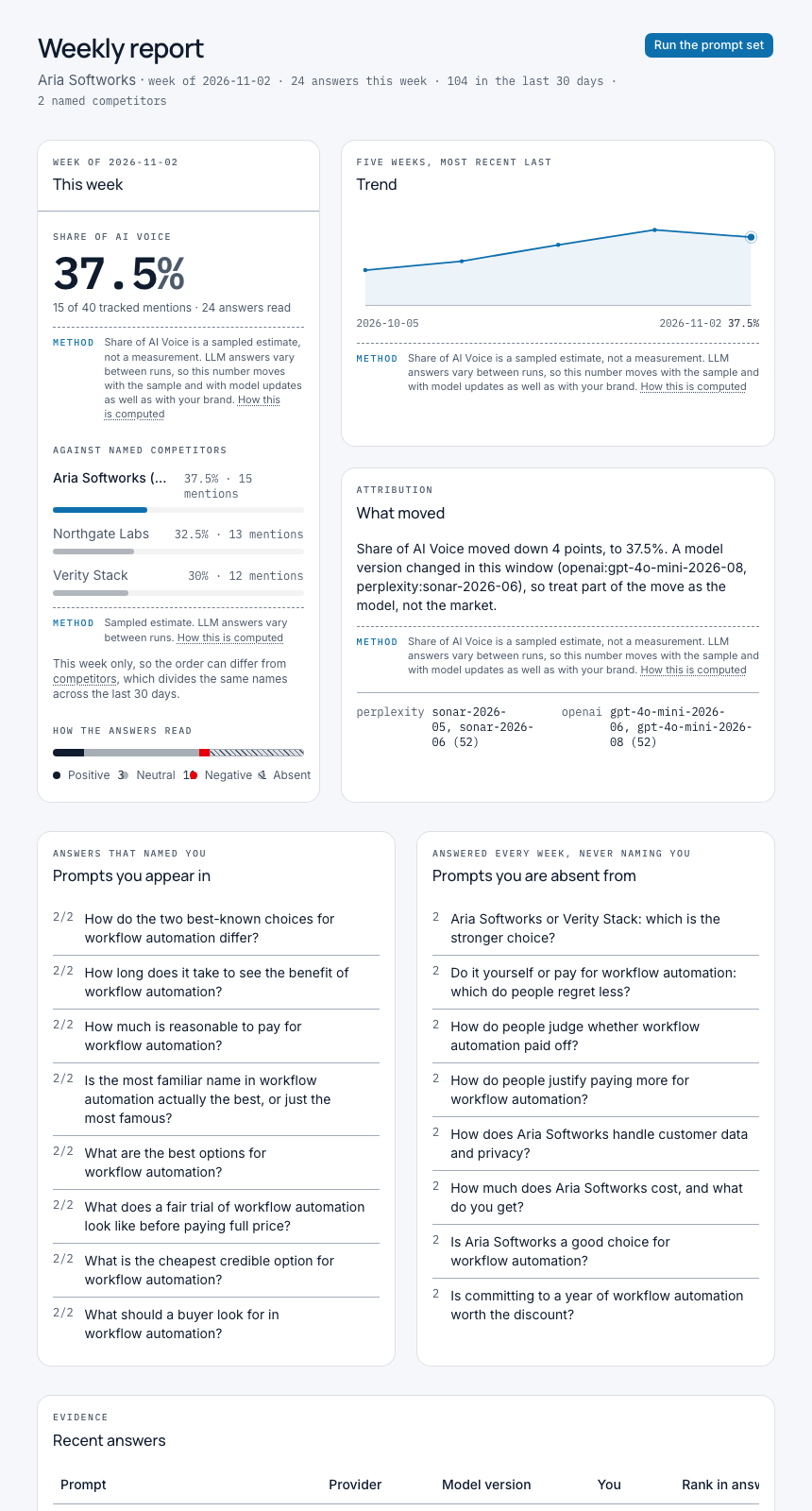
AthenaHQ vs Seenby
You are weighing two tools that both exist to answer one question: how do AI assistants describe your brand, and how does that compare with your competitors. This page states what Seenby is built to do, and it deliberately does not describe AthenaHQ's features or price, because we have not verified them and will not repeat them from memory.
Seenby is not open yet, so anything on this page about what it does is what it is being built to do.
Two tools on the same shelf, and the limits of this page
Seenby and AthenaHQ sit in the same young category, the one that grew out of a single executive question: how does ChatGPT describe us, and why does a competitor get recommended instead. AthenaHQ operates in that category, and their own positioning line lives on their own site, which is where you should read it. This page makes no claim about what AthenaHQ says of itself, what it covers, or what it costs.
The reason is simple. We have not fetched and quoted AthenaHQ's live site for this page, and this category changes its feature lists and its prices faster than any comparison page can keep up. A table that confidently lists a competitor's model coverage from memory is not a comparison, it is a guess dressed as research. So you will find no AthenaHQ price, no AthenaHQ model list and no judgement about their reliability or support anywhere below. Read those on their own site, where they are current.
What this page can do is more useful than a guess. It states precisely what Seenby is built to do, names what Seenby does not have, and hands you the short list of questions that actually separates tools in this category when you put them to any vendor, including us.
What Seenby is built to do
Seenby is a waitlist today, not a launched product, so read everything here as intent backed by what is built rather than as a track record.
The scheduled query engine hits exactly two providers, OpenAI and Perplexity, behind a provider adapter interface that degrades to the remaining provider if one is disabled. Two providers is a choice, not an omission we are hiding. Provider access in this category is a dependency, so the architecture assumes one of them can go away, and the copy says two rather than implying every assistant.
Setup takes a brand name, a description and up to three competitor names, and generates a set of 50 to 100 prompts that is then frozen. The same set runs every week, which is the only way a trend line measures the market rather than the questions you happened to type that Monday.
From each answer, Seenby extracts brand and competitor mentions, classifies sentiment as positive, neutral, negative or absent, and records the ranking position inside the response. Those roll into one headline number, Share of AI Voice, computed per brand per week and stored with its methodology caveat attached to every computed record. The dashboard carries a 30-day trend, the sentiment breakdown, the prompts where you are named and the prompts where you are not, and a competitor benchmarking view. A weekly email digest sends the top insights and drift alerts tied to model-version changes, with the caveat included.
One thing to be blunt about. Every stored response is tagged with its model version, because week-over-week movement in any tool in this category can reflect a model update rather than a real competitive change. Seenby surfaces its methodology disclosure on every score display in-product and on a dedicated methodology page, so the caveat travels with the number instead of living in a footnote.
Side by side, with the empty column left honest
| Dimension | Seenby | AthenaHQ |
|---|---|---|
| Category position | Continuous Share of AI Voice tracking, benchmarked against named competitors, for brand and SEO leads at mid-market companies | Not stated here. Read their own positioning line on their site |
| Providers queried | Exactly two at MVP, OpenAI and Perplexity, behind an adapter that degrades gracefully if one is disabled | Not verified by us. Ask which assistants are queried, how often, and what happens when one provider restricts access |
| Headline metric | One Share of AI Voice score per brand per week, stored with its methodology caveat attached to every record | Not verified by us. Ask what the headline number is and how it is computed |
| Methodology disclosure | Surfaced in-product on every score display and on a dedicated static methodology page | Not verified by us. Ask whether the method is published and whether the caveat appears next to the score |
| Handling model updates | Every stored response is tagged with its model version, so model-update drift can be told apart from real movement, and drift alerts in the digest are tied to version changes | Not verified by us. Ask how a score change caused by a model update is distinguished from a real one |
| Evidence behind the score | Mention extraction, sentiment classification, ranking position per response, and the full answer log tagged with its model version | Not verified by us. Ask whether you can read the actual answers |
| Competitors tracked | Up to 3 named competitors, benchmarked answer by answer | Not verified by us. Ask how many competitors a plan covers |
| Prompt set | 50 to 100 prompts per week, frozen at setup so the same set runs every week | Not verified by us. Ask how prompts are chosen and whether they change between weeks |
| Brands per subscription | One | Not verified by us. Ask about multi-brand and multi-client workspaces |
| Sign-in | Email and password. No SAML or OIDC single sign-on | Not verified by us. Ask if your team requires single sign-on |
| Certifications | None today. No SOC 2, no ISO 27001, and no signed data processing agreement on request | Not verified by us. Ask for their current status if procurement will need it |
| Data handling | Answers are scrubbed of emails, phone numbers, handles and personal names before any answer is queryable, with a scrub flag on every stored response. Hosted on Amazon Web Services in a single region, | Not verified by us. Ask where data is hosted and what you can export |
| Availability | Waitlist. Not launched | Not verified by us |
Five questions that decide this faster than a feature list
Which models, and how often
Coverage claims are the easiest thing to stretch in this category. Ask for the literal list and the cadence. Seenby's answer: OpenAI and Perplexity, on a weekly cycle, with graceful degradation to one provider if the other is disabled.
How is the score computed, in writing
Any share metric depends on which mentions count and what the denominator is. If the arithmetic is not written down, the number is not comparable across weeks. Seenby's answer: one Share of AI Voice score per brand per week, with the methodology disclosed in-product on every score display and on a dedicated page.
What happens when the model updates
LLM answers are not deterministic, and a model release can move a score without anything changing in your market. Ask how the tool separates the two. Seenby's answer: model-version tagging on every stored response, and drift alerts in the weekly digest tied to version changes when applicable.
Can I read the actual answers
A score without the underlying text cannot be argued about in a marketing meeting, and arguing about it is the point. Ask whether the answer log is visible, per prompt, with the provider and model named.
What does the subscription actually cover
Brands, competitors, prompt volume and providers are the four limits that matter.
When to choose which
Seenby fits when the shape is one brand, every week
Choose Seenby if you are a brand manager or SEO lead who needs one brand watched continuously, benchmarked against up to three named competitors, with a single number you can put in a monthly report and a published method behind it. Seenby is built for the case where the trend matters more than breadth: the same frozen prompt set, the same two providers, every week, so a movement means something. The price is one published figure, so you can decide without a sales call. If your procurement process needs SOC 2, single sign-on or a signed data processing agreement, Seenby does not have those today, and that is a reason to look elsewhere rather than a detail to discover later.
AthenaHQ may fit better, and here is how to tell
Go and read their site against the five questions above. If you need coverage beyond OpenAI and Perplexity, several brands in one account, a workspace per client, integrations we do not offer, or enterprise controls we have listed as absent, then a tool with a wider scope is the right call and we would rather you found that out on this page than after paying us. We are not going to characterise AthenaHQ's capabilities to make that comparison land one way or the other, because we have not verified them.
If you are still deciding whether to buy anything
The honest third option is the one most teams are on: a marketer types category prompts into ChatGPT by hand, screenshots the answers and keeps a sheet. It costs nothing and it answers the executive question once. What it cannot do is survive non-determinism, because the same prompt asked twice does not return the same answer, and a handful of manual checks cannot tell a model update from a real shift in how you are described. That is the gap any paid tool in this category, ours or theirs, has to justify.
Questions
Why does this page not list AthenaHQ's features or pricing?
Because we have not fetched and quoted their live site for this page, and we will not publish a competitor's coverage or price from memory. Their own site is current, ours would not be.
Which AI assistants does Seenby track?
Two at MVP: OpenAI and Perplexity. They sit behind a provider adapter interface that degrades gracefully if one provider is disabled, which is deliberate given how much this category depends on provider access.
How is Share of AI Voice calculated?
It is one headline score per brand per week, computed from mentions extracted from every stored answer, and stored with its methodology caveat text attached to every computed record. The full method is disclosed in-product on every score display and on a dedicated methodology page.
The results change every time I ask an AI assistant. Does a weekly score mean anything?
It means something only if the method is fixed and the caveat is visible. Seenby freezes the prompt set at setup so the same 50 to 100 prompts run every week, tags every response with its model version, and flags drift tied to model-version changes in the digest. A single week is a reading. The trend is the signal.
What does Seenby cost, and is there a free tier?
See the pricing page for what is included.
Can I track more than one brand or several clients?
A subscription covers one brand. If you are an agency running client brands, the agencies page explains how that works and where the limit bites.
Does Seenby have SOC 2 or single sign-on?
No. There is no independent security audit or certification today, no SAML or OIDC single sign-on, sign-in is email and password, and there is no signed data processing agreement on request. The app and its database run in a single Amazon Web Services region.
What happens to the AI answers you store about my brand?
Emails, phone numbers, handles and personal names are redacted before any answer is queryable, and every stored response carries a scrub flag. Answers and scores are kept while the account exists, because the week-over-week trend is the product, and you can delete the account and everything with it from brand settings.
Sources
Related
- How to choose an AI visibility tool: eleven questions to ask a vendor
A buyer's guide to AI visibility tools, built around eleven questions about model coverage, prompt sets, score method, drift, evidence, data handling and price.
- Evertune vs Seenby
A head-to-head for anyone shortlisting Evertune and Seenby: what Seenby measures, what it will cost, what it does not have, why it is still a waitlist, and why the Evertune column on this page says ask Evertune.
- Free AI visibility checkers: what a one-off scan can and cannot tell you
A free AI visibility checker gives you one sample of how an AI model describes your brand.
- How much does AI brand monitoring cost?
AI brand monitoring is priced on query volume, so cost tracks how many prompts, providers and brands you watch.
- Otterly.AI vs Seenby
A head-to-head for brand and SEO leads choosing an AI visibility tracker: what Seenby measures, what it will cost, what it does not do, and the questions to put to Otterly.AI before you decide.
- Peec AI vs Seenby
A head-to-head between Peec AI and Seenby, written with a hard rule: Seenby is described from what it is built to do, and Peec AI is not described from memory. Use the question list to hold both tools to the same standard.