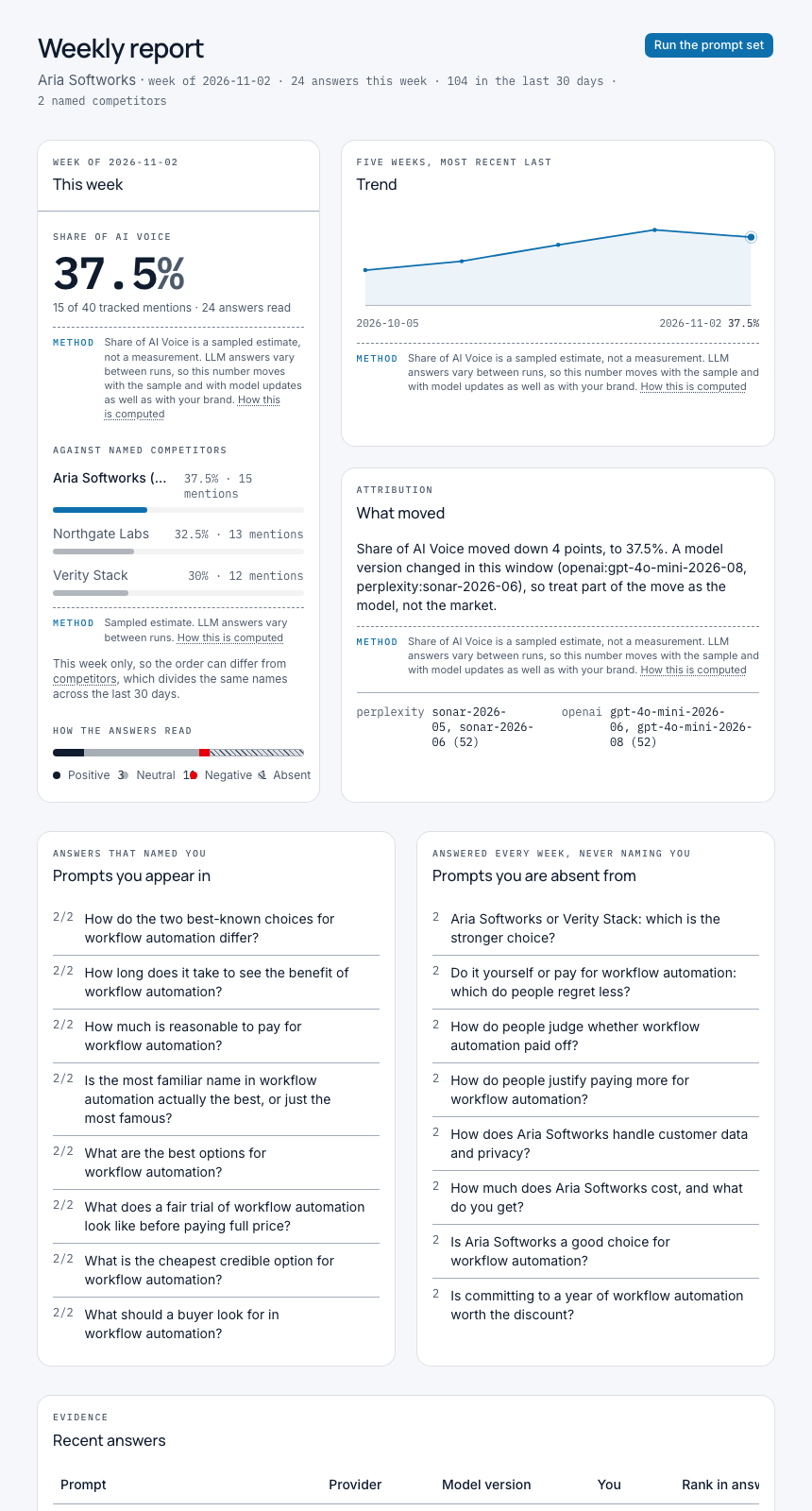
How to choose an AI visibility tool: eleven questions to ask a vendor
Choosing an AI visibility tool is a choice of method, not of dashboard. These eleven questions cover model coverage, prompt sets, the score's denominator, model drift, evidence and price, and the answers tell you which vendors have written any of it down.
Seenby is not open yet, so anything on this page about what it does is what it is being built to do.
The short answer: judge the method, not the dashboard
Every tool in this category does the same four things. It decides what to ask, asks it of one or more large language models, reads the answers for brand and competitor mentions, and turns those mentions into a number you can put in a deck. Dashboards differ. Methods differ far more, and the method is what you are buying.
So skip the screenshot tour for the first twenty minutes and work through eleven questions instead. They cover which models get queried and at what version, where the prompt set comes from and whether it stays fixed, what sits in the denominator of the visibility score, whether the methodology is published, how the tool separates a model update from a real competitive move, whether you can read the underlying answers, what happens if a provider restricts access, what is stored and for how long, and what the whole thing costs per brand per month.
Two things to hold in mind before the list.
No tool can promise a stable number. The models underneath are non-deterministic and they change without notice, so a week over week move can reflect a model update rather than a real shift in how the market talks about you. Any vendor who does not raise that themselves is selling you a false precision you will have to defend later.
And a tool that hides its method is not measuring more accurately. It is only harder to audit. When your CMO asks why the score fell four points, "proprietary algorithm" is not an answer you can take into the room.
What an AI visibility tool is actually doing under the hood
You cannot evaluate answers to the eleven questions without a rough picture of the pipeline. There are five stages, and a weak link at any one of them shows up as a confident number that means nothing.
One: the prompt set
Something has to decide what to ask. Usually a model generates a set of buyer-style questions from your brand name, your description and your competitors, sometimes a human writes them, often it is both. The prompt set is the instrument. If it changes between weeks, the trend measures your prompts rather than the market.
Two: the queries
Those prompts get sent to the answer providers on a cadence. This is the part that costs money, because it is one API call per prompt per provider per run, and it is the part most likely to break, because access to those providers is governed by their own usage policies.
Three: the parse
The returned text gets read for your brand, your named competitors, the position each is mentioned in, and the tone of the sentence around the mention. This is where quiet errors live. Keyword-based sentiment inverts on negation, and substring matching without word boundaries will read "unlimited" as limited.
Four: the score
Mentions become a share. Your visibility divided by the visibility of a defined set. Which set, and what the score does when nothing was sampled, is the single most important thing to establish.
Five: the reporting
A dashboard, a weekly email, or both. Reporting is where the caveat either travels with the number or gets stripped off on its way to the board deck.
How to run the evaluation in about a week
- Write down the question you are being asked
"How does ChatGPT describe us?" and "why does our competitor get recommended and we don't?" lead to different tools. The first needs readable answer text. The second needs competitor benchmarking on identical prompts. Pick the one your executives actually ask.
- Draft twenty prompts yourself, by hand
Write the questions a buyer in your category would type. This takes an hour and it becomes your test fixture. Any vendor whose generated prompt set does not overlap meaningfully with yours is measuring a different market.
- Name your competitors before the demos
Three or four is usually enough, and it should be the set your sales team loses to, not the set your category page lists. The competitor list defines the denominator, so choose it as carefully as you would choose a KPI.
- Shortlist on method, not on feature counts
Read each vendor's methodology page before you book anything. If there is no public methodology page, that is a finding. Two or three shortlisted tools is plenty, since you are comparing approaches, not spreadsheets.
- Send the eleven questions in writing
Email beats a call, because written answers are specific and quotable, and because the questions a vendor deflects in writing tell you where the product is thin. Ask for the price in the same email.
- Run your own manual baseline alongside the trial
Ask ten of your prompts by hand, twice, a few days apart, in the same tools the vendor queries. You will see the variance for yourself, and you will know whether the tool's number is in the right neighbourhood.
- Decide who reads it weekly before you sign
An AI visibility tool earns its cost when someone acts on it: a content brief, a comparison page, a correction pitched to a source the models quote. If no name goes next to the weekly read, buy nothing yet.
The eleven questions
Which models do you query, and can you name the versions?
Coverage is usually sold as a row of logos. Ask for exact model identifiers, and whether the tool reads the API or the consumer product, because they answer differently. Two providers read carefully beats five read badly. Get in writing what happens when a provider is added or dropped mid-contract.
Do the queries run on a schedule, or when someone clicks a button?
A trend is only a trend if the same prompts run on the same cadence. Ask who triggers a run, how long a full set takes, whether it can time out halfway, and what the chart shows for a week that was never sampled. An unsampled week is not a zero.
Where do the prompts come from, and are they frozen?
Ask how many prompts, who wrote them, and whether they are fixed after setup. A fixed set makes the week over week comparison honest. A set that regenerates each week makes movement uninterpretable. Ask whether you can see the full list, and whether there is a fallback when generation fails.
What exactly is in the denominator of your score?
Every share metric divides your mentions by something. If the denominator is your mentions plus your named competitors' mentions, then a brand with no competitors named scores one hundred percent forever, which is arithmetic, not measurement. Ask what the score returns when a week has no answers at all.
Is the methodology published where I can read it without a sales call?
Ask for a URL. Then ask the harder version: does the caveat sit next to the number in the product, or only in the document? A caveat in a PDF never reaches the executive reading the dashboard, and the dashboard is where the decision gets made.
How do you tell a model update from a real competitive change?
Every stored answer should carry the model version that produced it. Without that tag, a five point drop after a silent model refresh looks identical to a competitor gaining ground, and your team spends a week writing content to fix a problem that was never theirs.
Can I read the answers, or only the score?
Ask to open the log: prompt, provider, model version, your position, and the answer text. The sentence that names you, or fails to, is the artefact a content team can act on. A score with no evidence beneath it cannot be argued with, and cannot be defended in a review.
How is sentiment classified, and where does it break?
Ask whether it is keyword matching or a model call, then ask for known failure modes. Negation is the classic: "X is not the best option" reads positive to a naive classifier. A vendor who names that unprompted is showing you how they treat the rest of the pipeline.
What happens if a provider restricts or withdraws access?
Commercial monitoring at volume sits inside each provider's usage policy, and access can be narrowed at short notice. Ask whether the system keeps running on the remaining providers or stops entirely, and whether your history is preserved with a note or quietly recalculated.
What is stored, for how long, and what gets redacted?
Answers about your brand routinely name real people. Ask whether names, emails and handles are removed before storage, how long answers are kept, which subprocessors see your prompts, and how deletion works. Then ask for the list of what they do not have: audit, single sign-on, signed DPA, export.
What is the price per brand per month, and what is counted?
Ask for the number before the demo, not after. Then ask what the unit is: brands, prompts, providers, seats, or queries. Ask what changes when you add a second brand or a fourth competitor, because that is usually where the quoted price quietly stops applying.
The objection worth taking seriously: the results change every time
Ask an assistant the same question twice and you can get two different answers. That is the most common reason teams decide this whole category is unmeasurable, and it is a fair starting position. It is also an argument for sampling properly rather than for not measuring.
One question asked once is an anecdote. Fifty to a hundred fixed prompts, asked across more than one provider, on a fixed weekly cadence, is a sample. The point of a share metric is not that any single answer is reproducible. It is that the distribution over many answers moves slowly enough for a change to mean something, as long as the instrument stays still while the market moves.
That gives you two concrete tests for any vendor.
Test one: is the instrument fixed?
The prompt set, the competitor set, the providers and the cadence should all be constant between weeks. If any of them changes, the tool has to say so on the chart. Ask to see what that annotation looks like.
Test two: is model drift separated from real drift?
Providers ship new model versions without announcement. If the tool does not record which version produced each answer, it cannot distinguish a platform change from a competitive one, and neither can you. The correct behaviour is to tag the version on every stored answer and to flag the weeks where a version changed, so the reader knows to discount the movement.
Both tests point at the same underlying discipline: state what the data shows, name the uncertainty, and leave the editorial call to the marketer. Any number you take to a board should arrive with its caveat attached rather than bolted on afterwards.
How to read a vendor's answer
| What you asked about | A weak answer sounds like | A strong answer sounds like |
|---|---|---|
| Model coverage | We cover all the major AI platforms. | These two providers today, named, with the exact model version stored on every answer. |
| Cadence | The data updates continuously. | The same prompt set runs weekly on a schedule; a week we could not sample shows as unsampled, not as zero. |
| Score method | Our proprietary visibility algorithm. | Here is the formula, here is what is in the denominator, and here is what it returns with no data. |
| Drift | Our scores are stable week to week. | Scores move when models change; here is how we tag versions and flag a suspected model update. |
| Evidence | You get sentiment and rank positions. | You can open the answer text behind any mention, with its prompt and provider. |
| Data handling | Enterprise grade security. | Here is what we store, what we redact before storage, who our subprocessors are, and what we do not have. |
| Price | Let us scope it on a call. | A published price, published limits, and what changes when you add a brand. |
Scope and cost: what you are really paying for
The cost structure of this category is unusually legible, which helps you sanity check a quote. Each prompt, sent to each provider, on each run, is a paid API call made on your behalf. Volume is therefore the real unit: prompts multiplied by providers multiplied by runs per month. When a vendor prices per seat or per user, ask how that maps to query volume, because it usually does not, and the mismatch surfaces later as a limit you did not know about.
Three scope questions decide whether a headline price applies to you.
- How many brands? One brand per subscription is common in this category, and it is a genuine constraint rather than a packaging trick, because each brand is its own prompt set and its own weekly run. If you manage several brands, price it as several subscriptions and see whether the maths still works.
- How many named competitors? The competitor list is the denominator. A cap of three or four is defensible. What is not defensible is a tool that lets you name none and still shows you a share.
- How many prompts per week? This sets the resolution of your measurement. Too few and the variance swamps the signal. Too many and you are paying for precision you will never read.
Our own numbers sit on the pricing page in this guide's pillar, and the agencies page covers the multiple client brands case, including why one brand per subscription is the honest shape of it rather than a limitation we are hiding. Use both as a reference point when you compare quotes.
The procurement questions that stall these deals
Tools in this category are young, which means the security questionnaire is where most evaluations get stuck. Go there early rather than after you have picked a favourite.
Start with the data map. Your prompts leave the vendor and travel to the answer providers, so the provider list is a subprocessor list. The answers come back as free text about your brand, and free text about brands mentions real people: executives, journalists, customers. Ask whether personal names, emails, phone numbers and handles are stripped before the answer is stored, not after, and ask how you would verify that on a given record.
Then ask the questions that a mid-market legal team will ask you:
- How long are answers and scores retained, and why?
- Where is the data hosted, and can the region be chosen?
- Is there a signed data processing agreement?
- Is there an independent audit or certification?
- Is there single sign-on, or only email and password?
- Can you export your stored answers and scores if you leave?
- How do you delete the account, and what survives deletion?
You will not get a yes to all seven from a small vendor, and you should not expect to. What matters is whether they tell you which ones are no without being cornered into it. A vendor who publishes the gaps is a vendor whose methodology page you can also believe. A vendor who answers every question with the word "enterprise" is telling you they have not written any of this down.
One more practical item: ask what happens to your history if you pause the subscription. The trend is the asset, and a gap in it is expensive to rebuild because you cannot backfill questions you never asked.
Making the call
Once the eleven answers are in front of you, the decision usually resolves along one line: do you need a number for reporting, or evidence for action? Most teams say the number and then spend all their time in the evidence, so weight the answer log heavily.
A reasonable decision rule. If the vendor publishes a method, tags model versions, shows you the answer text, and states a price with its limits, the tool is auditable and you can work with it even if the coverage is narrower than you hoped. If any one of those four is missing, the number will not survive its first challenge from a sceptical executive, and defending it will cost you more time than the subscription costs money.
Be honest with yourself about the cadence too. Weekly is enough for almost everyone, because the underlying answers do not move faster than your content can respond, and a daily feed mostly buys you noise to explain.
Finally, decide what a bad number would make you do. If the honest answer is nothing, then the tool is a reporting line rather than an instrument, and you should buy the cheapest credible one. If the answer is a comparison page, a set of product docs, a correction to a source the models lean on, or a briefing for your PR team, then buy on the strength of the evidence layer and accept that the headline score is a summary, not a verdict.
Questions
What is an AI visibility tool?
It is software that asks language models a fixed set of buyer-style questions on a schedule, reads the answers for mentions of your brand and your competitors, and reports how often and how favourably you appear. The output is usually a share metric plus the underlying answers as evidence.
How do you measure AI visibility?
By sampling. You freeze a prompt set, run it across the same providers on the same cadence, count mentions of your brand against a defined comparison set, and track the share over time. A single question asked once tells you nothing reliable, which is why the prompt set and the cadence matter more than the dashboard.
How many models does a tool need to cover?
Fewer than most vendors imply. Coverage breadth is worth less than coverage you can audit, because each additional provider multiplies query cost and adds another usage policy that could restrict access. Ask which providers are queried today, at which model versions, and what happens to the score if one drops out.
Why do the answers change every time I ask?
Language models are non-deterministic, and providers ship new model versions without announcement. That is a real limit on precision, not a reason to skip measurement. Ask the vendor how they record the model version on each answer, because that is the only way to tell a platform change from a competitive one.
Is a free AI visibility checker enough?
A free checker answers the one-off question, "does this assistant mention us right now". It cannot give you a trend, because a trend needs the same prompts asked repeatedly over weeks, and repeated querying is the part that costs money. Use a free check to decide whether you have a problem, then buy for the trend.
How much should an AI visibility tool cost?
Price tracks query volume, so ask for the cost per brand per month and for the prompt, provider and competitor limits that come with it. The pricing page in this pillar sets out our single plan and its limits if you want a published reference point for comparison.
Can one subscription cover several client brands?
Not in our case, and often not elsewhere, because every brand needs its own prompt set and its own weekly run. Our agencies page explains how the one brand per subscription shape works when you are reporting for several clients.
What should I ask for during a trial?
The full prompt list, the raw answer text behind at least ten mentions, the model versions recorded that week, the exact score formula, and what the chart does for a week that was not sampled. If all five arrive without friction, the rest of the evaluation is about fit rather than trust.
Related
- AthenaHQ vs Seenby
A comparison for anyone choosing between AthenaHQ and Seenby: what Seenby is built to do, stated from its own build, and the questions to put to AthenaHQ directly rather than take from us.
- Evertune vs Seenby
A head-to-head for anyone shortlisting Evertune and Seenby: what Seenby measures, what it will cost, what it does not have, why it is still a waitlist, and why the Evertune column on this page says ask Evertune.
- Free AI visibility checkers: what a one-off scan can and cannot tell you
A free AI visibility checker gives you one sample of how an AI model describes your brand.
- How much does AI brand monitoring cost?
AI brand monitoring is priced on query volume, so cost tracks how many prompts, providers and brands you watch.
- Otterly.AI vs Seenby
A head-to-head for brand and SEO leads choosing an AI visibility tracker: what Seenby measures, what it will cost, what it does not do, and the questions to put to Otterly.AI before you decide.
- Peec AI vs Seenby
A head-to-head between Peec AI and Seenby, written with a hard rule: Seenby is described from what it is built to do, and Peec AI is not described from memory. Use the question list to hold both tools to the same standard.