Generative engine optimization: a practical guide for brand teams
Generative engine optimization, or GEO, is the practice of shaping and measuring how your brand is described in answers written by generative AI systems such as ChatGPT and Perplexity, rather than in a ranked list of links. This guide covers what the discipline is, what you can and cannot influence, and how to measure it without overclaiming.
Seenby is not open yet, so anything on this page about what it does is what it is being built to do.
What generative engine optimization means
Generative engine optimization, usually shortened to GEO, is the work of changing how a brand is described and recommended inside answers written by generative AI systems, and of measuring that description over time. The unit of competition is no longer position seven in a list of ten links. It is whether your name appears in the paragraph that answers a buyer's question, how you are characterised when it appears, and which rivals appear beside you.
Three consequences follow, and they are what make GEO a separate discipline rather than a new SEO checklist.
- The output is a sentence, not a ranking. An answer engine returns a short recommendation set, often three or four names with a line of reasoning each. You are inside that set or you are absent. There is no page two to be recovered later.
- You cannot edit the engine, only the evidence it reads. Nobody outside the model providers can adjust weights. What you can adjust is the material the engine draws on when it composes an answer about your category, and how clearly that material states what you do, who you are for, and how you differ.
- Measurement changes shape. A rank tracker asks a deterministic question of a crawlable index. GEO measurement asks a non-deterministic question of a model that may answer differently tomorrow, so it has to be a sampling exercise with a stated method, not a single lookup.
GEO is not a replacement for search engine optimization. Most of the source material an answer engine reaches for is still published on the web, still needs to be crawlable, and still benefits from being clear and well structured. What is new is the surface where the competition is settled and the way you have to read results.
The people doing this work are usually the brand manager who has been asked how ChatGPT describes the company, and the SEO lead who has been asked to put an answer in the next board deck. Both need the same thing before anything else: a defensible baseline.
Why the term appeared when it did
The behaviour changed before the vocabulary did. Buyers who used to type a category term and scan links now type a full question and read one answer. In that flow, the number of brands a buyer sees drops sharply. A results page shows ten organic listings plus ads. A generated answer shows a handful of names, sometimes one.
That compression is what turns AI answers into a brand problem rather than a traffic problem. If a shortlist of three is written for the buyer before they ever reach a website, the decision that used to happen on your landing page now happens in a paragraph you did not write. Teams describe the moment in a few recognisable ways: we are not showing up in ChatGPT, our competitor gets recommended and we do not, the AI is saying something out of date about us.
The second driver is reporting pressure. Executives ask the question directly, and it is a hard question to answer by hand. You can open ChatGPT, ask twice, and get two different lists. Anecdote is not a baseline, and a screenshot is not a trend. GEO exists as a named discipline largely because somebody has to turn that anecdote into a number with a method attached to it.
A note on scope before we go further. There is no reliable public figure for how much traffic any given category has lost to AI answers, and any vendor who quotes one for your business is guessing. Treat the shift as a change in where the consideration set is formed, and measure your own exposure rather than importing someone else's percentage.
GEO, AEO and classic SEO side by side
| Discipline | What it competes for | What you influence | How you measure it |
|---|---|---|---|
| Classic SEO | A position in a ranked list of links for a query | Crawlability, on-page content, internal structure, links | Rank position, impressions and clicks, mostly deterministic |
| Answer engine optimization (AEO) | Being the source that supplies a direct answer, including featured snippets and cited sources | Question-shaped content, clear factual statements, structure the engine can lift | Citation and source inclusion, presence in the answer block |
| Generative engine optimization (GEO) | Being named and described favourably inside a generated recommendation | The corpus the model draws on, how third parties describe you, factual clarity across the category | Sampled answers to a fixed prompt set: mention rate, share against named rivals, sentiment, position within the answer |
The difference between GEO and AEO, in one paragraph
The two terms overlap and are often used interchangeably, which is fine in conversation and unhelpful in a plan. The practical split is this. Answer engine optimization asks whether your page is the source an engine uses. Generative engine optimization asks whether your brand is one of the names the engine recommends, and what it says about you. You can be cited as a source and still lose the recommendation to a competitor in the same answer. You can also be recommended without being cited at all, because the model is drawing on what it learned about your category rather than on a document it fetched in that moment. Run both, but keep the scoreboards separate, because they fail for different reasons and the fixes are different.
Where a generated answer actually comes from
You cannot optimise what you cannot picture. Broadly, a generated answer about your category is assembled from three inputs, and different products weight them differently.
Model memory
What the model absorbed during training. This is the slowest layer to move and the least visible. It is why a brand that was small three years ago can be missing from an answer even after a strong year, and why out of date descriptions persist after a repositioning. Nothing you publish this week changes it directly.
Live retrieval
Many answers are grounded in documents fetched at the moment of asking, particularly in products built around search. This layer is the most responsive to your work, because it reads the current web, and it is where citations usually come from.
The system's own framing
The instructions and formatting the product applies, which push answers into comparison lists, pros and cons, or short recommendations. This is why the same question phrased two ways can produce a very different shape of answer, with different numbers of brands named.
The practical implication is that GEO work splits into two speeds. Retrieval you can influence in weeks by publishing clearer, more specific, more attributable material and by getting third parties to describe you accurately. Memory you influence only indirectly, over quarters, by becoming better represented across the sources that future models will read. Anyone promising to change what a model already believes about you on a fixed timetable is selling something they cannot control.
How to run a GEO programme
- Write the prompt set before you write anything else
List the questions a real buyer asks at the point of choosing: best tools for a given job, alternatives to a named rival, who is good for a mid-market team, is this vendor suitable for that use case. Fifty to a hundred prompts covers most categories. Include prompts that name your competitors, because those are the answers where you are most often absent. Then freeze the set. A prompt set that drifts each month measures your editing, not the market.
- Establish a baseline before you change a thing
Run the set, record every answer, and extract three things per answer: whether you were named, how you were characterised, and where you sat relative to the rivals named alongside you. One run is a snapshot with wide error bars. Several runs across a week give you something you can compare against. Resist acting on the first result you dislike.
- Read the answers, not only the score
The score tells you the size of the gap. The text tells you the cause. Answers usually reveal one of three problems: you are absent, you are present but described wrongly or out of date, or you are present and ranked below rivals for a reason the answer states out loud. Those are three different projects.
- Fix the material you control
Make the plain facts about your product unmissable and consistent: what it does, who it is for, what it costs, what it does not do, which categories it belongs in. Answer the buying questions directly on your own site in the words buyers use. Remove contradictions between your pages, your documentation and your older posts, because a model reading contradictory sources will hedge or omit you.
- Earn the descriptions you do not control
Most recommendation answers lean on third-party material: comparison articles, review platforms, community threads, directories, analyst and press coverage. Being accurately represented there is slower and less comfortable than editing your own site, and it usually matters more. Correct stale entries, ask for factual fixes, and give writers the specifics they need to place you properly.
- Re-measure on the same prompts and the same cadence
Weekly is a sensible rhythm for most brands: frequent enough to catch a sudden drop, slow enough that you are not reacting to sampling noise. Keep the prompt set, the providers and the extraction rules constant, and record which model version answered. Change one thing at a time or you will not be able to attribute movement.
- Report the number with its caveat attached
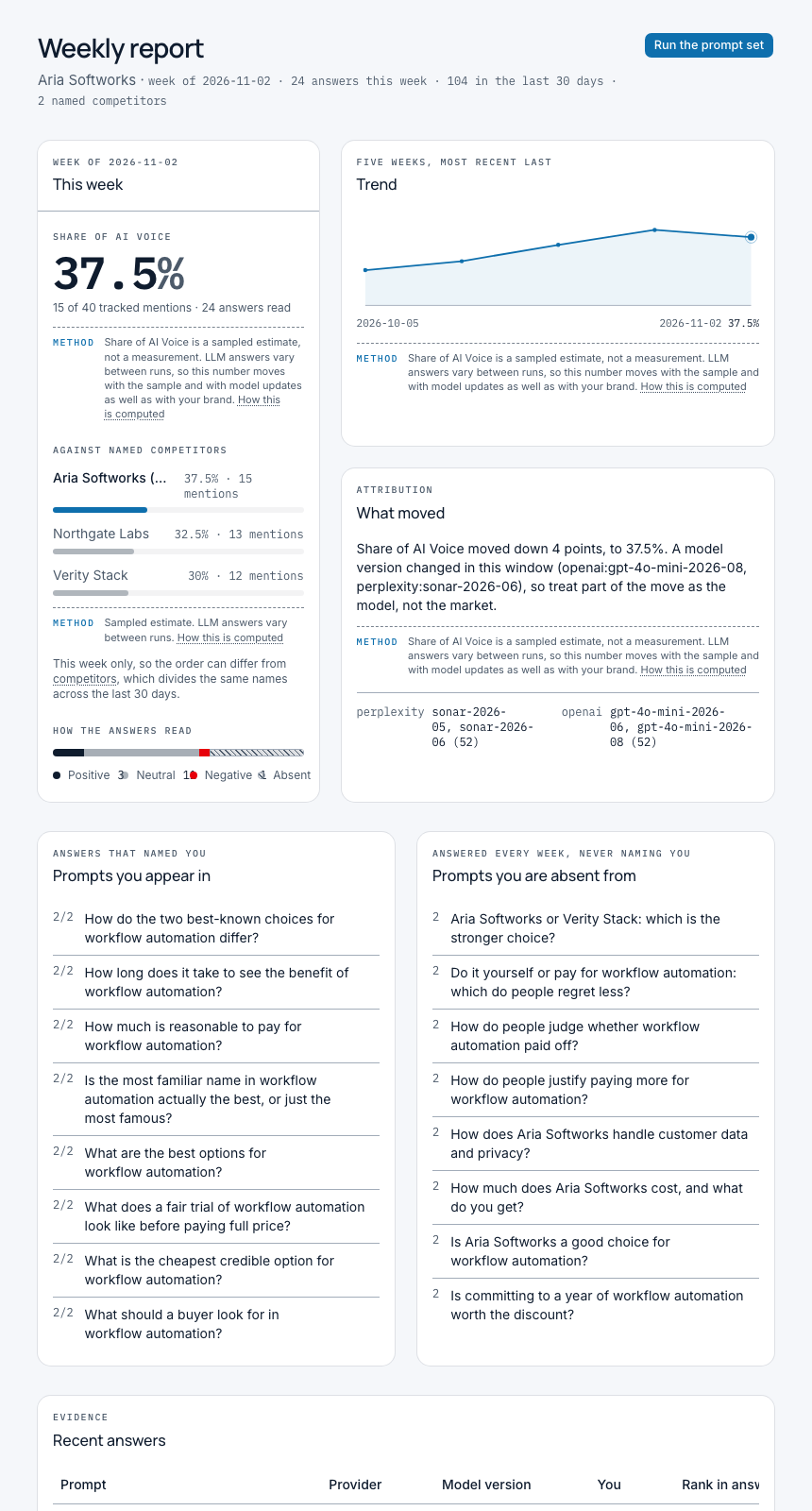
Any AI visibility figure needs a stated method next to it: which prompts, which providers, how many answers, which model versions, and the explicit warning that a week over week shift can reflect a model update rather than a change in your competitive position. A number without that sentence will eventually be used to make a decision it cannot support.
The measures worth reporting
Share of voice against named competitors
Your mentions as a proportion of mentions across you and a defined set of rivals, over a defined prompt set. This is the closest thing to a headline metric, and it only means something if the competitor set is named and fixed. Without rivals in the denominator, a share figure flatters you and tells you nothing.
Prompt coverage
The share of your prompt set where you are named at all. Coverage and share move independently. You can be named in a few answers and dominate them while being invisible across the rest of the category.
Sentiment and characterisation
Whether the mention is positive, neutral or negative, and what the answer actually claims. Treat automated sentiment as a triage signal that points you at answers worth reading, not as a verdict. Keyword and classifier approaches all misread negation and irony some of the time.
Position within the answer
Being listed first in a recommendation is not the same as being mentioned in passing in the final paragraph. Recording order gives you a finer read than a binary mentioned or not.
The competitor gap, answer by answer
The most useful view is not your number in isolation. It is the list of prompts where a rival is named and you are not, because that list is the work queue for the next month.
Model version
Record which model answered every time. When a score moves the week a provider ships an update, the version tag is the only thing that lets you separate real drift from model drift instead of guessing.
The objection that matters: the answers change every time
This is the strongest argument against measuring AI visibility at all, and it deserves a straight answer rather than a rebuttal. Generative models are non-deterministic. Ask the same question twice and the wording, the order and sometimes the names change. Providers ship model updates without notice, and a refreshed model can rewrite your category overnight.
So a single answer is evidence of almost nothing. What makes measurement possible is the same discipline that makes survey research possible.
- Sample, do not spot-check. Dozens of prompts across multiple providers, repeated on a schedule, produce a distribution. One question produces an anecdote.
- Hold the instrument still. A fixed prompt set and a fixed competitor set mean movement in the number reflects movement in the answers, not in your methodology.
- Tag the model version. Drift that coincides with a version change is a different fact from drift that does not, and only one of the two is about your brand.
- Publish the method. Anyone reading the number should be able to see how it was produced, and should see the caveat in the same view as the figure.
What you get from that is a defensible trend with a stated error character, which is enough to prioritise work and to brief an executive honestly. What you do not get is a precise, stable, audited figure. If someone offers you one, ask how they handled the model update that shipped last month.
What generative engine optimization cannot promise
Being specific about the limits is the fastest way to keep a GEO programme credible inside your company.
No guaranteed placement
No method, agency or tool can guarantee that a given engine will name you for a given prompt. The mechanism is not a ranking system you can satisfy, and the provider can change it at any time. Plan in terms of raising the probability of being named across a category, not in terms of securing a slot.
No attribution to revenue by default
AI answers often resolve without a click, so the usual analytics chain is thinner here. You can observe presence and characterisation reliably. Tying a share movement to pipeline requires the same careful, caveated reasoning you would apply to brand awareness work, not a straight line.
No access you do not depend on
Measurement runs on provider APIs, under provider terms, at provider rate limits. Any monitoring programme should assume a provider could restrict or withdraw commercial access, and should be built so the remaining providers still produce a usable read rather than a broken report.
No score without a comparison set
A visibility number computed without named rivals is not a share of anything. If your measurement can report a hundred percent when you have no competitors defined, it is measuring your setup, not the market.
Common ways a GEO programme goes wrong
Most failures are process failures rather than content failures.
- The prompt set is written by marketing for marketing. Prompts that use your internal category language will find you and miss the market. Use the words buyers actually type, including the ones that name your competitors and the ones that describe the problem without naming any category at all.
- Reacting to a single bad answer. One answer that describes you poorly is a data point. Escalating it to a crisis burns the credibility you will need when a real drop shows up in the trend.
- Chasing tactics with no evidence behind them. The category is full of confident advice about files, markup and formats that will supposedly make models prefer you. Some of it is low cost and harmless. Treat all of it as untested until your own before and after on a fixed prompt set says otherwise, and never build a quarter's plan on it.
- Changing the instrument mid-quarter. New prompts, a new competitor, a new provider, all in the same month, and the trend line becomes uninterpretable. Version your measurement setup the way you would version a tracking plan.
- Reporting the number without the caveat. This is the one that causes lasting damage. Once a leadership team treats an AI visibility score as precise, the first model update will produce a movement you have to explain after the fact instead of having framed in advance.
A first ninety days
If you are starting from nothing, this sequence keeps the work honest and the reporting defensible.
Weeks one to three. Name up to three competitors you genuinely lose deals to. Write the prompt set with sales input. Run a baseline and read at least thirty answers end to end yourself, because nothing else will teach you as quickly how your category is being described.
Weeks four to six. Fix your own material. Publish direct answers to the buying questions where you are absent. Reconcile contradictions across your site and documentation. Decide which factual corrections you need from third parties and start asking for them.
Weeks seven to ten. Work the gap list, the prompts where a rival is named and you are not. Pursue accurate representation in the sources those answers appear to lean on. Keep measuring weekly without touching the prompt set.
Weeks eleven to thirteen. Report the trend, not the snapshot. Show coverage, share against the named set, the sentiment mix, and the prompts that changed. State which model versions produced each week's answers and which movements you are not prepared to attribute to your own work. That last sentence is what makes the report worth repeating next quarter.
Questions
What is GEO in marketing?
GEO, generative engine optimization, is the practice of improving how a brand is described and recommended inside answers written by generative AI systems, and measuring that representation over time. The work is done on the material those systems read and on how third parties describe you, since nobody outside the providers can change the models themselves.
Is GEO replacing SEO?
No. Most of the evidence a generative answer draws on is still published on the web and still needs to be findable, so classic search work remains the foundation. What GEO adds is a second surface with its own scoreboard, where the outcome is being named in a recommendation rather than ranking in a list.
What is the difference between GEO and AEO?
Answer engine optimization asks whether your page is the source an engine uses to answer a question. Generative engine optimization asks whether your brand is one of the names the engine recommends and how it describes you. You can be cited as a source and still lose the recommendation, so the two are worth tracking separately.
How do you measure generative engine optimization?
Sample it. Fix a prompt set of the questions buyers actually ask, name the competitors you are measured against, run the set on a schedule across the engines that matter, and extract whether you were named, how you were characterised and who appeared beside you. Report the trend with the method and the model versions attached, never a single answer.
Why do the answers change every time I ask?
Generative models are non-deterministic, and providers update them without notice. That is why one question is not a measurement. A fixed prompt set, repeated sampling and model-version tagging let you tell the difference between ordinary variation, a model update and a real change in how your category is described.
Can you optimise for ChatGPT directly?
You can improve the odds, not guarantee the outcome. Making your own facts clear and consistent, answering buying questions directly, and getting accurate descriptions into the third-party sources the category relies on are the levers with a plausible mechanism. Anyone guaranteeing a placement for a given prompt is promising something the provider controls.
Does llms.txt work?
There is no dependable public evidence that it changes whether a model recommends you, and adoption across crawlers is not something a brand can verify from outside. Treat it as a cheap experiment to run and measure on your own prompt set, not as a strategy.
Which engines should a mid-market brand track first?
Start with the engines your buyers actually use to shortlist vendors, which for most B2B categories means a general assistant and a search-native answer engine. Two providers sampled properly every week beats four sampled occasionally, because the value is in the trend rather than in the breadth of the snapshot.
Related
- Answer engine optimization (AEO)
Answer engine optimization is the practice of shaping your content and public footprint so systems that answer questions directly name and cite you.