Methodology on every score, not in a footnote
For brand managers and heads of SEO who have to defend an AI visibility number to a CMO: this is the Share of AI Voice methodology in full. Seenby computes one headline score per brand per week and stores the methodology caveat text on every record it computes, so the method travels with the figure instead of sitting in a footnote.
Seenby is not open yet, so anything on this page about what it does is what it is being built to do.
The question that follows the number
How it goes today
You put an AI visibility figure in a monthly deck. The next question is always the same: how was that calculated, and why did it move four points? If the method lives in a PDF, a help centre article or a footnote on slide fourteen, the number gets screenshotted and the method stays behind.
How it goes with Seenby
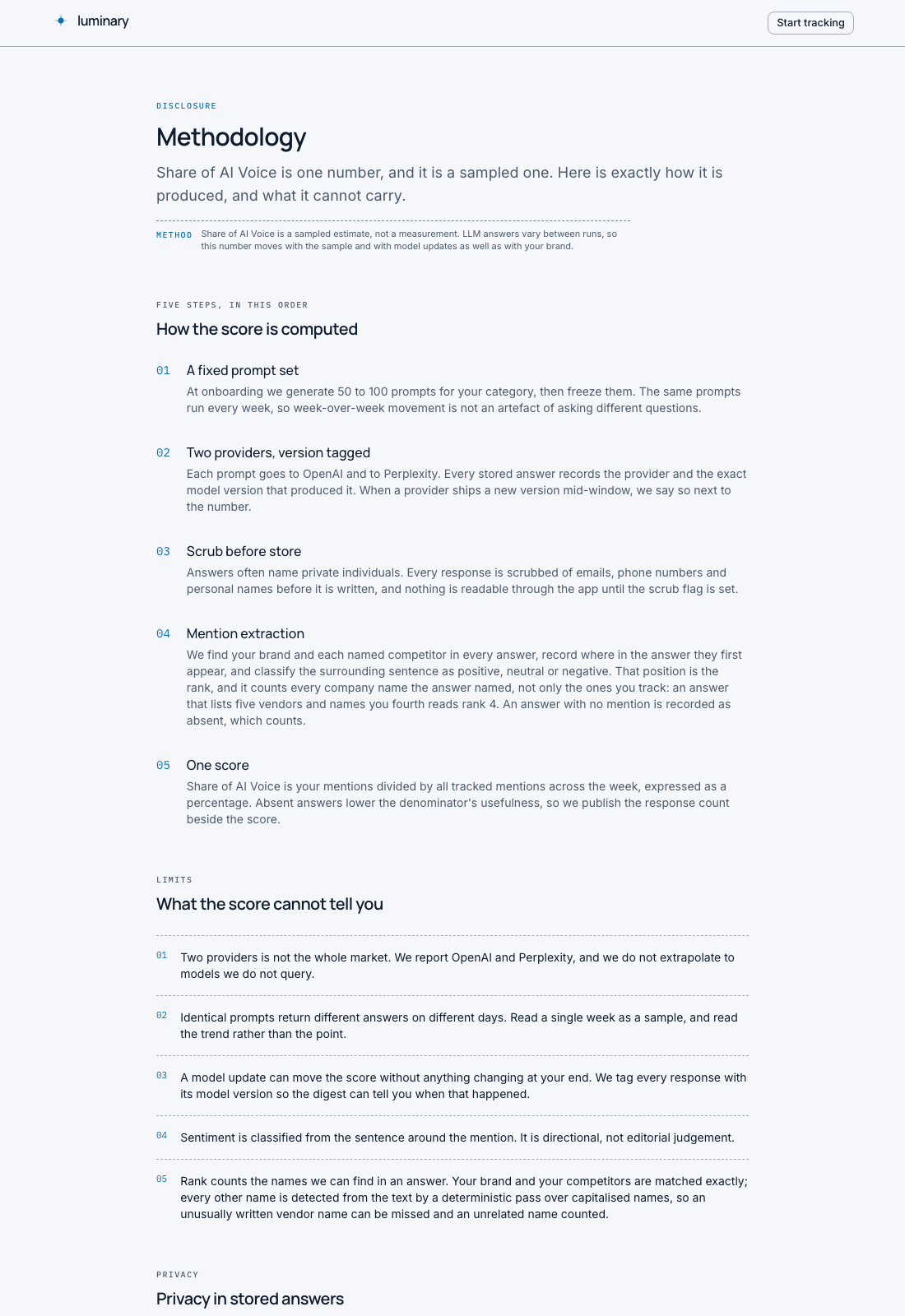
Share of AI Voice is computed as one headline metric per brand per week, and the methodology caveat text is stored on every computed record. The disclosure is surfaced in-product on every score display, and published in full on a dedicated static methodology page.
What that changes for you
The caveat cannot be separated from the score it describes. When the CMO asks how the figure was built and whether the movement is real, the conditions arrive with the number rather than waiting to be fetched out of a file nobody opened.
How the methodology travels with the score
- The prompt set is fixed and inspectable
Onboarding takes your brand name, a description and up to three competitor names, then generates 50 to 100 prompt templates in one model call, with a curated fallback set if generation fails or returns too few. The score reads a known question set, not an open-ended sample you cannot reconstruct.
- Two providers are read, and they are named
The scheduled query engine hits exactly two providers, OpenAI and Perplexity, behind a provider adapter that degrades gracefully if one is disabled. A score is a reading of the providers that actually answered that week, which is part of why the caveat sits next to it.
- Every response is parsed the same way
The parser extracts brand and competitor mentions, classifies sentiment as positive, neutral, negative or absent, and records the ranking position within each response. The score is built from those per-response records, not from an impression of the week.
- Every response carries its model version
Each stored query response is tagged with the model version that produced it. That tag is what makes it possible to tell real movement apart from movement caused by a provider updating the model underneath you.
- One number per week, with its caveat attached
Share of AI Voice is computed as a single headline metric per brand per week, stored with its methodology caveat text on the record itself. Wherever that score is displayed in the product, the disclosure is displayed with it.
What the caveat says, in plain terms
- The score is a share, not a rank
Share of AI Voice expresses how often the answers name you across the week's prompt set, set against the competitors you named. Ranking position inside a single answer is a separate, per-response field. Both are useful. They are not the same measurement, and we do not blend them into one figure.
- Non-determinism is in the method, not hidden from it
Ask a large language model the same question twice and the wording, the brands named and the order they appear in can all differ. We do not present the score as a precise instrument reading. It is a weekly aggregate over a fixed prompt set, read as direction and magnitude over several weeks rather than as a number accurate to the decimal.
- A model update can move a score on its own
Because every stored response carries its model version, a shift that lines up with a model-version change can be distinguished from a shift in how the market describes you. Where that applies, the weekly digest raises it as a drift alert rather than reporting the move as a competitive change.
- What we will not claim
We can measure how these two providers described you in a given week. We cannot promise that a model will change what it says because you changed something, and we will not sell a number as proof that it did.
What the disclosure is worth in practice
One page to send onward
The full disclosure is published on a dedicated static methodology page, the same text surfaced in-product on every score display. Send the link to a CMO, to procurement, to legal or to an agency partner and they can read the method in full without a login, a demo or a call with us.
The number and its limits arrive together
The caveat is stored with the computed record and shown on every score display, so a figure lifted into a slide or a digest does not arrive stripped of the conditions that produced it.
An answer ready for the sceptic in the room
When someone says the results change every time you ask, you can agree, then point at the prompt set, the two providers and the model-version tags that the score is built from.
Model drift separated from market movement
Version tagging on every response, and drift alerts in the weekly digest when a change lines up with a model update, keep you from briefing a competitive story that was really a release note.
Questions the methodology answers directly
| Question | What we say |
|---|---|
| What does the score measure? | How often your brand is named across one week of answers to your prompt set, set against the competitors you named. |
| How many prompts sit behind it? | 50 a week on Starter, 100 on Growth and Agency, generated at onboarding from your brand description and competitor names. |
| Which models are read? | Two providers, OpenAI and Perplexity. No others are read, and we do not imply otherwise. |
| Is the score deterministic? | No. Answers vary between runs and change with model updates, which is why the caveat is attached to every record. |
| How is model drift handled? | Every stored response is tagged with its model version, and the weekly digest flags drift tied to model-version changes when applicable. |
| Where is the method published? | In-product on every score display, and in full on a dedicated static methodology page. |
What tracking costs when Seenby opens
Starter
£79 / month
A brand manager or head of SEO at one mid-market company who just needs an answer to how ChatGPT and Perplexity describe them.
- Brands: 1
- Named competitors: Up to 3
- Prompts per week: 50
- AI providers: OpenAI and Perplexity
- Query cadence: Weekly
- Answer log history: 30 days
Growth
£149 / month
The same in-house buyer once the score is part of their reporting and they need the per-prompt evidence behind it for their CMO.
- Brands: 1
- Named competitors: Up to 3
- Prompts per week: 100
- AI providers: OpenAI and Perplexity
- API access: Not included
- White-label reports: Not included
Agency
£399 / month
An agency principal running SEO or brand for several client companies who needs a score per client in one account.
- Brands: Up to 5
- Named competitors: Up to 3 per brand
- Prompts per week: 100 per brand
- AI providers: OpenAI and Perplexity
- White-label reports: Not included
- API access: Not included
Questions
How is AI share of voice calculated?
Seenby runs a fixed set of 50 to 100 prompts against OpenAI and Perplexity, parses each response for brand and competitor mentions, sentiment and ranking position, then computes one headline share per brand per week from those records. The methodology caveat is stored with the computed record and shown wherever the score appears.
What is a good AI share of voice score?
We will not give you a benchmark number, because we have no evidence for one and inventing a threshold would undermine the point of this page. Read your own trend over several weeks against the competitors you named, and treat a single week as one sample rather than a verdict.
The answers change every time I ask. Does that make the score meaningless?
It makes a single reading weak and a repeated one useful. The prompt set stays constant, the providers stay constant, and every response is tagged with its model version, so the comparison week to week is between like and like as far as the models allow.
Which AI providers does the score cover?
Two: OpenAI and Perplexity. The provider adapter degrades gracefully if one is disabled, so a week can reflect fewer providers than usual, which is one of the reasons the caveat sits next to the number.
How do I know a change is real and not a model update?
Model-version tagging on every stored response is what separates the two, and the weekly digest raises drift alerts tied to model-version changes when applicable. Where the evidence is ambiguous, the disclosure says so rather than resolving it for you.
Do you store personal names that appear in AI answers?
A PII-scrubbing step runs in the response-storage pipeline before any response becomes queryable, and every stored response carries a flag recording that it was scrubbed. Emails, phone numbers, handles and personal names are redacted before an answer is stored.
Can I read the methodology without signing up?
Yes. The full method is published on a dedicated static methodology page, and the same disclosure is surfaced in-product on every score display for customers.
How long are the answers behind a score kept?
Starter keeps 30 days of answer log history. On Growth and Agency the full scrubbed answer log is kept while the account exists, because the week-over-week trend is the product. You can export a copy of your data or delete the account from Settings.