Generative engine optimization (GEO)
Generative engine optimization, usually shortened to GEO, is the practice of shaping how generative AI systems describe and recommend your brand when a person asks them a question. It is the same instinct as SEO applied to a different surface: not a ranked link, but a sentence inside a written answer that names you, or leaves you out.
Seenby is not open yet, so anything on this page about what it does is what it is being built to do.
What generative engine optimization means
Generative engine optimization (GEO) is the practice of shaping how generative AI systems, ChatGPT and Perplexity and Google's AI Overviews among them, describe and recommend your brand in the answers they write. The unit of success is a mention inside a generated answer rather than a position in a list of links.
Why the term appeared
Search used to end in a list. A reader compared links and chose one, and SEO was the discipline of being near the top of that list. A generative engine ends the same query with a paragraph instead. It reads sources, decides which brands belong in the answer, and writes a short recommendation with reasoning attached. The reader often never leaves the answer, which is the behaviour marketers mean when they say zero-click search.
That changes the work in two ways. You are competing to be part of a synthesis you cannot inspect unless you go and ask for it. And the surface you are optimising for is written fresh each time, so two people asking the same question on the same day can get different brands back.
An example
A buyer types: what are the best analytics tools for a 200-person B2B company? The model returns four names with a line of justification each. Your closest competitor is second. You are absent. No rank tracker moved, your keyword positions are intact, and your traffic report explains nothing, because the loss happened inside a sentence nobody logged. GEO is the work of finding out why you were left out, changing what can be changed, and checking whether the answer actually shifted.
The honest limit
Nobody can guarantee a place in a generated answer. The models are non-deterministic, they are retrained and updated on their own schedule, and a week-over-week change in how you are described may reflect a model update rather than anything that happened in your market. Treat GEO as a measurable practice with real levers and an unstable read, not as a rank you can lock in. Any number in this category deserves its caveat printed next to it.
GEO next to classic SEO
| Question | Classic SEO | Generative engine optimization |
|---|---|---|
| What you compete for | A rank position on a results page | A mention, and its framing, inside a written answer |
| What the reader sees | Broadly the same page as everyone else | Wording that varies by asker, by run and by model |
| How you check it | Rank trackers, Search Console, analytics | Asking the models a fixed set of prompts and reading what comes back |
| What moves it | Content, links, technical health | The same signals, plus how clearly your category and your rivals are described across sources |
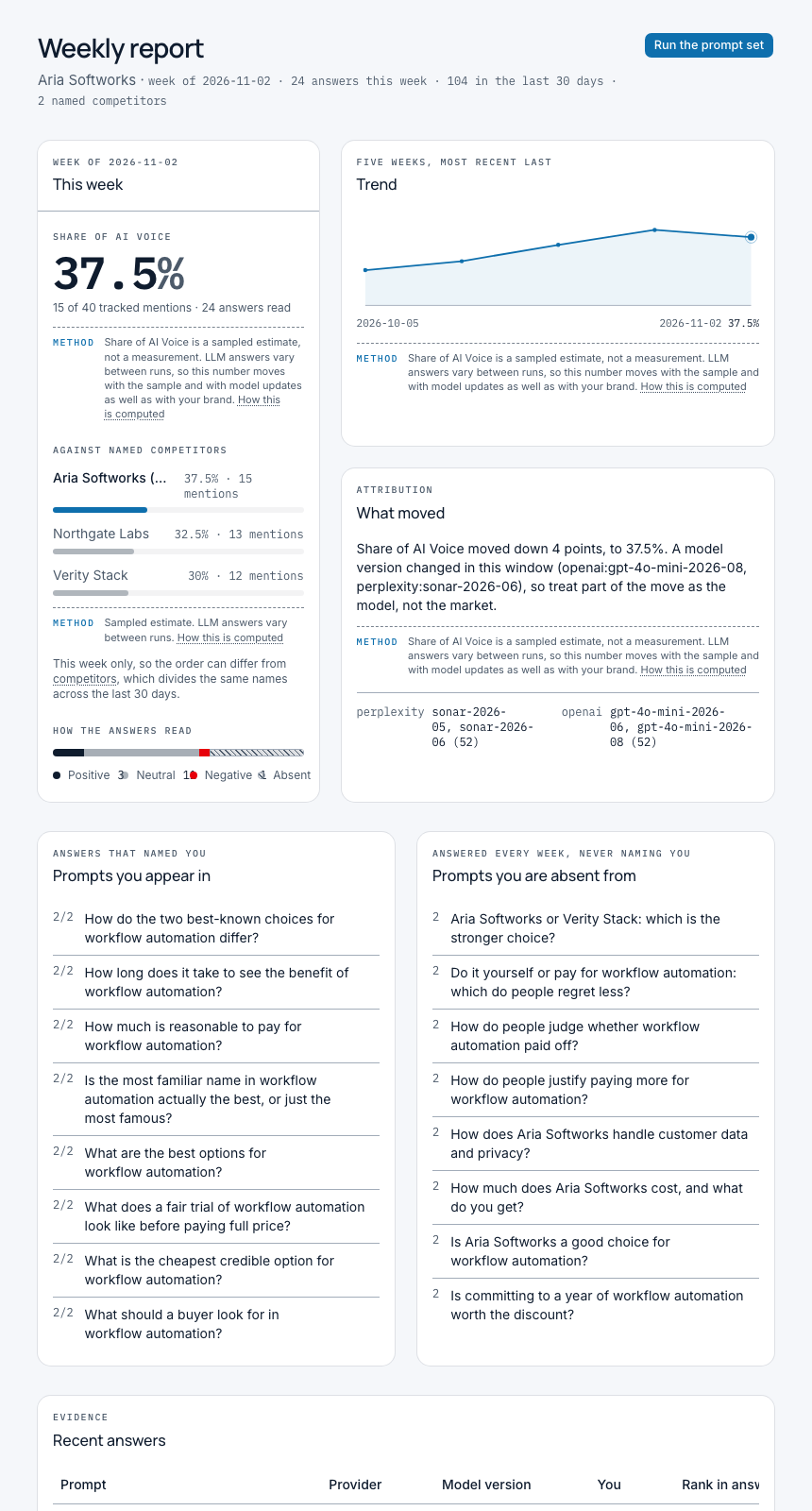
| What breaks your baseline | An algorithm update | A model version change, which can move answers with no market change behind it |
| What you report | Rankings, sessions, conversions | Presence and share against named competitors, with a methodology note |
What GEO work looks like in practice
Fix the questions before you measure anything
Pick the prompts a real buyer would type, then freeze them. If the questions change every week, the trend measures your question writing rather than the market.
Make your category description unambiguous
A generative answer has to decide which list you belong on. Copy that says what you are, who you are for, and what you are not gives the model less to guess at.
Assume the model read more than your homepage
Answers are assembled from sources, and your own site is only one of them. Roundups, documentation, reviews and community threads describe you too, and they are part of the work.
Read the answers, not just the score
The useful artefact is the sentence itself: whether you were named, in what position, and in what tone. A single number hides whether you were recommended or dismissed.
Separate real drift from model drift
Record which model version produced each answer. Without that, every provider update looks like a competitive event and you will brief your team on noise.
Report it in comparative terms
An absolute presence figure means little on its own. Presence relative to two or three named competitors is the version an executive can act on.
Related terms
GEO arrived with a cluster of near-synonyms, some of them genuinely distinct and some of them the same idea under a different acronym.
- Answer engine optimization (AEO): the sibling acronym, usually framed around direct answers and citations rather than recommendations. The distinction is worth reading on its own page.
- Share of AI voice: the metric people reach for when they need to put GEO in a monthly report, expressing how often you are named against a defined competitor set. Its own page covers how it is calculated and where it misleads.
- LLM SEO and AI SEO: informal labels for the same practice, common in job titles and agency decks. No settled difference from GEO.
- AI Overviews: Google's generated summary above the classic results, the surface most teams notice first because it sits where their clicks used to be.
- Citations: the linked sources some engines attach to an answer. Being cited and being recommended are not the same outcome, and a brand can get one without the other.
- llms.txt: a proposed file for telling AI crawlers what to read on your site. Adoption is the open question, and it has its own page here.
- Model drift: the change in answers caused by a provider updating a model. The reason GEO reporting needs version tags and dated baselines.
Questions
What is GEO in marketing?
It is the practice of shaping how generative AI systems describe and recommend your brand in their answers, rather than where your pages rank in a list of links. In marketing teams it usually sits with whoever owns SEO or brand measurement.
Is GEO replacing SEO?
No, it sits beside it. The levers overlap heavily, because the models read the same web your SEO work produces. What changes is the surface you are measured on and the fact that the measurement is non-deterministic.
What is the difference between GEO and AEO?
In common usage they describe the same work. GEO tends to be framed around being recommended inside generated answers, AEO around being the cited source of a direct answer. Our glossary entry for answer engine optimization goes into where the two genuinely diverge.
Can you actually optimise for ChatGPT?
You can influence it and you cannot guarantee it. Clear category language, corroboration from sources beyond your own site and accurate third-party descriptions are real levers, but no provider offers a ranking contract and answers change with each model update.
How do you measure GEO?
By asking the models a fixed set of prompts on a schedule and recording what came back: whether you were named, in what position, in what tone, and how that compares with named competitors. Record the model version each answer came from, or you cannot tell real movement from a provider update.
The answers change every time I ask. Does measuring them mean anything?
Single answers are noisy, which is why a single check is not evidence. Repeating the same prompt set on a schedule and reading the trend gives you a usable signal, as long as the caveat travels with the number: some of the movement will be the model, not the market.
Do I need a tool to do GEO?
Not to start. You can run a handful of prompts by hand and learn a lot in an afternoon. A tool starts to matter when the same prompt set has to run every week, be stored with its model version, and be compared against named competitors without a person repeating the work.
Related
- How to rank in ChatGPT: what actually moves a brand into an answer
ChatGPT has no ranking table, so the real question is what makes it name your brand in an answer.
- LLM SEO
A definition of LLM SEO, the practice of shaping how large language models describe and recommend a brand, with the related terms it gets confused with and the measurement problem underneath it.
- llms.txt
llms.txt is a proposed markdown file at a site's root that hands large language models a curated map of what to read.