LLM SEO
LLM SEO is the work of influencing how large language models such as ChatGPT and Perplexity describe and recommend your brand. It borrows the instinct of search engine optimisation and aims it at an answer rather than a results page.
Seenby is not open yet, so anything on this page about what it does is what it is being built to do.
What LLM SEO means
LLM SEO is the practice of shaping how large language models describe, recommend and cite a brand when a person asks them a question. The unit of success is not a ranking position on a page of ten blue links. It is whether your name appears inside a written answer, in what order, and in what tone.
The term arrived because marketers needed a label for a problem they could already feel. A buyer asks ChatGPT for the best options in a category, reads one paragraph, and clicks nothing. Three names appear in that paragraph. If yours is not one of them, no keyword report tells you, because there was no keyword and no click.
A worked example
A mid-market payroll platform ranks third on Google for its main category term. Someone asks an assistant which payroll tools suit a 200-person company. The answer names four vendors and describes two of them warmly. The payroll platform is absent. Nothing about its site changed. What changed is that the model assembled an answer from what it had absorbed about the category, and the platform was not part of that picture in a way the model could use.
LLM SEO is the set of decisions a team makes in response: what to publish, where to be described by others, what facts to make unambiguous, and what to measure week over week. The tactics are a separate subject, covered in the guide on what moves a brand into a ChatGPT answer.
How it differs from classic SEO
Three differences matter, and all three are structural rather than cosmetic.
- There is no single result to hold. An answer is generated per question. Two people asking the same thing in different words can get different vendor lists, so position is a distribution, not a fact.
- The output is prose, so tone counts. Being mentioned dismissively is a different outcome from being mentioned as a recommendation. Rank alone does not capture it.
- The index is not visible. You cannot inspect what a model believes about your category the way you can inspect a backlink profile. You can only sample it by asking, repeatedly, and reading what comes back.
Related terms
| Term | What it means | Relationship to LLM SEO |
|---|---|---|
| GEO, generative engine optimization | Optimising for systems that generate an answer rather than list links. | Near synonym. GEO is the term favoured by researchers and agencies; LLM SEO is the term practitioners type into a search box. |
| AEO, answer engine optimization | Optimising to be the source an answer engine draws on, including featured snippets and AI Overviews. | Broader and older. AEO predates chat assistants and includes classic answer boxes. |
| AI visibility | Whether and how often a brand surfaces in AI-generated answers. | The outcome LLM SEO tries to change, stated as a measurable condition. |
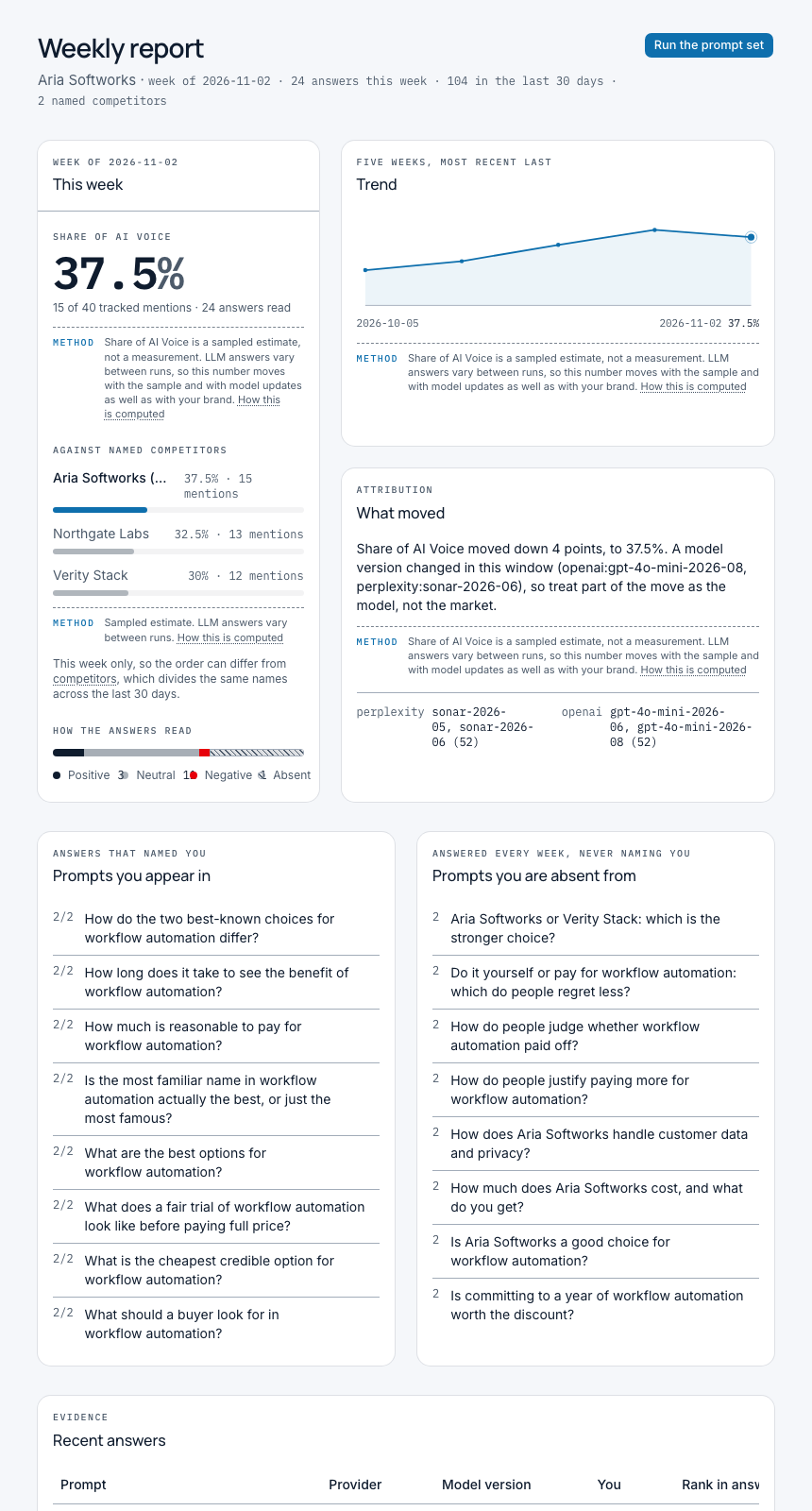
| Share of AI Voice | A brand's proportion of the mentions in a fixed set of AI answers, benchmarked against named competitors. | The metric most teams use to report AI visibility to a board. |
| Citations | The source links some assistants attach to an answer. | One mechanism of visibility, not the whole of it. A brand can be named without being cited, and cited without being recommended. |
| Zero-click search | A search that ends without a visit to any website. | The commercial reason LLM SEO exists as a budget line. |
The honest caveat in the term
LLM SEO implies a controllable input and a stable output. Neither is fully true. Model responses are non-deterministic, so the same prompt can return different names on different days. Providers also ship model updates, which can move a brand's apparent standing without anything changing in the market.
That is not a reason to skip measurement. It is a reason to measure with a fixed prompt set, on a fixed cadence, with the model version recorded, so that a week-over-week shift can be read against what the provider changed rather than assumed to be competitive movement. Any score presented without that context should be treated as directional.
Questions
Is LLM SEO the same as GEO?
In practice, yes. Generative engine optimization is the more formal label and LLM SEO is the more searched one. If a vendor or agency draws a hard line between them, ask what they do differently, not what they call it.
Does LLM SEO replace traditional SEO?
No. Models are trained on and retrieve from the open web, so the pages, mentions and clear descriptions that classic SEO produces still feed the answers. What changes is the reporting: clicks and positions no longer describe the whole of your presence.
How do you measure LLM SEO?
By sampling. You write a fixed set of prompts a buyer would plausibly ask, run them on a schedule against the assistants you care about, and record whether your brand appears, where in the answer, in what tone, and alongside which competitors.
Why do the results change every time I ask?
Language models sample from probabilities rather than returning a fixed record, and providers update models without notice. This is why a single manual check is anecdote and a repeated fixed prompt set is a trend, and why any score should carry the model version it was read on.
Which assistants should be tracked?
Start with the ones your buyers actually use. For most mid-market B2B teams that means a general assistant such as ChatGPT and a research-oriented one such as Perplexity, since those two cover the recommend-me and the cite-me behaviours.
Can you guarantee a brand will appear in an AI answer?
No one can, and anyone who says otherwise is overclaiming. Providers do not sell placement in an answer and do not publish the selection logic. What you can do is measure the current position honestly and act on where you are absent.
Related
- How to rank in ChatGPT: what actually moves a brand into an answer
ChatGPT has no ranking table, so the real question is what makes it name your brand in an answer.
- Generative engine optimization (GEO)
Generative engine optimization is the practice of shaping how AI answer engines describe and recommend your brand.
- llms.txt
llms.txt is a proposed markdown file at a site's root that hands large language models a curated map of what to read.